A classroom library on a budget starts with counting what you already own, then filling the gaps with free and low-cost books before you spend anything. Most teachers can reach 150 to 200 usable titles for the price of a couple of new hardbacks. Allow a few focused weekends and the setup takes about six steps.
The reason a classroom library matters is access. A school library is often a trip away on a fixed schedule, which means a child who finishes early waits. A shelf in your own room means every student can hold a book today. That is the whole argument.
This guide is updated for 2026 and covers elementary, middle and specialist classrooms, including teachers who inherited an empty room with no shelves at all.
Table of Contents
- What You Need
- The books
- Storage
- Labels and a catalog
- Student helpers
- A sourcing plan
- Step-by-Step
- Step 1: Set a Budget and Define the Library’s Purpose
- Step 2: Choose a Balanced Collection
- Step 3: Find Free and Low-Cost Books
- Step 4: Organize Books So Students Can Find Them
- Step 5: Create an Inviting Reading Space
- Step 6: Involve Students and Maintain the Collection
- Common Mistakes
- Frequently Asked Questions
- How much should I spend on a classroom library?
- Where can teachers find free books for a classroom library?
- How many books should a classroom library contain?
- Should donated books be organized in a classroom library?
- How can students choose books in a classroom library?
- What is the easiest way to organize a classroom library?
- Conclusion
What You Need
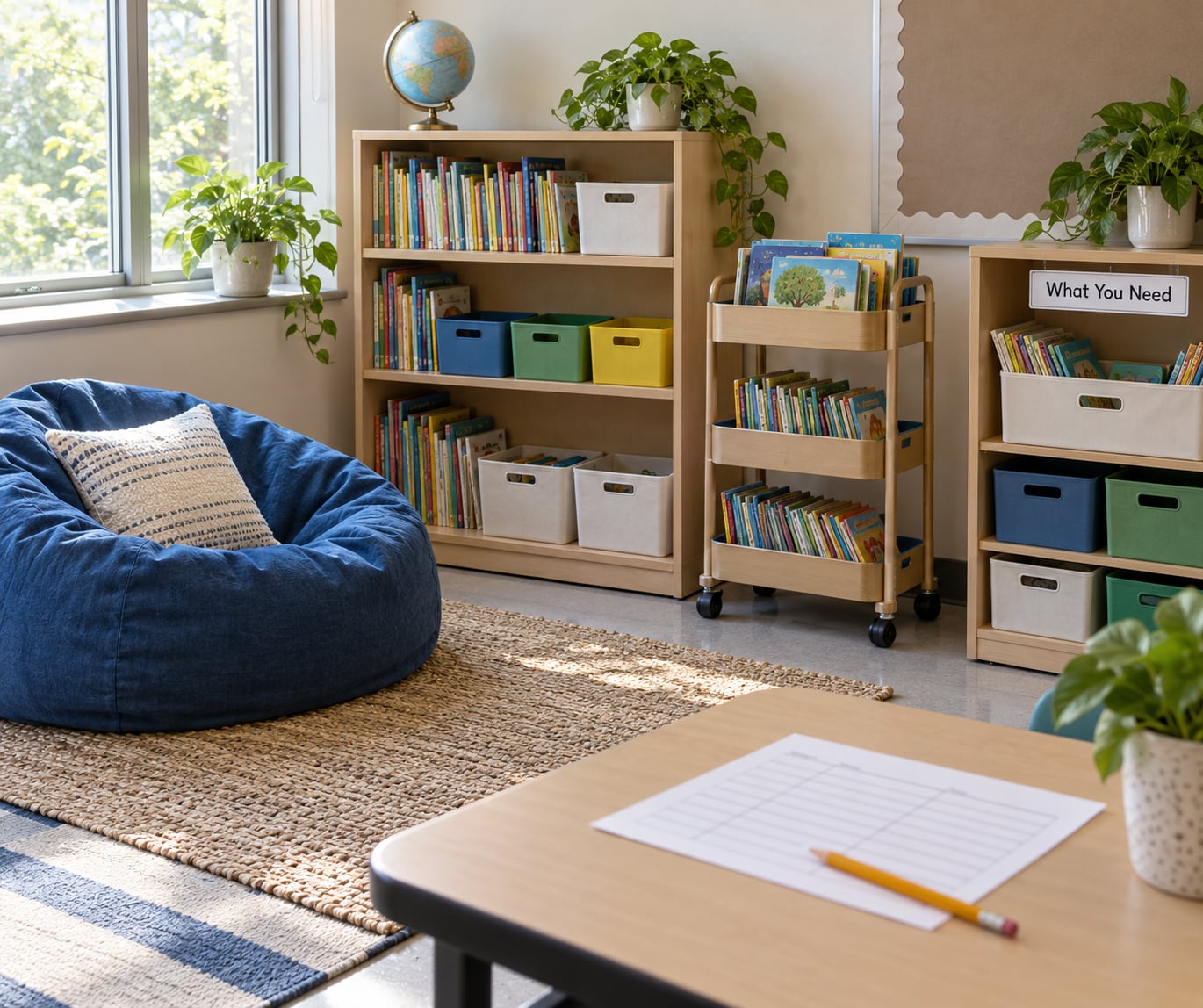
Before shopping, gather four things: a written list of what you already own, some containers, a labeling method, and a checkout sheet. That is genuinely all the equipment a budget classroom library requires. Anything more is a nice-to-have.
The books
Inventory what is in the room now, including home books you may be storing and any boxes left by a retiring colleague. Sort into keep, repair and discard. Discard anything water-damaged, mildewed or missing pages, because those books quietly take up space that a working title could use.
Storage
You need vertical shelving, bins, or both. Secondhand wood cubes from a yard sale, a rolling classroom cart, or a set of milk crates works. School districts frequently have empty shelving units in storage, so ask facilities before you buy anything.
Labels and a catalog
Spine labels and genre stickers are the cheapest organizational tool you can buy, and many teachers’ libraries offer free printable sets. One sheet of card stock cut into cards works too. Keep a simple catalog of title, genre and reading level in a spreadsheet or a notebook so you know what you are missing.
Student helpers
Two or three reliable students can sort and shelve with you on a Sunday afternoon. This is the single biggest time saver in the whole process. Building the library alone on weeknights is how projects stall.
A sourcing plan
Write down where books will come from before you need them: the school library sale, a thrift run, a donation letter to families, and a request to retiring teachers. Teachers on teacher forums repeatedly report that entire libraries show up free when you ask, which only happens if you ask ahead of time.
Step-by-Step
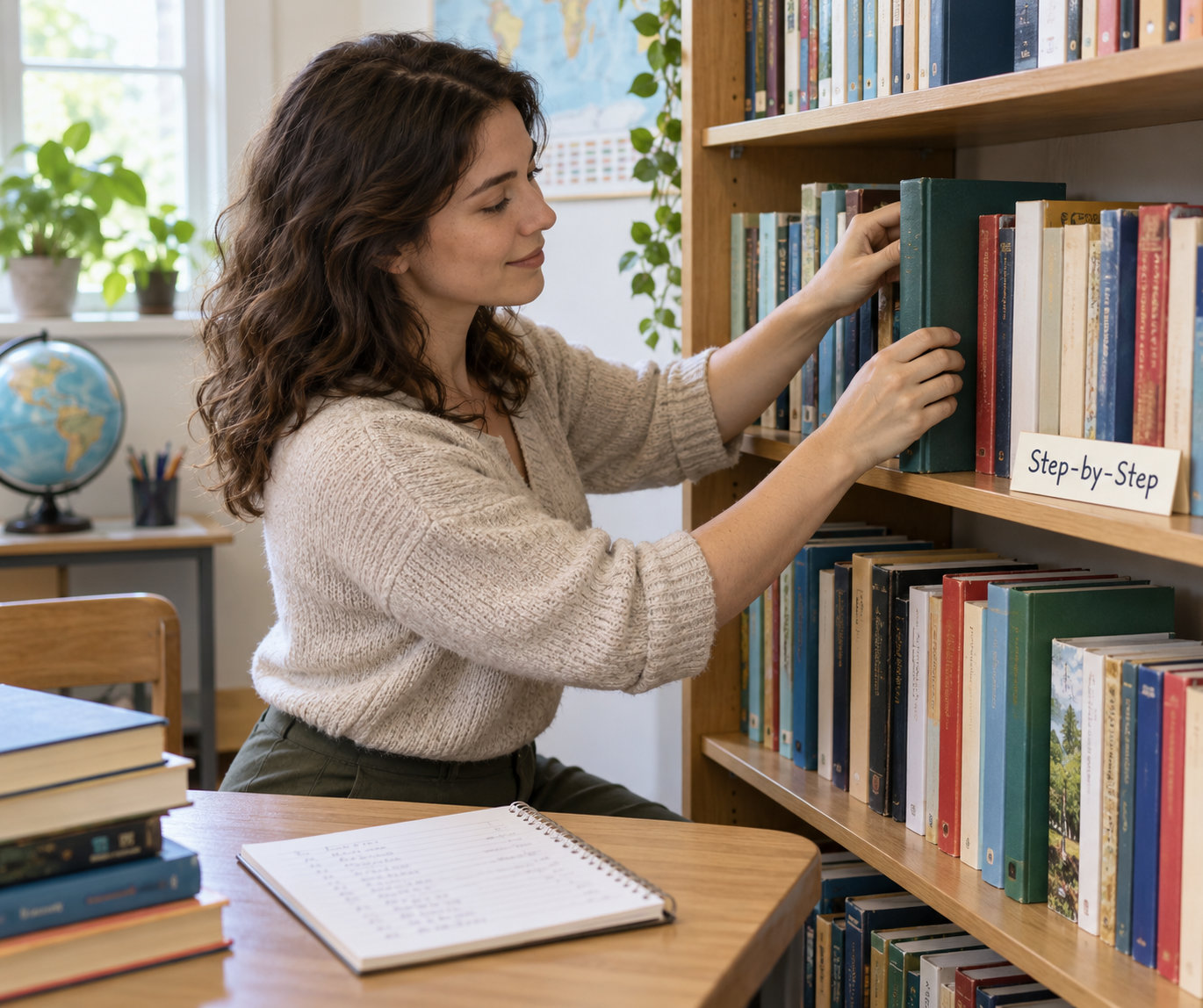
Here is how to set up a classroom library on a budget in six steps, in the order that wastes the least money. Do them in sequence rather than jumping to shopping.
Step 1: Set a Budget and Define the Library’s Purpose
Pick one number and one purpose. The number is a book count, not a dollar figure. The purpose is the choice that decides everything else: a large collection of many single-copy titles for independent choice, or a smaller set of several copies of fewer titles for book clubs and small-group reading.
Most elementary classrooms need roughly 5 to 7 books per student, which lands around 150 to 200 titles for a class of 25 to 30. Build that in phases. Get roughly half from free or donated sources before spending a cent, because the secondhand and donation channels move faster than any budget can.
Test that the setup worked by timing yourself: a student should be able to find a book that matches their reading level in under a minute without asking you.
Step 2: Choose a Balanced Collection
A shelf of nothing but chapter books turns reluctant readers off. Aim for a mix where no single category runs away with the budget, and fill gaps from donations rather than purchases.
- High-interest fiction for the kids who read for pleasure: mysteries, sports, funny animal stories, graphic novels.
- Accessible levels below the grade-level expectation, which is where reluctant and struggling readers actually live.
- Literary classics in inexpensive paperback editions, enough for whole-class read-alouds and unit studies.
- Poetry, short stories and collections that can be opened at any page, which makes them the easiest books to abandon halfway through a busy week.
- Nonfiction and reference on topics kids choose: animals, space, sports, inventions, biographies.
- Biography and history with a range of subjects students can see themselves in.
- Culturally representative titles written by and about a wide range of experiences, free programmes covered in Step 3 cover most of this need.
- Class sets of two or three titles for guided groups.
Priorities shift by age band. In grades K to 2, weight picture books, easy readers and read-aloud titles. In grades 3 to 5, weight chapter books, nonfiction series and early graphic novels. In grades 6 to 12, weight a mix of novels, nonfiction and adult-interest titles, plus several copies of popular series.
If you cannot decide whether many titles or several copies of few titles is right for your room, try this: build a base of single-copy titles for choice, then add four or five copies of a handful of proven crowd-pleasers. High-interest titles that already circulate at your public library are the safest bet.
Step 3: Find Free and Low-Cost Books
Free and donated books should supply most of your volume. This is where teachers on forums like r/Teachers report the biggest wins, usually because they never planned for it.
- Ask retiring teachers directly. Retiring colleagues give away whole libraries rather than moving them. Search local classifieds and Freecycle groups, where teachers clearing out classrooms post exactly this.
- Run a family donation drive. A short letter explaining what you need beats a general appeal. Some parents will donate more readily if a sticker inside the book names them.
- Post on teacher communities and social groups. Specific requests get answered: “need 20 easy readers for a grade 2 classroom” travels further than “books please.”
- Comic shops and local shops. Comic shops often donate boxes of older comics, which pull in students who claim they hate reading.
- Public and school libraries. Get your own library card, and ask about interlibrary loan for titles that are hard to replace. It costs nothing and covers gaps.
- Free book programmes. Multicultural Children’s Book Day offers diverse titles for classrooms at no cost, and national giveaways on social platforms post regularly.
- Book swaps. A swap party with colleagues doubles your collection and halves what you store.
Then spend what remains where books are genuinely cheap. Library and school book sales commonly run about 25 cents for a children’s paperback, and teachers who arrive early pick the best titles. Thrift stores stock paperbacks for about a dollar. Deep-discount online resale sites sell used titles from a few dollars each and suit you best when you need a specific title or a matching set.
Skip anything with visible mold, water staining, a musty smell, missing pages or a broken spine. Cover the bottom edge of each book with your name in pen, and use clear contact paper on the spine and covers of high-circulation paperbacks, which is the cheapest way to make books survive a school year.
Step 4: Organize Books So Students Can Find Them
Pick one system and stick to it. Colour-coded genre stickers on bins is the simplest option that works in every grade, because a student chooses a color instead of reading a shelf of spines.
Put stickers on the spine and on the front cover so face-out displays stay labelled. Stand books in bins facing forward, grouped by genre, and keep reading-level matters simple: sort by what students can actually read, not by printed grade number on the jacket.
Use the checkout sheet. One column for the student’s name and one for the title is enough. A binder on a hook by the shelf beats any app for most classrooms, and it works without devices or school accounts. Decide in advance that popular titles may not come back, because in most rooms they will not, and books still circulate productively.
Step 5: Create an Inviting Reading Space
The cheapest upgrade is not a rug, it is light and order. Face-out book displays on a shelf riser or a wall grid show covers instead of spines, and covers are what make a student walk over.
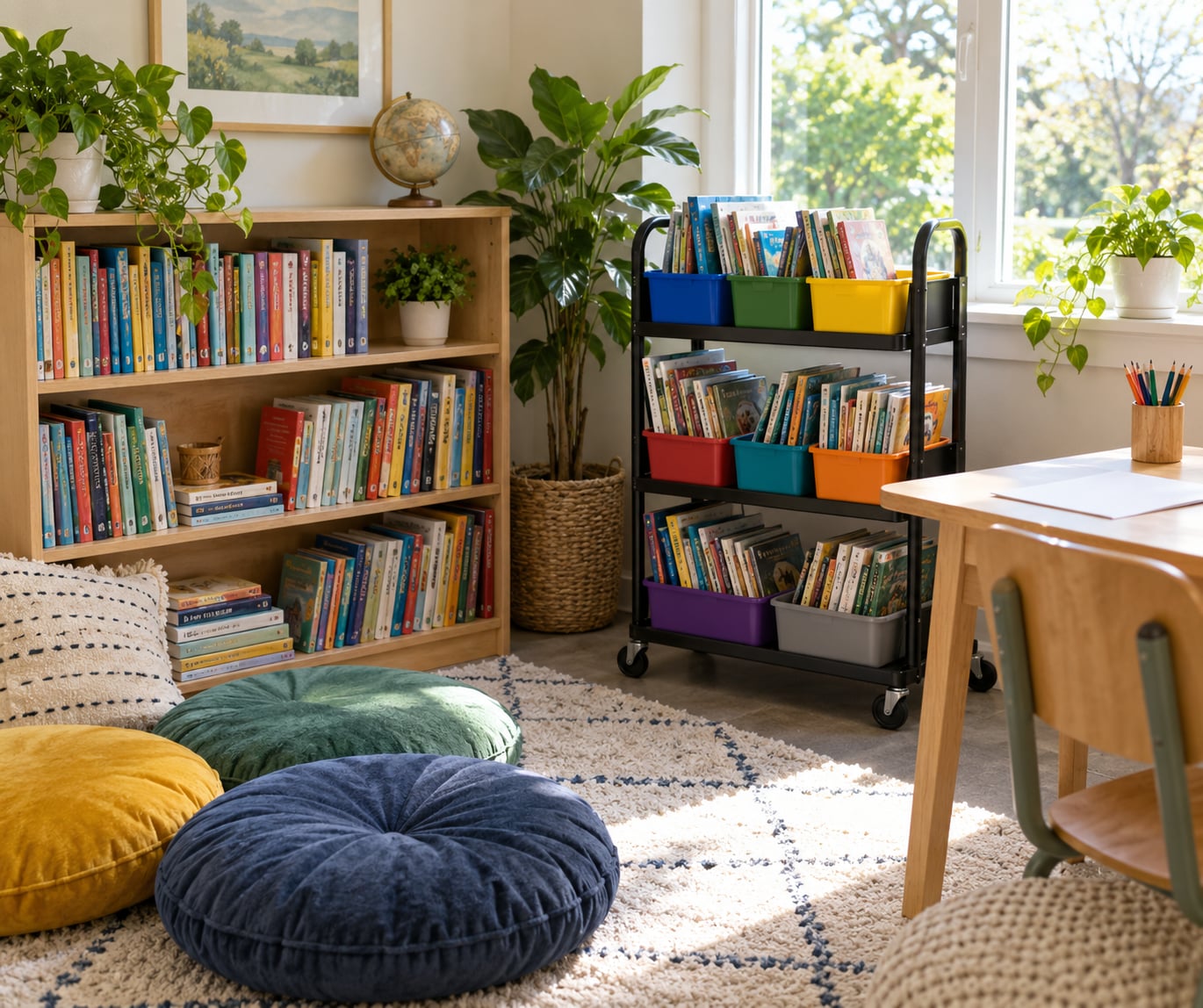
Add seating that costs nothing: floor cushions, a donated beanbag, or two reading buddies per student. Put student artwork above the shelves so the corner reads as a place rather than storage. A rolling cart lets you take books to students who are stuck at a desk, which matters more in a room with fixed seating.
A good classroom book nook on a budget is simply a defined corner, a labelled shelf, a soft seat and a display. Students notice it within a week.
Step 6: Involve Students and Maintain the Collection
Hand students a real job. Let a small group recommend titles at the start of each term, and feature their picks on a display board. Teachers running book talks and student book posters report noticeably more borrowing, because the recommendation comes from a peer rather than a poster on the wall.
Set simple rules: a checkout limit of two books, a return basket by the shelf, and a lost-book rule that never embarrasses a student in front of the class. Then run a fifteen-minute reset every Friday, returning books and straightening bins. A library that looks chaotic on Monday gets ignored by Wednesday.
Track your catalog once a term and replace what did not circulate. Note the titles that vanish, because those are your replacement list and they usually number under ten.
Common Mistakes
Most budget libraries fail on the same five things, and all five are fixable before you buy another book.
- Buying too many books at once. A sudden pile of 200 titles is impossible to sort and impossible to shelve. Fix: cap any single shopping trip at 30 or 40 books and stop until they are shelved.
- Ignoring reading levels. A beautiful collection at the wrong level gets ignored. Fix: pull ten books a struggling reader can actually finish and put them face-out in the first bin they touch.
- Overcomplicating the system. Colour by genre, level and format at once and nobody can decode it. Fix: one organizing principle, one label color per genre, and bins arranged so a kindergartener can reach them.
- No plan for lost or damaged books. Paperbacks get dropped and shoved into bathrooms between lessons. Fix: name the bottom edge, tape the spines, keep checkout in a binder, and accept that some loss is the price of access.
- Waiting for the books to arrive before starting. Shelves that stay empty for a month produce a room that never becomes a reading space. Fix: start with 30 books this week, use the school library weekly in the meantime, and grow the collection continuously after that.
Frequently Asked Questions
How much should I spend on a classroom library?
Less than most teachers assume, if you sequence your buying. Target roughly half your books from free and donated sources, then spend the remainder at library book sales running about 25 cents per paperback, thrift stores near a dollar each, and deep-discount online resale for specific titles. A 150-book collection can be built for the cost of a handful of new hardbacks.
Where can teachers find free books for a classroom library?
Ask retiring colleagues first, then check local classifieds and Freecycle groups, where teachers clearing classrooms post whole libraries free. Family donation drives work well when the letter explains exactly which genres you need, and comic shops often donate boxes of older comics. Free school and public library cards, interlibrary loan, book swaps with colleagues, and classroom diverse-book giveaways add more.
How many books should a classroom library contain?
Aim for about 5 to 7 books per student, which is roughly 150 to 200 titles for a class of 25 to 30. Build it in phases rather than at once. Fifty well-chosen titles that students actually borrow beat two hundred shelved once and forgotten, so track what circulates and replace that list instead of adding to the total.
Should donated books be organized in a classroom library?
Organize them exactly like purchased books. Readers should not be able to tell where a title came from, and separating donated titles into a lesser shelf signals that they matter less. Discard water-damaged, mildewed or incomplete books without hesitation, and keep a donor sticker inside each accepted title so you can thank families and ask for more.
How can students choose books in a classroom library?
Give them a color, not a rule. Colour-coded genre stickers on spine and cover let students sort by mood and interest, and face-out displays on shelf risers show covers instead of unreadable spines. Set a checkout limit of two books with a paper checkout sheet, and let students recommend titles on a display board each term.
What is the easiest way to organize a classroom library?
Genre-based bins with matching stickers is the easiest system that still works with older students. Label bins, sort books once with student helpers, and shelve everything facing forward so covers show. Use a paper checkout sheet in a binder by the shelf instead of an app, since it needs no devices, accounts or school approval.
Conclusion
Do not plan the whole library before you start. Count what you own, choose 30 titles this weekend, label two bins, and put them where students can reach them. Then write to retiring teachers and families, and let the collection grow one free donation at a time through 2026 and next year.