
The immigrant experience in America is the whole arc of migration: leaving a homeland, crossing a border, building work and community in the United States, then negotiating language, identity, and belonging across generations. The books on this list follow ordinary families through that arc rather than through policy debate, and they span literary fiction, narrative nonfiction, essays, and history.
Updated for October 2026. This is a curated set of ten rather than an exhaustive catalog, because the biggest complaint in reader forums is that lists of books about immigration run to a hundred titles and tell you nothing about where to start. Each entry below names a format, a community, an era, and a specific use, so you can pick the one that fits your reader before you commit to three hundred pages.
Readers who ask for immigrant stories tend to want one of three things: a first-generation arrival story, a second-generation identity story, or the historical record that explains why both of those stories happened. Only some books do all three, and the sections below say which is which. Teachers and book club hosts get grade-band guidance, tone notes, and pairing suggestions in the final section.
Table of Contents
- Books About the Immigrant Experience in America at a Glance
- 1. The Warmth of Other Suns by Isabel Wilkerson
- 2. Americanah by Chimamanda Ngozi Adichie
- 3. The Namesake by Jhumpa Lahiri
- 4. The Joy Luck Club by Amy Tan
- 5. Middlesex by Jeffrey Eugenides
- 6. The Sympathizer by Viet Thanh Nguyen
- 7. The Lowland by Jhumpa Lahiri
- 8. Brooklyn by Colm Tóibín
- 9. The Good Immigrant: And Other Essays by Bharati Mukherjee
- 10. The Immigrant Trail: A History of the Chinese in America by H. Richard Fry
- How to Choose a Book About Immigration for Your Class or Reading Group
- Start with the reader, not the subject
- Pair fiction with history on the same community
- Match the book to the age band
- A reading path for students new to this genre
- Frequently Asked Questions
- What is the best book about the immigrant experience in America?
- Are these books appropriate for high school students?
- How would you describe the immigrant experience in America?
- Should I read fiction or nonfiction about immigration?
- Is American Dirt based on a true story?
- Which book best captures the experience of Latin American immigrants?
- Conclusion
Books About the Immigrant Experience in America at a Glance
| Book and author | Format | Community or perspective | Era | Central experience | Best for |
|---|---|---|---|---|---|
| The Warmth of Other Suns, Isabel Wilkerson | Narrative nonfiction | Black American Great Migration | 1910s to 1960s | Three families leave the rural South for Northern and Western cities | Students who need the historical frame before the novels |
| Americanah, Chimamanda Ngozi Adichie | Literary fiction | Nigerian and Igbo | Contemporary | A student arrives for college and learns the cost of being visible | Newcomers to the genre; book clubs wanting warmth |
| The Namesake, Jhumpa Lahiri | Literary fiction | Bengali Indian American | 1970s to 2000s | Naming, education, marriage, and an unplanned trip back to Calcutta | Close reading of names, class, and cultural expectation |
| The Joy Luck Club, Amy Tan | Literary fiction | Chinese American | 1930s to 1980s stories | Mothers who immigrated and daughters raised in San Francisco | Intergenerational discussion; high school classrooms |
| Middlesex, Jeffrey Eugenides | Literary fiction | Greek American, Detroit | 1960s to 1980s | Three generations of one Detroit family and a secret kept for decades | Long-form readers; AP Literature study |
| The Sympathizer, Viet Thanh Nguyen | Historical fiction | Vietnamese and Chinese American | 1975 and after | A half-Chinese, half-American communist spy inside a Los Angeles network | Advanced readers; politically curious adults |
| The Lowland, Jhumpa Lahiri | Literary fiction | Bengali Indian American | 1960s to 1990s | Two brothers shaped by revolution, poverty, and family duty | Readers who want migration before the airplane |
| Brooklyn, Colm Tóibín | Literary fiction | Irish | 1950s to 1960s | An emigrant works, marries, and decides whether to go home | Quiet reading; Irish American and genealogy readers |
| The Good Immigrant, Bharati Mukherjee | Essays | Indian and South Asian American | Late twentieth century | The writer’s split relationship to language, class, and two countries | Essay writing; short assignments |
| The Immigrant Trail, H. Richard Fry | Scholarly history | Chinese American | 1850s to 1970s | Labor migration, exclusion law, and community formation | Pairing with any Chinese American novel |
Two things stand out. First, fiction outnumbers nonfiction here, which is deliberate: readers who want to understand how immigration feels tend to get more from a character than from a chronology. Second, the nonfiction titles are worth reading anyway, because most of the novels skip the laws and labor conditions that shaped the characters’ options.
1. The Warmth of Other Suns by Isabel Wilkerson
Published in 2010 and winner of the Pulitzer Prize, this is narrative nonfiction that reads like a novel. Wilkerson follows three people who left the rural South between roughly 1910 and 1970: a sharecropper’s wife from Mississippi, a Chicago man who leaves his family for a job on the Gulf Coast, and a young Army recruit who claims to be from Georgia.
What makes it the strongest entry point on any books about the immigrant experience in America list is that it names the forces the novels usually treat as atmosphere. Housing covenants, redlined neighborhoods, factory hiring, and the domestic labor Black women were pushed into all appear here as specific pressures with specific dates.
For classrooms, the structure works well because each chapter can stand alone. Ask students to compare what each character expected from the North against what they found, and then ask why Wilkerson frames the whole book around a photograph taken in the Chicago cemetery where one of them is buried. Content note: the book includes racial violence and lynchings, described without flinching.
2. Americanah by Chimamanda Ngozi Adichie
Adichie’s 2013 novel follows Ifeoma, a Nigerian woman who leaves for college in the United States and discovers that the same confidence that made her exceptional at home makes her an object of curiosity and commentary in America. Her cousin Obiora stays in Nigeria, marries, and builds a life that is frequently reported back to her as the sensible one.
What separates this from most first-generation novels is the tone. There is racism in the book, including an incident with a campus security officer, but Adichie keeps Ifeoma funny, sharp, and mostly uninterested in performing gratitude. Readers who tell you they want an immigrant story that is not relentlessly bleak tend to name this one, and they are right.
Discussion prompts that pay off: what does Ifeoma learn from Obiora’s marriage that she would refuse to hear from an American? How does Adichie use her mother’s shrewd, translated advice as a competing source of authority? And what changes when you realize the cousin’s life is being narrated as a series of risks avoided? Content note: racism and one physical confrontation with police.
3. The Namesake by Jhumpa Lahiri
Lahiri’s 2003 debut novel, which won the Pulitzer Prize, follows a Bengali family in Queens and the son they name Gogol after the Bengali poet. The family wanted him to carry a homeland inside a body born in New Jersey. Instead he grows into a Harvard-educated man who hates his parents’ apartment rules, marries an American woman, and takes a year of solo travel through Europe and Egypt.
The last third of the novel turns on a trip to Calcutta that Gogol did not plan and does not understand until he sees a photograph of the family he grew up in, sitting in the foreground of someone else’s life. For analysis, that shift is the whole book in miniature. Identity arrives not as a decision but as a delay in recognition.
The strongest discussion questions concern naming and translation. Why do Gogol and his sister stop using their Bengali names almost immediately while their parents never do? When Gogol falls in love with a woman named Moushumi, is he choosing her or choosing a piece of his parents’ world? Content note: a death by accident, illness, and adult estrangement.
4. The Joy Luck Club by Amy Tan
Tan’s 1989 debut links eight stories around a San Francisco group of women who played mahjong, their American-born daughters, and the wars fought across a language gap in the same kitchens. The early stories run from the 1930s forward, so you watch immigrant mothers arrive and then watch their children become the people deciding what the family is.
This is the title most often assigned in high school classes, and readers who resent that often find it flabby. The counterargument worth testing in discussion: the novel’s looseness is formal, not careless. Tan uses linked fragments to model a family that is coherent only when you assemble it, which is the same thing a second-generation reader has to do.
Best discussion questions: Where does Tan put the story that explains everything, and why does it come late? How much do you believe Lindo and Waverly when they disagree about duty? Content notes: suicide attempt, an unwanted pregnancy pressured into an abortion, and racist remarks from a white suitor.
5. Middlesex by Jeffrey Eugenides
Eugenides’s 2002 Pulitzer winner opens in 1971 with a Detroit Greek family celebrating the wedding of their daughter, then jumps decades ahead to a man in San Francisco who once worked as a waitress at a drive-in. That waitress was Stephanie’s mother, and Stephanie’s life since has been a twenty-year silence about who she is.
The book’s real subject is Detroit itself: the auto industry that drew Greek immigrants in, the neighborhoods they built, the decline that scattered the family, and the parts of a self that stay sealed after the neighborhood disappears. Migration is treated as a slow structural force rather than a single arrival scene, which makes the book useful paired with Wilkerson.
Discussion questions: Why does the novel extend itself to the father and grandfather before giving us the mother’s history? What does Eugenides gain by treating secrecy as inheritance rather than as deception? Content notes: sexual abuse, disclosed late and indirectly, and domestic violence.
6. The Sympathizer by Viet Thanh Nguyen
Nguyen’s 2015 Pulitzer winner begins in 1975 Los Angeles, where a communist agent, the Sympathizer, is inserted into a network of Vietnamese officers and their American supporters. He is half-Chinese, half-American, a Communist Party member who has come home from studying overseas and cannot decide whether his sympathies belong to one side.
The immigrant question here is not arrival but translation. Nguyen insists the Sympathizer can read everyone’s inner weather, including people who have never met a Vietnamese person in their lives, and the novel turns that skill into a moral problem. For older students, it is the most productive bridge between immigrant stories and Vietnam War studies.
Discussion questions: Who owns the Sympathizer’s story, given the novel’s shape? How does Nguyen use genre, including the film-obsessed sections, to undercut any reader’s expectation about where loyalty lies? Content note: the book contains violence, sexual assault, and depictions of torture told with restraint rather than spectacle.
7. The Lowland by Jhumpa Lahiri
Published in 2016, The Lowland begins in Calcutta in the 1960s with two brothers, Udayan and Subhash, and follows them into separate lives: one stays and becomes entangled in political violence during a period of upheaval in West Bengal, the other leaves for a physics degree in the United States. Both journeys are consequences of the same household.
Where The Namesake moves toward recognition, this novel moves toward dispersal. Family obligation looks different from across an ocean, and the ending deliberately refuses to resolve it. It is the entry to pick when someone has read The Namesake and wants to see what the same author’s diaspora looks like at greater distance.
Discussion questions: Does Udayan’s political arc make him irresponsible, or is the novel arguing against that framing? How does the closing section change the meaning of the earlier chapters? Content notes: political violence and a miscarriage described plainly.
8. Brooklyn by Colm Tóibín
Tóibín’s 2009 novel sends Eilis Lacey from a small Irish town to Brooklyn in the 1950s, where an Irish-American bookkeeper introduces her to ground-level work in accounting and a boyfriend whose family has opinions. She marries, she nearly forgets the life before, and then an event at home brings her back across the Atlantic for one more visit.
This is the entry for readers who want a quiet book. Almost nothing is explained, and the immigration is felt as weather rather than crisis, which also makes it a good contrast to the contemporary border stories. Readers tracing family histories will recognize the shipboard arrival and the first job described in a family’s stories.
Discussion questions: Why does Tóibín let Eilis’s silence do so much of the work? What does the novel suggest about how much a person can want to go back and still not fit there? Content notes: death of a parent, a missed pregnancy, and period language.
9. The Good Immigrant: And Other Essays by Bharati Mukherjee
Mukherjee’s 1998 collection is the shortest reading on this list and the one most often assigned alongside a novel. The title essay argues that she is a “good immigrant” precisely because she writes about the parts of her community she was raised to disapprove of, and the collection follows that argument through pieces on language, gender, class, translation, and the writer’s split relationship to two countries.
Short pieces suit readers who do not have room for a novel, and they are excellent material for close reading. An essay can be put in front of a class as a single argument with a clear claim, which is harder to find anywhere else in immigrant literature.
Strong prompts: Which essay argues most directly against the myth of the successful immigrant, and what evidence does it use? How does Mukherjee distinguish between critiquing a community and refusing it? Content note: the essays discuss domestic violence and communal violence in India.
10. The Immigrant Trail: A History of the Chinese in America by H. Richard Fry
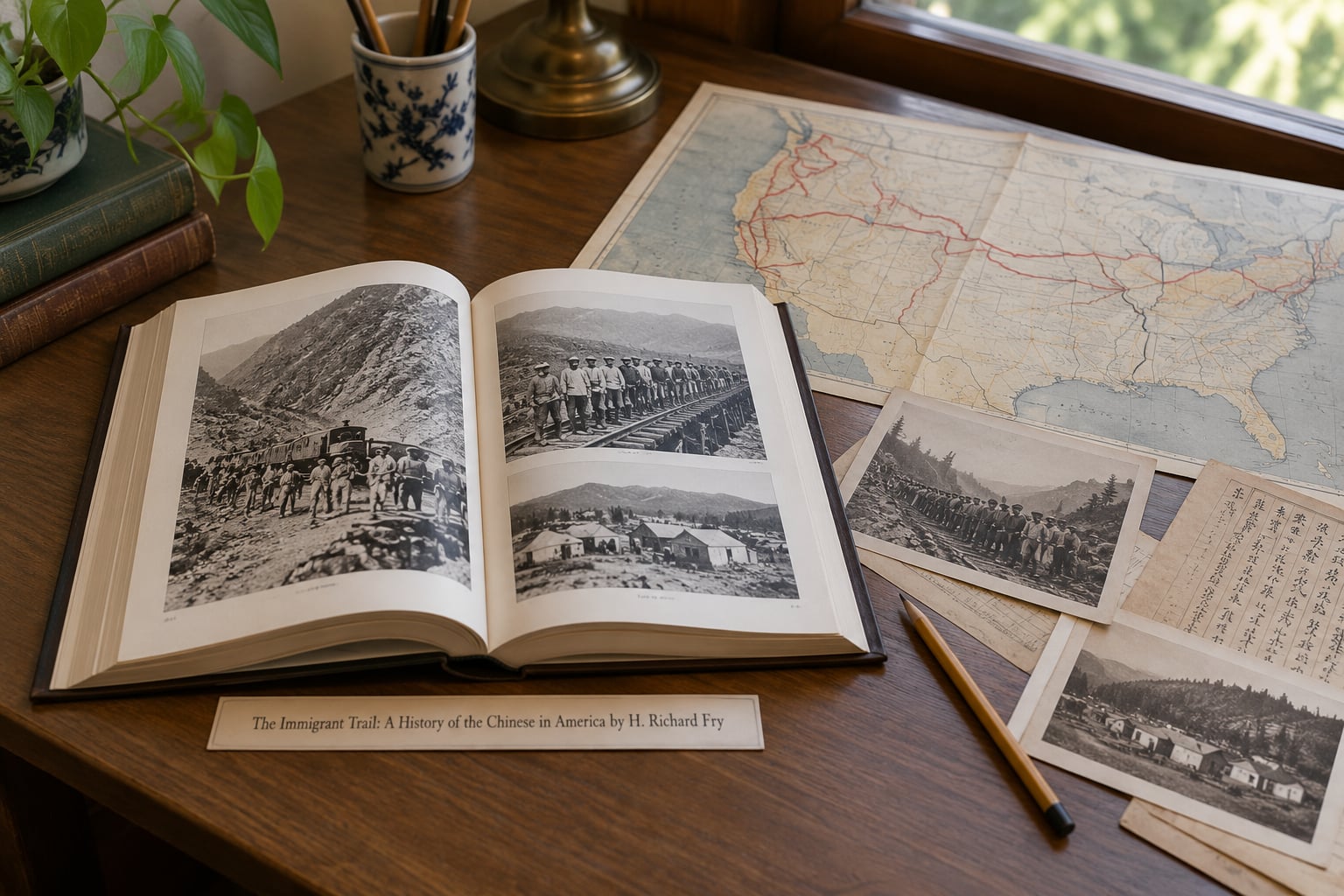
Fry’s 2004 history is the nonfiction anchor for any Chinese American novel on your shelf. It covers the labor migration that began in the mid-nineteenth century, the railroad and mining work that funded it, the Chinese Exclusion Act of 1882 and its extension through the 1940s, and the community, business, and family patterns that formed under those restrictions.
Read it before a novel and you will notice things you missed. The laundry work in chapters by Amy Tan and the generational counting in older oral histories make sense only once you know how many men crossed the Pacific and how few were permitted to bring wives over.
Discussion questions: What did families gain from sending money home and losing the right to return? Compare the legal restriction described here with the pressures characters describe in The Joy Luck Club. Content note: the book documents violence against Chinese workers, including mass casualty incidents on the railroad.
How to Choose a Book About Immigration for Your Class or Reading Group
Start with the reader, not the subject
Begin from what the reader already has, because the most useful book here is the one that answers a question they have already asked. Students who need the history pick up Wilkerson or Fry in an afternoon. Book clubs with mixed backgrounds do well with Americanah or Brooklyn, because the story carries the history inside it without requiring notes.
Ask what your group can handle emotionally. This material includes racism, detention, family separation, sexual violence, and war, often in plain language, and none of the ten titles is a light read. Readers who want warmth rather than hardship generally respond best to Americanah; readers who want a measured, unsentimental voice tend to choose Brooklyn.
Pair fiction with history on the same community
Pairing is the fastest way to make a list feel like a course. The Warmth of Other Suns or The Immigrant Trail supplies the structural facts, and the novel supplies the interior life. Two pairings work especially well:
- Chinese American: The Immigrant Trail for the law and labor history, then The Joy Luck Club for what the law did to one family over fifty years.
- Black Great Migration: The Warmth of Other Suns for the national movement, then fiction or memoir for a single city. No novel on this list covers it, which is a deliberate gap rather than an oversight.
- Indian American: The Namesake for the second generation, The Good Immigrant for the writer’s account of the split, and The Lowland for the political history that sent the family into the arrangement in the first place.
Match the book to the age band
Grade-band guidance, in rough terms. Grades 7 through 10 handles The Namesake and Americanah with scaffolding; The Joy Luck Club and Brooklyn work as well with older teens who read widely. Warmth of Other Suns fits a capable eleventh-grade reader or an undergraduate survey course, and The Sympathizer is best with a group that already has context for the Vietnam War. The Good Immigrant and The Immigrant Trail fit adult education, ESL teacher preparation, and graduate seminars.
For younger readers looking for a shorter introduction, look for the young adult and graphic memoirs that pair with these titles rather than adapting them. Assign content notes in advance and tell students which questions you are comfortable discussing.
A reading path for students new to this genre
Three books give a beginner nearly the full range: The Namesake for close reading of a second-generation identity, Americanah for a first-generation arrival with humor and momentum, and The Sympathizer for the historical and political scale. Add one nonfiction title from the table above if you want the underlying record, and the reader will have a working map of the field.
Frequently Asked Questions
What is the best book about the immigrant experience in America?
It depends on the reader’s goal. The Warmth of Other Suns is the best single starting point because it delivers the historical frame the novels assume. For literary analysis, Americanah and The Namesake are the strongest choices. Readers who want short pieces they can analyze in one sitting usually prefer The Good Immigrant. Each of these covers a different community and a different era, so there is no single correct choice.
Are these books appropriate for high school students?
Most of them, with previewing. The Namesake, Americanah, and Brooklyn are widely taught in high school and suit older teens who read beyond grade level. The Warmth of Other Suns works for advanced eleventh-grade readers and survey courses. The Sympathizer is better for students with prior context on the Vietnam War. Every title contains mature material, so share the content notes in the sections above before assigning anything.
How would you describe the immigrant experience in America?
The immigrant experience is the full arc of migration: leaving a homeland, crossing a border, finding work and community, and then negotiating language, identity, and belonging across generations. In these books it shows up as ordinary pressure rather than policy, which is why a shop, a kitchen, a campus, or a first apartment carries as much weight as a courthouse.
Should I read fiction or nonfiction about immigration?
Both work, and they answer different questions. Fiction shows what the experience feels like from inside a household, which is why readers understand things they could not have taken from a news report. Nonfiction such as The Warmth of Other Suns and The Immigrant Trail supplies the dates, laws, and labor conditions that fiction leaves in the background. If you teach this topic, pairing one of each works better than choosing between them.
Is American Dirt based on a true story?
It is a novel, not journalism, so nothing in it is presented as fact. It draws loosely on widely reported conditions during the 2018 migrant caravan, but critics including many Latinx writers argued that its method built a marketable account out of Mexican and Central American experience, and several publication profiles withdrew from it. The controversy is real enough that a classroom should meet it directly rather than quietly avoid the title.
Which book best captures the experience of Latin American immigrants?
None of these ten centers Latin American migration, which is a genuine gap worth naming rather than hiding. The closest discussion material is Americanah, which approaches the same question of arrival, racism, and expectation from a Nigerian perspective and is useful precisely because the comparison is visible. If you need Latin American immigrant fiction, look for it separately rather than assuming this list covers the field.
Conclusion
Ten titles cannot cover every community that has built America, and this list leaves Latin American, Arab American, Somali, and Southeast Asian stories largely to other reading lists. What it does cover spans about a century and every form the subject takes here: history, report, essay, and novel.
Start with The Warmth of Other Suns if you want the record, then move to Americanah or The Namesake when you want to argue about craft. If you have twenty minutes rather than twenty chapters, read The Good Immigrant and come back to the novels afterwards.