
To write a conclusion for a literary essay, do four things in order: restate your argument in fresh language, fold your body paragraphs into one claim, widen out to what the text reveals, and land on a closing line about the writing itself. No new quotations, no plot recap, no recycled introduction. Four to seven sentences, roughly a tenth of the essay.
Most weak literary conclusions fail in the same two places. The first sentence copies the introduction word for word, and the last one drifts into something general about life or society that could sit under any book on the shelf.
The repair is mechanical once you separate the moves. Below is a seven-step process built for literary analysis, close-reading, comparative and exam-condition essays, with checks at each stage so you can tell whether the step actually worked.
Table of Contents
- What You Need
- Step-by-Step: How to Write a Conclusion for a Literary Essay
- Step 1: Revisit Your Thesis and Prompt
- Step 2: Select the Most Important Evidence
- Step 3: Add a Deeper Interpretive Point
- Step 4: Show Why the Argument Matters
- Step 5: Write Clear Topic and Concluding Sentences
- Step 6: Avoid Repetition and New Arguments
- Step 7: Revise for One Clear Literary Insight
- Common Mistakes and How to Fix Them
- Frequently Asked Questions
- How long should a conclusion for a literary essay be?
- Can a conclusion be just three sentences?
- Should a literary essay conclusion include new evidence?
- How do I restate the thesis without sounding repetitive?
- How do I end a literary analysis essay with a quotation?
- What is a good way to end a conclusion in an essay?
- Start With the Insight, Not a Summary
What You Need
Five things, and you should have all of them open before you write a single sentence. Scrambling to find your thesis while drafting is the reason conclusions drift.
- The assignment prompt. The exact wording decides what kind of conclusion is acceptable. An essay that asks you to discuss symbolism needs a closing claim about symbolism; one that asks you to compare two texts needs a closing claim about the comparison, not about either text alone.
- Your thesis statement. Not the one you started with if it has drifted. Read your body paragraphs and write the thesis you were actually arguing by paragraph three.
- Your central evidence. The two or three pieces of textual evidence that carried the most weight. You are selecting, not listing.
- Your main literary insight. The thing you learned that a plot summary would not tell you. A character, a theme, a conflict, a recurring symbol, a pattern in the author’s choices.
- Your opening line. Because the strongest literary conclusions echo the image or motif the introduction opened on, and you cannot echo what you don’t remember.
If you can write your insight in a single sentence without naming any character, chapter or quotation, it is not an insight yet. It is a summary. Sharpen it until a specific noun is doing the work.
Step-by-Step: How to Write a Conclusion for a Literary Essay
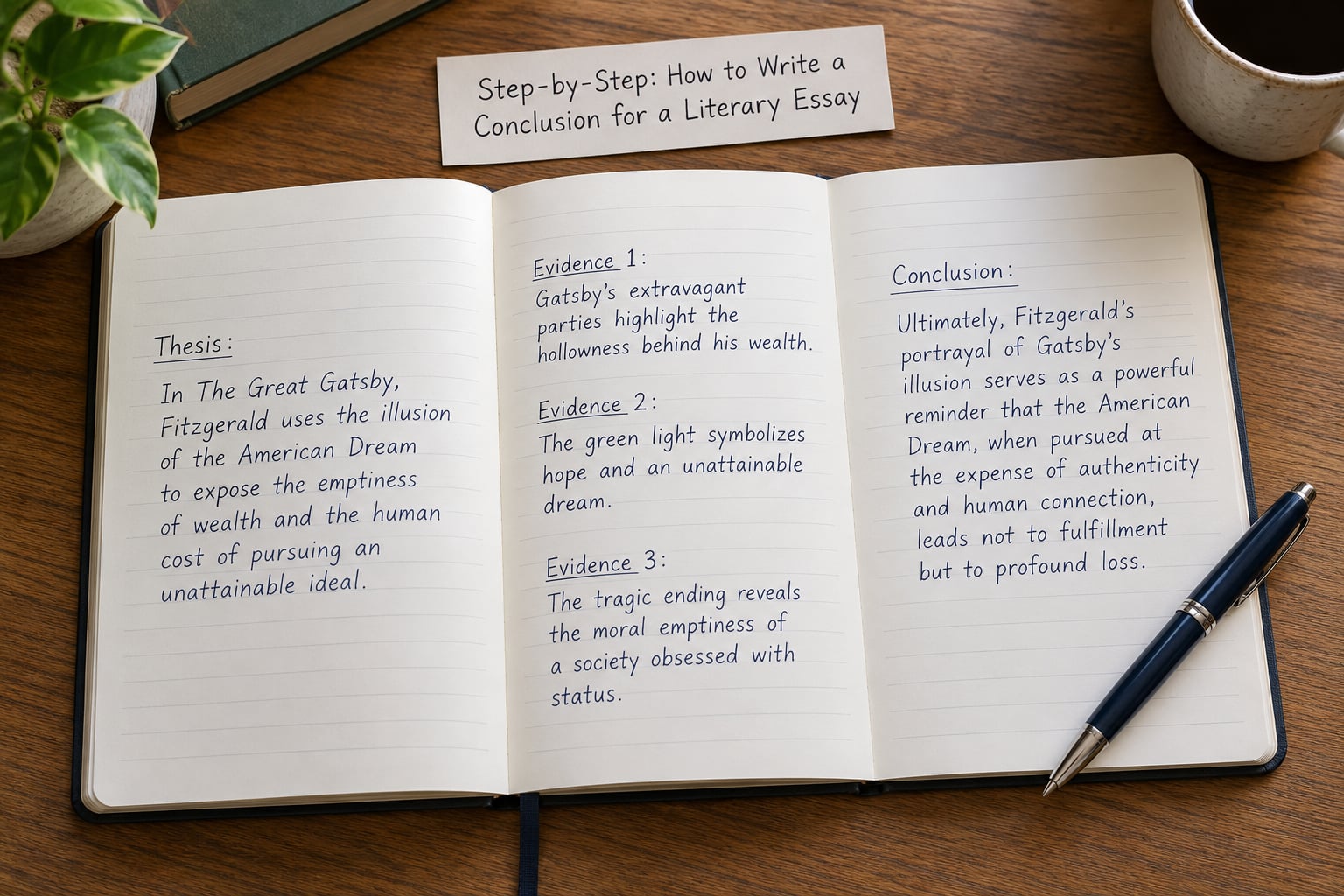
The order matters. Students who start with the closing line and then justify it end up defending a sentence they wrote before they knew what the essay proved.
Step 1: Revisit Your Thesis and Prompt
Restate the argument, not the wording. Read the prompt, then read the last sentence of your third body paragraph, and write a thesis in one sentence that answers the prompt directly.
The test is a side-by-side comparison. Put your introduction’s thesis next to the one you just wrote. If the meaning is identical but the phrasing is new, you have a restatement. If a reader could not tell them apart, you have copied your intro, which is the single most common way a strong essay ends up sounding thin.
Also notice what has changed. By the end of a body you often hold the argument more firmly than you did at the start, and the conclusion is the right place to show that. Purdue OWL’s guidance on conclusions makes the same point: the closing paragraph returns to the argument the essay has now established, not the one it announced.
Step 2: Select the Most Important Evidence
Choose one or two pieces of evidence, never four. Ask which quotation or moment your argument would collapse without, and take only that.
Then connect them instead of stacking them. The difference between summary and synthesis is the connector. Writing “the novel uses light in many ways, including X and Y” lists. Writing “X and Y both turn an ordinary object into a measure of what the family cannot say aloud” argues. One sentence is enough for this move, and it usually carries more weight than a paragraph of recap.
A quick check: if your evidence sentence would still make sense with the character and the text name swapped out, it is summary. Bring in the specific detail.
Step 3: Add a Deeper Interpretive Point
This is where literary conclusions either gain weight or lose it. Go one level past what you have already said about the evidence and name what it reveals: about a character’s self-deception, the limits of a symbol, the cost of a silence, a contradiction in the narrator’s voice.
Threads on Reddit’s r/alevel and r/CollegeEssays tend to circle one worry here, that zooming out produces something vague. They are right to worry, because vagueness is what happens when the writer zooms out without first pinning down the text. Stay concrete for two beats longer than feels comfortable, and the general statement will be earned rather than tacked on.
The check: your interpretive sentence must contain at least one word only this author and this book would produce. If it reads as a sentence about literature as a category, go back to the page.
Step 4: Show Why the Argument Matters
Answer the reader’s silent “so what?” without leaving the text. Significance in a literature essay is not a claim about society in general. It is a claim about what this particular text does that another treatment of the same material would not do.
Compare the two versions. “Austen uses irony to expose the limits of polite speech in Regency England” is a subject worth five minutes of anyone’s evening and belongs to no one. “Austen’s irony is at its sharpest when the narrator’s most reasonable sentences turn out to be the least accurate” is a claim about the technique, and the essay has earned it.
Watch for the drift here. If a significance sentence introduces a claim you have not touched in a single body paragraph, it is a new argument, not a conclusion.
Step 5: Write Clear Topic and Concluding Sentences
Know which sentence is which. The topic sentence states the takeaway: restated thesis plus the point your evidence has now proven. The concluding sentence lands it, usually with an image from the text rather than an explanation.
Five topic sentence patterns work for most literary essays:
- Although the novel opens on [image], by the final chapter that [image] has become [transformed thing], which shows that [thesis].
- Taken together, these moments reveal that the narrator’s [trait] is not [surface reading] but [deeper reading].
- The evidence complicates the essay’s opening claim: [restated thesis], though the cost of that claim is [wider implication].
- What begins in the [first scene] as [thing] ends in the [last scene] as its opposite, and that reversal is the argument this novel makes about [theme].
- Each of these moments places the same pressure on [character], and the pressure is what makes [theme] a conflict rather than a mood.
The final sentence is where echo pays off. Return to the image, object or question your introduction used, and show it has changed meaning. That gives the reader a small, satisfying sense of an arc without a summary.
Step 6: Avoid Repetition and New Arguments
Print the draft and mark every sentence that appears, in any form, in your introduction or in a body paragraph. You are not forbidding the same words. You are forbidding the same moves.
A five-item scan catches most problems. Copied sentences from the intro. Quotations longer than needed, since a closing paragraph should rarely run a full quotation. Plot recap, especially anything that happens without carrying argument. Claims with no evidence behind them. And ideas that appear for the first time in the last two sentences, which readers register as bait-and-switch even when the idea is good.
One small quotation is allowed, and in a literary essay it is often the best available closing move, as long as it is four words or fewer and is doing analytical work rather than decorating the ending.
A closing question, meanwhile, usually reads as unfinished. Students ask about this constantly on r/HomeworkHelp, and the answer is consistent: a question works only if you have clearly framed it as the text’s own unresolved question rather than your own.
Step 7: Revise for One Clear Literary Insight
Read the paragraph aloud against five checks: is every sentence relevant to the insight, does the evidence connect rather than list, is the claim specific to this text, does the logic run in order, and does the paragraph fit the space you gave it.
Then do one editing routine in a fixed order. Cut first, since cutting exposes padding faster than any other move. Tighten the topic sentence next, then replace abstract nouns with the specific thing you mean, then read the final sentence alone and ask whether it would still be interesting if the paragraph were one line longer.
Two length problems come up constantly. A conclusion running long means it has smuggled in a body paragraph; pick the strongest sentence in it and delete the rest. A conclusion running short usually means steps 3 and 4 got skipped, so add significance rather than more summary.
Common Mistakes and How to Fix Them
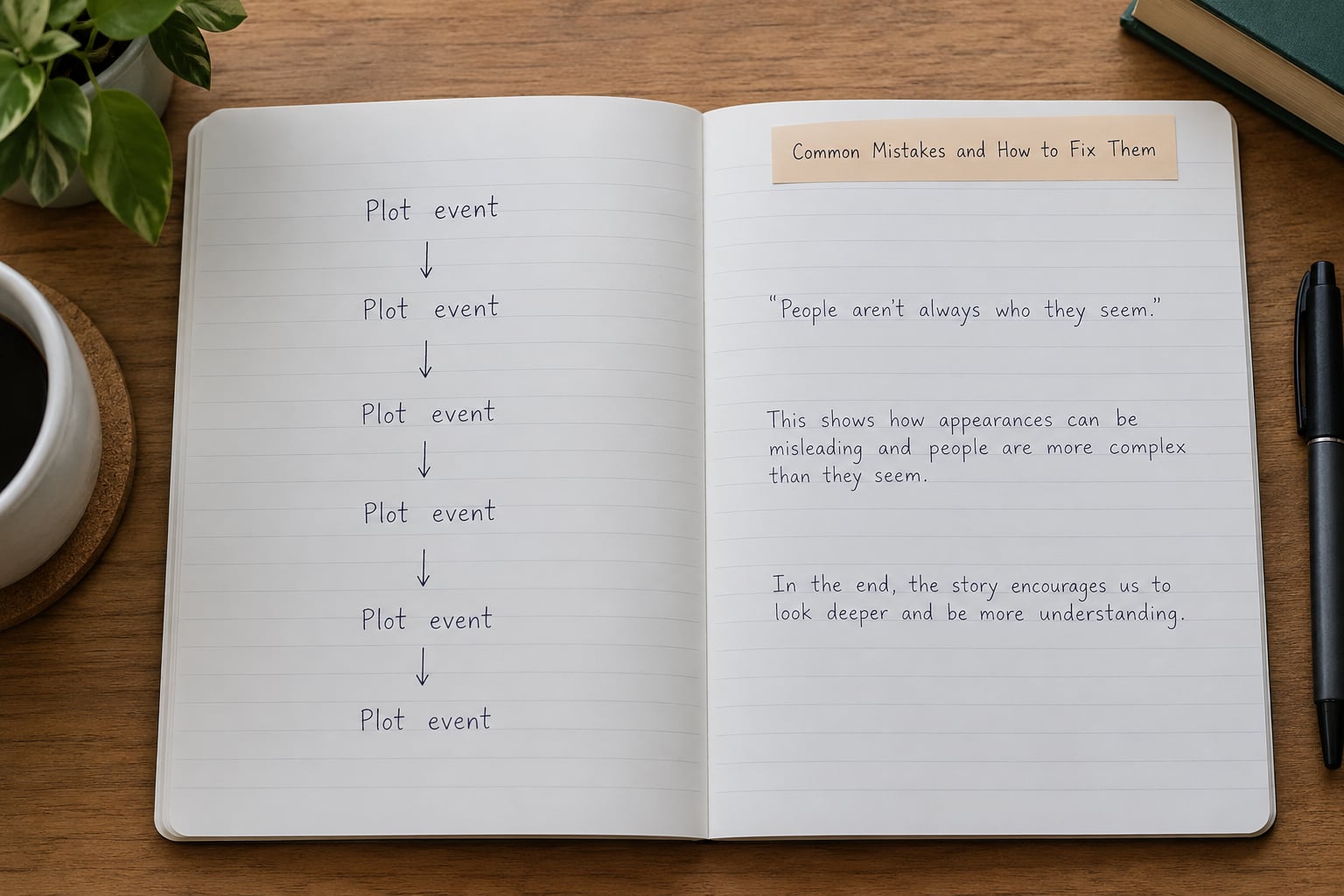
Almost every bad literary conclusion is one of eight patterns. Each has a direct revision.
1. The recycled introduction. The opening sentence is copied. Fix: rewrite it so the same claim arrives in a different shape, then keep only that version.
2. The plot recap. Two sentences on what happens at the end. Fix: delete the events and ask what they mean. If the meaning cannot be stated without the event restated first, cut the sentence entirely.
3. Signposting clichés. Opening with “In conclusion” or “To sum up” spends a precious sentence saying nothing. Fix: begin with the restated thesis. The paragraph position already tells the reader what it is.
4. Writing about the author instead of the text. Sentences about the author’s life or reputation that could have been written without reading the book. Fix: ask what this author’s choice does on this page, and keep the claim there.
5. The evidence list. Quotation after quotation with no connective analysis between them. Fix: keep the two strongest, delete the rest, and add one sentence explaining why they belong together.
6. The vague zoom-out. A claim about humanity, society or the power of love with no textual anchor. Fix: insert the specific detail that proves you mean this text and not every other one.
7. The borrowed persuasive ending. A call to action or a set of next steps, advice that belongs to an argumentative essay and looks wrong on a literary analysis. Fix: replace it with a claim about significance and close on the text’s image.
8. The last-minute idea. A new theme surfaced in the final paragraph. Fix: move it into a body paragraph with evidence, or cut it. If it cannot survive two hundred words of support, it cannot survive ninety words of conclusion.
One more worth knowing, since schools often teach conclusion formulas from argumentative writing: a literature review or literary essay conclusion has no call to action because the reader is not being asked to do anything. Asking what the text means is enough.
Frequently Asked Questions
How long should a conclusion for a literary essay be?
Four to seven sentences is the working rule, or roughly one tenth of the finished essay. A three-sentence conclusion can work in a short response essay, provided it still restates the argument, connects the evidence and states significance. If a conclusion runs longer, it is usually carrying a body paragraph rather than closing one.
Can a conclusion be just three sentences?
Yes. Three sentences can carry a full argument if each one does a distinct job: restate the thesis, synthesise the evidence and name the wider significance. What fails is three sentences that summarise, then summarise again, then stop. Test it by checking that your final sentence contains a claim about the text that appears nowhere else in the essay.
Should a literary essay conclusion include new evidence?
No major new evidence. A conclusion may quote a few words from a moment already discussed, and it may name a detail you have not quoted before, provided you attach a sentence of analysis to it. Anything requiring fresh explanation belongs in a body paragraph. Introducing an argument in the last two sentences reads as a bait-and-switch to markers.
How do I restate the thesis without sounding repetitive?
Return to the same claim in fresh language and sharpen it to reflect what the essay proved. Keep the original meaning, change the framing, and lead with a structure word rather than the phrasing of your first sentence. Reading both versions side by side is the reliable test: same argument, different sentences. If they are interchangeable, rewrite.
How do I end a literary analysis essay with a quotation?
Use four words or fewer, place them in your final sentence, and follow them with a phrase of analysis rather than leaving them bare. A quotation works best when it echoes the image your introduction opened on, so the essay closes the circle it began. A long quotation with no commentary reads as padding and usually costs marks.
What is a good way to end a conclusion in an essay?
End on a specific claim about the text rather than a general statement about life. Two reliable moves work: echo the opening image and show how its meaning has shifted, or land a short analytical sentence naming what the evidence adds up to. Avoid ending on a question, unless you have framed that question as one the text itself leaves open.
Start With the Insight, Not a Summary
Write the one sentence you want a reader to remember when they finish, then work backwards to build the paragraph around it. If that sentence is a summary of what happened, keep cutting until it becomes a claim about what the writing means. Everything else in the conclusion is scaffolding for that line, and it should read like one.