
To identify ethos, pathos, and logos in a speech, read it line by line and ask what each sentence is doing: building your trust in the speaker (ethos), stirring a feeling in you (pathos), or proving a claim with evidence and reasoning (logos). Label each one and quote the exact words that give it away.
That is the whole method, and it takes about thirty minutes once you have a transcript. The hard part is not the definitions, which most students can recite. It is telling a statistic that exists to create sympathy apart from a statistic that exists to prove something.
Table of Contents
- What You Need
- Step-by-Step: How to Identify Ethos Pathos and Logos in Any Speech
- 1. Prepare the Speech for Close Reading
- 2. Look for Ethos: Authority and Credibility
- 3. Look for Pathos: Emotion and Values
- 4. Look for Logos: Logic and Evidence
- 5. Explain How to Identify Ethos Pathos and Logos in a Speech
- 6. Check the Speech’s Overall Strategy
- Common Mistakes
- Frequently Asked Questions
- What is the easiest way to tell ethos, pathos, and logos apart?
- Can one sentence in a speech contain more than one rhetorical appeal?
- What counts as ethos if the speaker has no formal credentials?
- How do I identify pathos when a speaker does not use obvious emotional words?
- Does using statistics automatically make a speech logo-based?
- How should I write an analysis paragraph about rhetorical appeals?
- Conclusion
What You Need
You need four things, and one of them is not a product.
- The speech itself — a recording, a video, or a printed copy.
- A readable transcript — if you were given a video without text, pause it and type out what is said. Reading from a transcript is much faster than replaying audio, and you will catch far more appeals.
- A notebook or a document — paper suits colour-coding, a screen suits tagging and search.
- One or two colours — optional, but helpful. Three colours, one per appeal, is enough. Most students add more and stop using them by page two.
No special software is needed. If your assignment allows annotation tools, fine. If not, a pen works. Students sometimes believe they need a highlighting app before they are allowed to begin, and then never begin.
A second recording is useful too. Listening once without writing tells you the purpose and shape of the speech before you start hunting for language, and that order saves a lot of backtracking.
Step-by-Step: How to Identify Ethos Pathos and Logos in Any Speech
1. Prepare the Speech for Close Reading
Before you label anything, listen once straight through for the purpose and structure.
Write down the speaker’s thesis in your own words, list the major claims, and mark the transitions and the conclusion. Those four things give you a map, and when you hit a vivid sentence twenty pages later you will know which part of the argument it is supporting.
Then go back and read for appeals. If you try to label appeals while you are still working out what the speech is arguing, you end up tagging sentences that support nothing at all.
2. Look for Ethos: Authority and Credibility
Ethos is an appeal to the speaker’s credibility, and you identify it by asking who the audience has a reason to trust.
Six signals cover most cases: stated credentials, demonstrated expertise, personal or professional experience, shared values with the audience, common ground, and borrowed authority.
- Credentials — a title, a job, a qualification, or membership of an institution. “As a nurse with fifteen years in emergency rooms, I have seen what this does.”
- Expertise — the speaker shows knowledge through precise, technical language that a layperson would not use.
- Personal experience — “I grew up in a house without reliable heat.”
- Values — the speaker names principles the audience already holds, which builds standing quickly.
- Common ground — shared membership, shared struggle, shared habit. “Anyone who has coached a junior football team knows this.”
- Borrowed authority — endorsement by someone the audience already trusts, or appeal to a document, report, or tradition.
Watch for ethos that is implied rather than stated. A speaker who mentions a well-known figure as a friend, or who speaks in a setting that signals expertise, is borrowing credibility without ever claiming a title.
3. Look for Pathos: Emotion and Values
Pathos is an appeal to emotion, and you identify it by asking what feeling the language is engineered to produce.
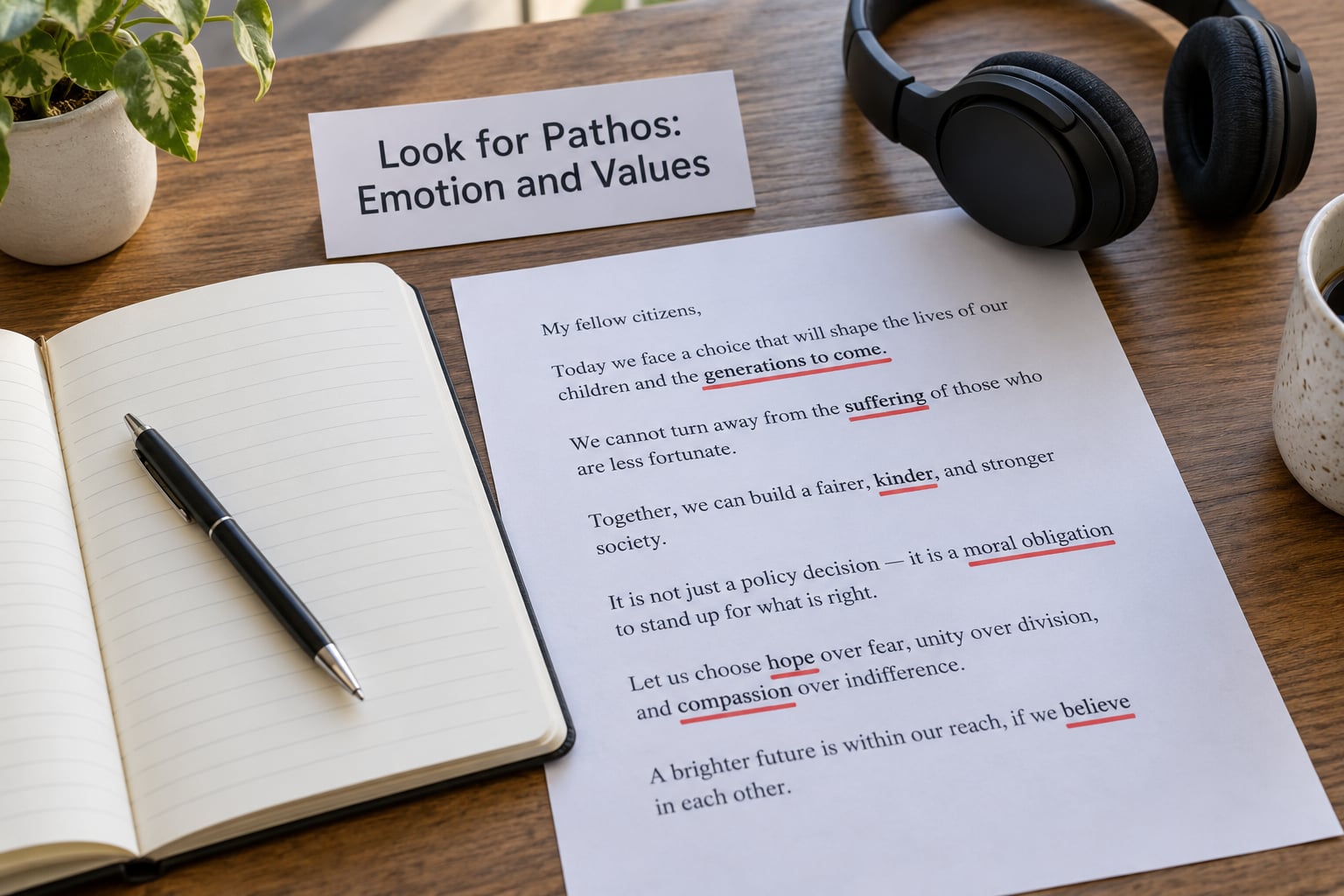
The signals are emotionally loaded words, vivid sensory imagery, personal stories, appeals to fear or hope, and language that connects with the audience’s values.
- Loaded words — “devastating”, “betrayal”, “innocent”, “urgent”.
- Imagery — description that makes a scene visible. “Cold water at three in the morning, and the sound of the pipes.”
- Personal narrative — a short story used to make a point feel lived rather than argued.
- Fear and hope — warnings about a bad outcome or promises of a better one.
- Value language — freedom, fairness, family, duty, belonging.
Pathos is often quiet. A flat factual sentence can carry more feeling than a stack of adjectives, which is why students scanning only for emotional vocabulary miss plenty of it.
4. Look for Logos: Logic and Evidence
Logos is an appeal to logic and evidence, and you identify it by asking whether the claim is supported and whether the reasoning holds.
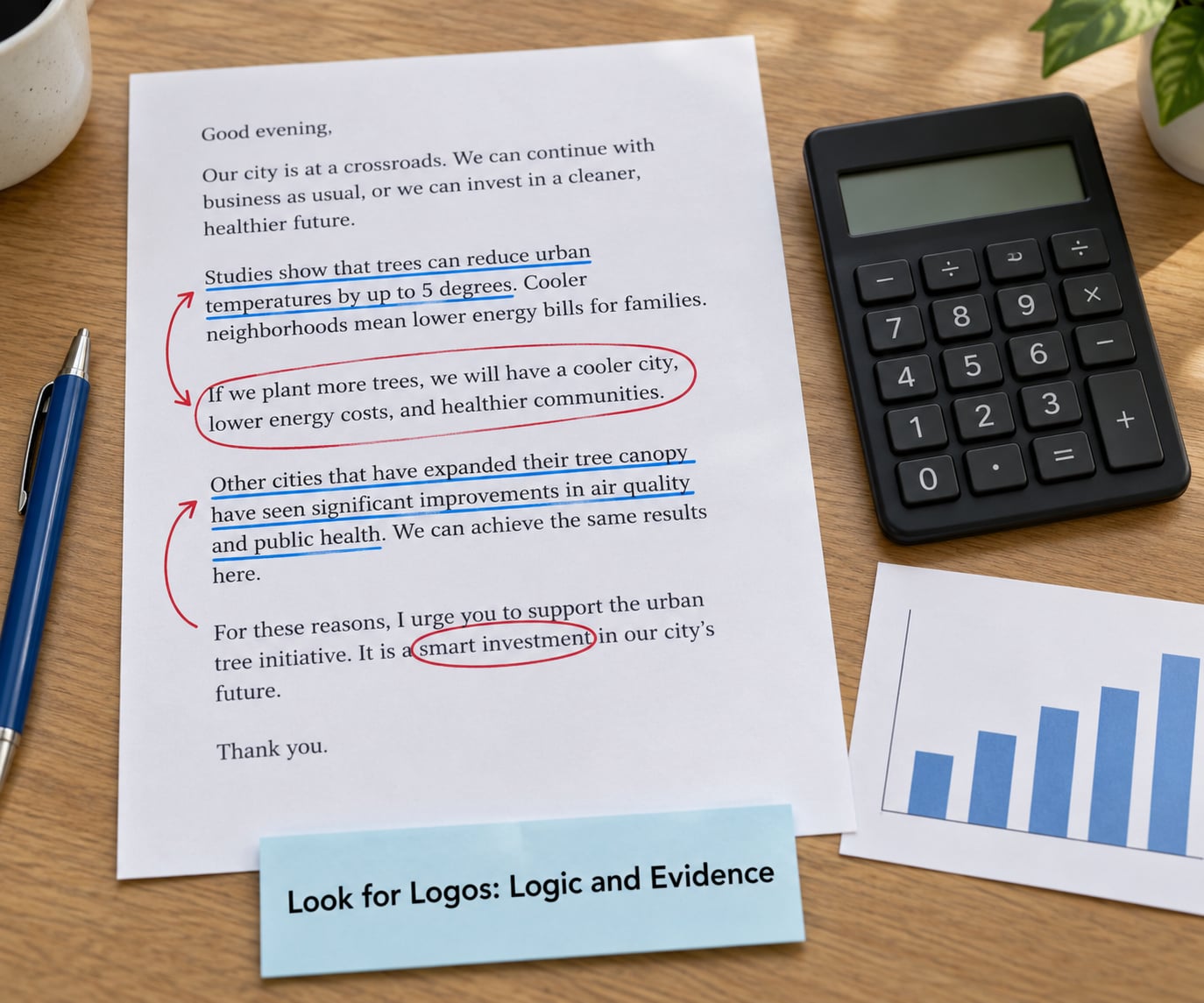
Look for statistics, documented facts, worked examples, cause-and-effect reasoning, comparisons, and stated warrants, which are the unstated assumptions that make an argument work.
- Statistics and data — numbers with a source and a date.
- Documented facts — verifiable specifics rather than generalities.
- Causal reasoning — “because”, “which means”, “as a result”, and the assumption hiding behind them.
- Comparison — before and after, this policy versus that one, cost per unit.
- Warrants — the bridge the speaker expects you to accept without saying it. “We cut bus routes, so fewer people can get to work” assumes that reliable transport is a precondition for employment.
Ask whether a claim could be checked. If it could not, it is not logos, whatever it is dressed up as.
5. Explain How to Identify Ethos Pathos and Logos in a Speech
Here is the comparison that does most of the work once you have your marked-up copy.
| Appeal | Question to ask | Example language | Effect on the audience |
|---|---|---|---|
| Ethos | Why should I trust this speaker? | Credentials, experience, common ground, endorsement | Willingness to listen |
| Pathos | What am I meant to feel? | Loaded words, imagery, personal story, fear, hope | Emotional investment |
| Logos | Is this true, and does it prove the claim? | Statistics, documented facts, comparisons, warrants | Agreement based on reason |
One sentence usually carries more than one appeal. “I have nursed in this town for thirty-one years, and I have watched the ward close twice” is ethos in the credentials and pathos in the closing image, with an implied argument underneath both.
Rather than forcing a single label, name the appeal that carries the most weight and note the secondary one in a clause. Then write the analysis, not just the label.
A weak entry says “this is pathos.” A strong one quotes, names the technique, and says what it does to the listener:
The speaker describes her grandmother’s kitchen as “bare on one side, where the table used to be,” then asks the audience to picture their own first winter without heating. The image is pathos, and it works because it converts an abstract policy failure into a domestic loss. Establishing ethos in the same line, she introduces herself as “a grandmother of four who paid my own heating bills,” so the feeling arrives through a source the audience has already been given a reason to trust.
Notice the structure: quotation, technique, effect. Repeat that shape and the analysis writes itself.
6. Check the Speech’s Overall Strategy
Step back from your annotations and ask which appeal dominates. Count the marks as a rough signal, but do not read equal numbers as equal importance. One well-placed story near the end often does more work than three passing appeals in the middle.
Then ask how the appeals serve the thesis. Good speeches build ethos early so that pathos and logos land on a listener who is already inclined to attend. A speech that opens with statistics and saves its credibility move for the last paragraph is usually weaker, because the audience has already decided whether to care.
Finally, check whether the balance fits the audience and purpose. A charity appeal leaning on pathos is normal. A courtroom or a budget meeting leaning on pathos alone is not. Noticing that mismatch is often the strongest thing you can say in an analysis.
One more check catches an appeal that never appears in the standard three: timeliness, or kairos. Ask why this speech was delivered now, to this audience, at this moment. A speech that exists because of an event happening this week is using kairos whether or not its author names it.
Common Mistakes
These are the errors I see most often in student analysis, and each has a simple fix.
- Labelling every opinion pathos. An opinion is not an appeal by itself. Ask what the speaker is doing with it — building sympathy, or supporting a claim with reasoning.
- Calling any statistic logos. A number used to make people feel sorry for someone is functioning as pathos, even though it is a number. Ask what job it does in the paragraph.
- Missing implied credibility. Ethos often arrives without a title. Mentions of status, setting, or association all count.
- Quoting without explaining. A quotation on its own is transcription. Add the technique and the effect.
- Analysing isolated words. Underlining “hope” and stopping tells the reader nothing. Read the sentence around it.
- Treating a personal story as pure pathos. This is the most common confusion. Lived experience that establishes who the speaker is and why they know the subject is doing ethos work; the feeling in the telling is pathos. Most speeches do both, and saying so is a stronger reading than picking one.
- Counting appeals as proof of quality. A speech with fifteen appeals is not persuasive. A speech with three well-placed appeals usually is.
One practical habit fixes more of these than any other: write the thesis at the top of the page before you start labelling. When every mark has to connect to an argument, wandering labels become obvious immediately.
Frequently Asked Questions
What is the easiest way to tell ethos, pathos, and logos apart?
Ask what the sentence is trying to do to you. If it is making you trust the speaker, look for credentials, experience, or common ground, and you have ethos. If it is making you feel something, look for loaded words, imagery, or a personal story, and you have pathos. If it is giving you a reason to believe a claim is true, look for evidence and reasoning, and you have logos. The test is effect, not vocabulary: a statistic that exists to create sympathy is functioning as pathos.
Can one sentence in a speech contain more than one rhetorical appeal?
Yes, and most strong sentences do. A speaker who says she has worked as a nurse for fifteen years and describes a patient she watched deteriorate is using ethos with the experience and pathos with the description. Rather than forcing one label, name the appeal doing the heavier work in that sentence and mention the other briefly. Examiners reward noticing overlap, because it shows you are tracking what a sentence is doing rather than pattern-matching single words.
What counts as ethos if the speaker has no formal credentials?
Plenty. Ethos comes from perceived authority, not official titles. Personal experience that proves the speaker knows the subject first-hand builds ethos. Shared values, membership in a community the audience belongs to, and borrowed authority such as a respected figure or an established report all count. Ask yourself whether a listener has been given a reason to trust this person on this topic. If yes, you have found ethos, whether or not anyone printed a qualification on a slide.
How do I identify pathos when a speaker does not use obvious emotional words?
Pathos often arrives through scene-setting and stakes rather than adjectives. Read for what the speaker invites you to picture, what outcome they ask you to fear, and what they want you to hope for. A neutral description of a difficult moment, a repeated image, or a shift into the second person can carry more feeling than a page of emotional vocabulary. If a sentence makes you imagine something or care about an outcome, it is doing pathos work regardless of the words used.
Does using statistics automatically make a speech logo-based?
No. Statistics are evidence, but evidence does its persuasive work in different ways. A figure paired with a sound inference, a comparison, or a causal claim is functioning as logos. A figure introduced with a named child and a sympathetic detail, or used to shock listeners into action, is functioning as pathos even though the number is accurate. Judge the appeal by the job the evidence does in the argument, not by the presence of digits.
How should I write an analysis paragraph about rhetorical appeals?
Use a quotation, a technique, and an effect, in that order. Quote the exact language, name the appeal or device, then explain what it produces in the audience and how it advances the speech’s purpose. Add a sentence on why the speaker chose that technique here, since that is where the analysis goes past summary. One well-built paragraph on a single sentence beats a paragraph that lists five appeals without explaining any of them.
Conclusion
Start with the thesis. Write down what the speaker is arguing, mark the claims and the transitions, then go back through for one clear example of each appeal and label it in the margin.
When you can say why each marked sentence is doing the job you have assigned to it, you have done the analysis. Everything after that, weighting, balance, and audience fit, becomes refinement rather than rescue.