
Analyzing a political speech for class means five things: pin down the rhetorical situation, state the speaker’s central claim in one sentence, annotate the text, judge the evidence, and explain what each rhetorical choice does to the audience. That last part is where most assignments are won or lost. Summarizing gets you a passing paragraph. Explaining effect gets you the top band.
Below is a seven-step process that keeps the analysis in order and saves you from rewriting. Work it top to bottom the first time, then skip ahead once you know which steps your particular prompt needs.
Table of Contents
- What You Need
- Step-by-Step: How to Analyze a Political Speech for Class
- Step 1: Establish the Speech’s Historical Context
- Step 2: Determine the Speaker’s Purpose and Central Claim
- Step 3: How to Analyze a Political Speech for Class
- Step 4: Examine the Speech’s Structure and Organization
- Step 5: Analyze the Evidence and Reasoning
- Step 6: Evaluate the Language and Rhetorical Appeals
- Step 7: Write a Thesis and Evidence-Based Analysis
- Common Mistakes
- Frequently Asked Questions
- How long should a political speech analysis be for class?
- Should I summarize a political speech or focus on analysis?
- What rhetorical appeals should I discuss in a political speech?
- How many quotations should I use in a speech analysis essay?
- Can I use AI to analyze a political speech for my class?
- Conclusion
What You Need
Five things. The full transcript of the speech, not a summary of it. The assignment prompt, read twice, because the prompt tells you which framework your teacher wants. Two or three reliable historical sources. A dictionary for the words that have drifted in meaning since the speech was given. And a one-page organizer with four columns.
That organizer is worth the ten minutes it takes to set up: device, quoted example, effect on the audience, and where it supports the claim. Read the whole text once and note word choice, emphasis, and repeated phrases rather than hunting for devices from a list. The list comes after.
One more decision before you start. If your teacher hands you a short excerpt, check whether analyzing the whole speech is allowed. Usually it is better. A speech is an argument built over minutes, and cutting it to a paragraph removes the structure that makes the analysis interesting.
Step-by-Step: How to Analyze a Political Speech for Class
The process runs from the outside in. You start with the world around the speech, move to the claim, then read the language closely, then judge the reasoning, then explain the effect, and only then write. Students who jump straight to finding devices usually end up with a list and no argument.
Step 1: Establish the Speech’s Historical Context
Write down the speaker, the exact date, the occasion, and who is physically in the audience. Then add the two or three events immediately preceding the speech. A speech delivered to a convention on the eve of a vote means something different from the same speech delivered by a candidate on the morning after a defeat.
Ask why this speech happened now. Frequently the answer is that something had already gone wrong. A party lost a vote, a bill collapsed, a war ended badly, a movement had a moment of visibility. Naming that pressure point gives you something to say about urgency, and urgency is usually where the rhetoric gets interesting.
Step 2: Determine the Speaker’s Purpose and Central Claim

Separate the topic from the claim. The topic is “the economy.” The claim is the specific position the speaker takes about it. If you cannot write the claim in one plain sentence, you do not understand the speech yet.
Then name the purpose. Is the speech trying to inform, to persuade, to inspire, to criticize, or to propose action? Most campaign and party convention speeches do two of these at once, which is fine. Just be precise. “Persuade and mobilize” is a stronger reading than “talk about the economy.”
Paraphrase the claim rather than quoting it. Put the claim in your own words at the top of your organizer, then check that every piece of evidence you later select actually supports that sentence.
Step 3: How to Analyze a Political Speech for Class
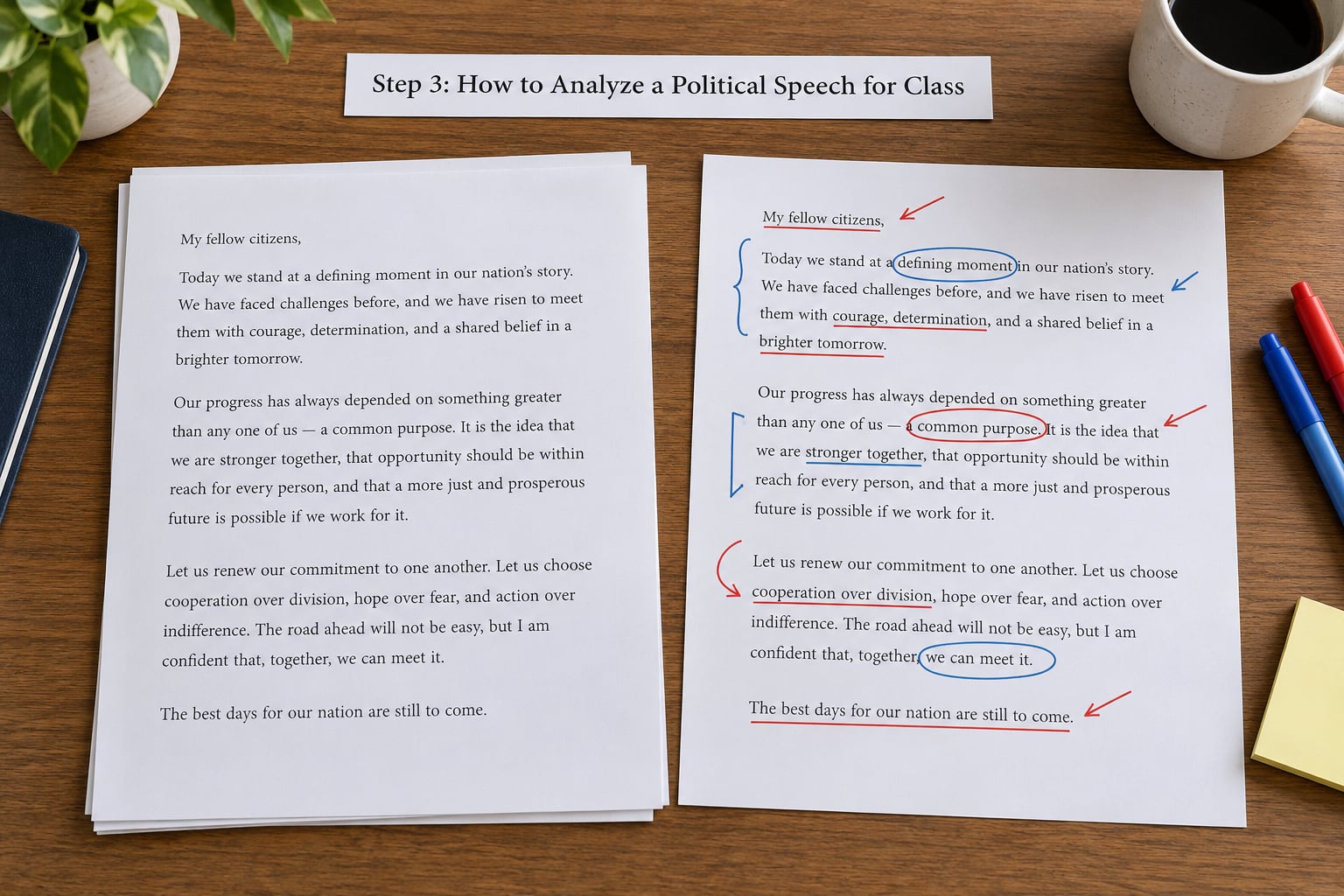
Read the transcript out loud once, then annotate a second copy. Use five marks and stick to them:
- Mark the thesis. Box the sentence that states the claim outright, if there is one.
- Mark transitions. Bracket words like therefore, because, and instead, since those words show you how the argument is assembled.
- Circle appeals to logic or authority. Statistics, dates, named experts, official documents.
- Underline emotionally charged language. Words chosen for feeling rather than information.
- Box appeals to emotion or values. Family, sacrifice, freedom, dignity, home.
That last mark is the one students skip. Speech after speech relies on values language, and it is usually the fastest route into a good paragraph.
Do not annotate in color only. Some of your marks are for you now and some are for your teacher later, and a text covered in five colors proves nothing about which choices mattered.
Step 4: Examine the Speech’s Structure and Organization
Look at how the pieces are arranged. Does the speaker open with a story, a statistic, or a greeting? Does the argument move from problem to solution, or from a shared value to a specific demand? Where do the transitions sit, and what do they assume the audience already accepts?
Pay attention to how the speaker handles opposition. A speech rarely ignores a serious objection. It reframes it, concedes a small piece, or redirects to a different question. Any of those moves is a structural choice worth naming, because it shows the speaker managing an audience rather than just reciting talking points.
Also check the ending. A speech that closes on a command and a speech that closes on an image do different jobs, and the closing is usually where the purpose becomes unmistakable.
Step 5: Analyze the Evidence and Reasoning
Sort the evidence into types before you judge it. Statistics. Concrete examples. Personal or community stories. Testimony from named individuals. Historical references. And assumptions, which are the least visible and the most important.
For each one, ask three questions. Is it relevant to the central claim, or is it merely on topic? Where does it come from, and would the speaker gain by exaggerating it? And does it actually do argumentative work, or does it decorate the claim without carrying it?
Assumptions deserve special attention because they are the load-bearing part. A speaker may present a statistic and never explain why that statistic should change your mind. That unstated bridge between evidence and conclusion is the argument’s warrant, and identifying it is often the strongest analytical move available to you.
Step 6: Evaluate the Language and Rhetorical Appeals
Aristotle’s framework splits persuasion into three appeals. Ethos is the speaker’s authority or standing with this audience. Logos is the logic and reasoning. Pathos is the appeal to emotion and shared values. A strong analysis shows all three working, and shows where they pull against each other. A speaker leaning hard on pathos while presenting thin logos is doing something you can name, and that tension is a good paragraph.
Beyond the appeals, work through the devices that do the persuading:
- Repetition. A phrase repeated at the opening, the turn, and the close is a spine, not decoration.
- Diction. Word choice. Compare the register of two sentences aimed at the same idea.
- Tone. Measured or urgent, conciliatory or accusatory, ceremonial or plain.
- Analogy and extended metaphor. Shows the speaker’s model of the problem, which is often more revealing than the claim itself.
- Contrast and antithesis. Then versus now, them versus us, a past condition set against a promised one.
- Direct address. Shifts to we or you pull the listener into the argument rather than watching it.
- Understatement and hyperbole. Deliberate mismatches in scale, often used to make a criticism land harder.
- Rhetorical questions. Staged questions whose answer is supplied in the next sentence, so the audience reaches the conclusion itself.
For each device, write the quoted example and then the effect in one sentence: what does this make the audience believe, feel, or do? That effect sentence is the part your teacher is grading for.
Step 7: Write a Thesis and Evidence-Based Analysis
Turn your observations into a claim about the speech, not a label on a device. “Uses pathos” describes a technique. “Shifts from statistical evidence to a single named family in the second half, trading logos for pathos to make an abstract policy feel personal” describes an argument, and it can be argued with.
A workable formula: the speech + the choice it makes + the effect that choice has on this audience + the stakes. Four parts, one or two sentences, something a reasonable person could disagree with.
Then select three to five quotations, each one doing a job your claim needs. Build each body paragraph the same way: topic sentence naming the choice and its effect, the quotation, the analysis explaining what the language does, and a closing line that ties back to the thesis. Note the speech in MLA style in the text and on the works cited page.
Close by stating what the analysis has shown, not what you will discuss next. If you want one counterpoint, give it a sentence and then say why the speech’s choices still hold.
Common Mistakes
Summarizing instead of analyzing. If a paragraph would make sense with the word “discusses” swapped in, it is summary. Say what the speech does and what that does to the listener.
Stating opinion as fact. “The speech is manipulative” is a verdict. “The speaker drops all qualification once the audience is described as a family” is an observation you can defend.
Listing devices without effect. This is the most common flaw in student analyses. A list of anaphora, metaphor, and rhetorical question is inventory. The effect is the analysis.
Quoting without context. A quotation pulled from the middle of a paragraph hides what came before it. Note where it sits and how the speaker got there.
Judging intention without evidence. You can argue about how a choice functions. Claiming what the speaker secretly meant is speculation, and teachers mark it down.
Picking quotations that do not support the thesis. If your best line belongs under a different claim, either change the claim or drop the line.
Two revision habits fix most of these at once. Read only your topic sentences and check whether they make claims or announcements. Then underline every sentence of analysis and ask whether the device could be swapped for a different one without changing the paragraph. If it could, the analysis is too general.
Frequently Asked Questions
How long should a political speech analysis be for class?
Length follows the prompt. A single close-reading paragraph might be 250 words, a full rhetorical analysis essay is commonly 750 to 1200 words, and a longer unit may ask for several thousand. Check the rubric for a required word count and for how many quotations it expects. If no count is given, aim for the shortest piece that still covers context, claim, appeals, and effect, since length never compensates for a missing explanation.
Should I summarize a political speech or focus on analysis?
Focus on analysis, with a short summary serving as scaffolding. Give one or two sentences of what the speech covers so the reader has orientation, then spend the rest of the paragraph explaining how the speech argues. Many students rewrite the speech in order and run out of room before the analysis begins. Test each paragraph: if it would still be accurate with a different speech in its place, it is too general.
What rhetorical appeals should I discuss in a political speech?
Discuss all three of Aristotle’s appeals, but not equally. Identify ethos, logos, and pathos, then explain where each appears in the text and what it achieves. The strongest paragraphs focus on a moment where the speaker shifts between appeals, such as moving from statistics to a named family to make an abstract policy personal. Saying only that a speech uses pathos adds nothing, because almost every speech does.
How many quotations should I use in a speech analysis essay?
Three to five well-chosen quotations usually serve better than eight scattered ones. Each quotation should anchor one point and receive real analysis, and a short phrase is often enough when you are tracing repetition or diction. Reserve longer passages for the moment where structure or tone changes, since extended quotation is justified when the language itself is the evidence. Follow your rubric if it specifies a number.
Can I use AI to analyze a political speech for my class?
Check your course policy first, because rules range from fully permitted to prohibited. Where AI is allowed, use it as a drafting partner rather than a source: paste your own annotated passages and ask for feedback on your claim and paragraph structure, then verify every quotation against the original transcript. Teachers generally mark down invented quotes, invented historical detail, and analysis you cannot explain out loud, so keep full control of the evidence.
Conclusion
Start with the speech’s context, its purpose, and its central claim in one sentence each. Then let the evidence and the language do the work, and spend most of your sentences explaining what each choice makes the audience feel or do. A strong analysis is not the one that names the most devices. It is the one that shows why this speech had to be delivered this way, to these people, at this moment.