Learning how to tell if a source is credible takes about a minute per source once you know the eight checks: author, publisher, evidence, bias, date, purpose, corroboration and tone. None of it requires special training, which is good, because most people never learn it and just trust whatever lands first on a search page.
That habit is the problem. A page can look like a university library, quote a real study, and still be entirely wrong about what that study found. Here is the method I teach students, in the order I teach it.
Table of Contents
- What You Need
- Step-by-Step: How to Tell If a Source Is Credible in 8 Checks
- 1. Identify the Author and Their Qualifications
- 2. Check the Publisher or Website Behind the Page
- 3. Examine the Evidence and Supporting Sources
- 4. Look for Bias, Opinion, and Advertising
- 5. Check the Date and the Purpose
- 6. Confirm With Other Sources: How to Tell If a Source Is Credible Beyond One Page
- 7. Look for Accuracy, Clarity, and Corroboration
- 8. Make a Final Credibility Judgment
- Common Mistakes
- Frequently Asked Questions
- What are three characteristics of a credible source?
- Why is Reddit not a credible source?
- What are some examples of bad research sources?
- Can a website be a credible source?
- How do you know if a research article is peer reviewed?
- What should I do when every source I can find is low confidence?
- Conclusion
What You Need
Four things, and you probably already have all of them.
- The specific claim. Not “is this site trustworthy” but “does this article’s claim that the new battery lasts 40 percent longer hold up.” A specific claim can be checked. A vague vibe cannot.
- What you already know. Two or three facts about the topic from a source you trust. Without a baseline you cannot tell whether a new claim is surprising, impossible, or ordinary.
- Access to the original. If an article cites a study, you need to be able to open that study, or at least the abstract and methods. Most articles quote a single sentence from a paper and drop it.
- A way to find independent confirmation. A second search in your own words, Google Scholar, a library database, or a fact-checking site that names its sources.
For literary and text-based research, the same setup applies with one adjustment. The original document is the primary text itself, so check the edition, the editor, the publisher and the date of that edition before you check anything about an essay about it. A critique of a 1922 edition tells you nothing about the text you are holding.
Step-by-Step: How to Tell If a Source Is Credible in 8 Checks
1. Identify the Author and Their Qualifications
Look for a byline with a real name, and then go find out who that person is. Search the name plus the topic. A clinical psychologist writing about sleep research is a different signal from a marketing account with the same name.
Your result at this step: a name, a field, an institution, and an honest note about whether you could find anything at all.
If there is no byline, that is not automatically disqualifying. Encyclopedia entries and government fact sheets are often unsigned because a whole editorial team stands behind them. But an unsigned opinion piece is a problem, and an anonymous article making a strong factual claim is a bigger one.
2. Check the Publisher or Website Behind the Page
Read the footer and the About page. Who funds this, who edits it, and does anyone answer email? Then look at the domain with actual attention: .gov, .edu and established national .org domains are usually accountable to an institution that has a reputation to protect, while .com is simply whatever someone registered.
Your result: the name of the organization, plus whether it publishes corrections and has any editorial oversight.
Two cautions here. A .org is not automatically trustworthy; anyone can buy one. And a big name does not vouch for everything on the site. Reuters, the BBC and a university press all carry errors, and some of their pages are sponsored or user-submitted. Check the specific page, not the brand.
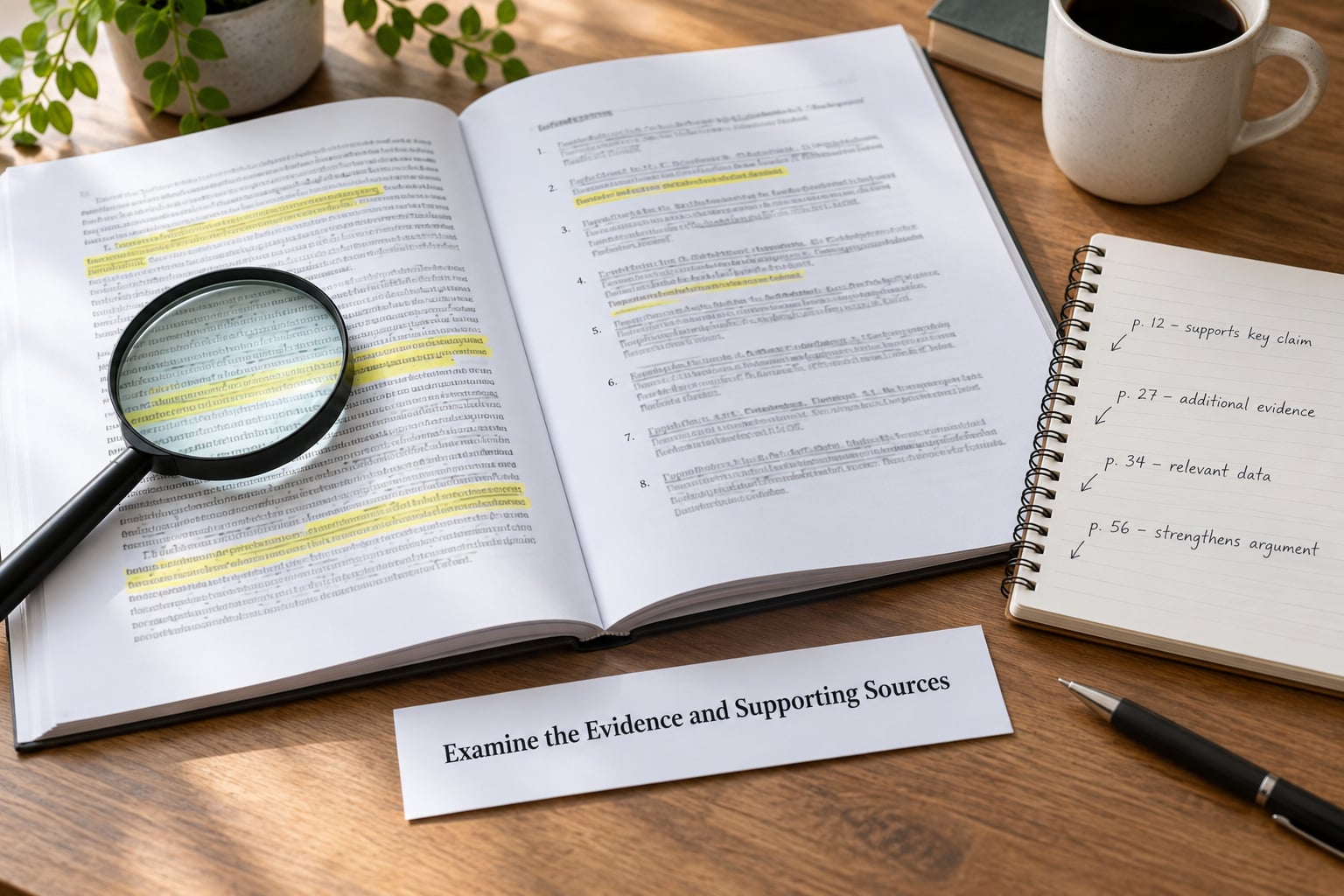
3. Examine the Evidence and Supporting Sources
Follow the citations. If the article says a study found something, open the study. Check three things: whether the sources it cites actually say what the article claims, whether a method is described at all, and whether the strongest counter-evidence got left out.
Your result: at least one source you opened yourself, or a clear note that you could not open any of them.
Watch for citation laundering, where an article points to five other articles that all point back to the same unnamed study. One study is not five sources. If a piece quotes a quotation with no speaker, no date and no context, treat it as decoration rather than evidence.
4. Look for Bias, Opinion, and Advertising
Every source has a point of view. The useful question is whether the writer tells you what it is. Loaded words, a one-sided guest list, and a claim that “everyone agrees” are all signals that other evidence was filtered out before you arrived.
Your result: a one-line statement of the source’s likely interest in the outcome, such as a supplement company selling the thing, a union defending its position, or a researcher who wants the next grant.
Hidden sponsorship is the thing to hunt for. If a page sells a course, a supplement, a supplement stack or a device, it has a reason to be positive. Disclosure statements are a good sign. Absent disclosure combined with commercial intent is not. Bias does not make a source useless, it changes what you can safely use it for: an advocate’s data may be perfectly accurate once you read it with their interest in mind.
5. Check the Date and the Purpose
Find the published date and the last-updated date. If there is neither, treat the content as undated and lower your confidence accordingly.
Your result: a date, and a judgement about whether that date is recent enough for your topic. Nutrition, software, product recalls and election results go stale in months. The causes of the First World War do not.
Purpose comes next: is this page meant to inform, persuade, sell or entertain? A restaurant review and a research summary can both be accurate and serve completely different goals, and reading them for the wrong purpose is how people end up citing an opinion as a finding.
6. Confirm With Other Sources: How to Tell If a Source Is Credible Beyond One Page
Search the claim itself in your own words and see what independently published sources say. This is called lateral reading, and research by Sam Wineburg and Tom Schrag and the Stanford History Education Group found something that surprises people: experienced readers do not evaluate a page closely and then decide. They leave it, open new tabs, and check who the publisher is.
That same work found that student readers correctly identified the author about 83 percent of the time but correctly identified whether the source was reliable only about 25 percent of the time. Naming the writer is easy. Judging the source is the hard part, which is what the rest of this method is for.
Your result: at least two independent sources that agree, or a written note that they disagree. Disagreement is information. When reputable sources conflict, find out whether they examined the same period, the same population or the same definition of the thing. Often they are both right about different questions.
7. Look for Accuracy, Clarity, and Corroboration
Now read it like a skeptic. Look for absolute claims with nothing behind them, statistics with no sample size or no comparison group, quotations that appear without their original context, and typos or garbled sentences in places a careful editor would have caught.
Your result: a list of anything you could not confirm, written down so you do not forget it in the citation.
A number needs a base. A claim that spending rose sharply is incomplete unless you know from what, over what period, and compared with which other group. Cherry-picked data usually still has a real source attached, which is why the citation you check is not the same as the statistic you accept.
8. Make a Final Credibility Judgment
Write one sentence: who wrote this, what they want, what evidence they used, and whether independent sources back the specific claim you are citing. If you cannot write that sentence, you do not yet understand the source well enough to use it.
Then sort it into one of three piles. Reliable, so usable with normal citation. Questionable, so usable for background or with the disagreement stated openly. Unusable, so it does not go in your bibliography and you start over.
Doing this for a class assignment takes five or ten minutes. Doing it for something you are about to act on, a health claim, a legal question, a financial decision, is worth more time than that.
Common Mistakes
- Judging by design. A polished layout with pop-up ads and a professional logo tells you someone can afford a designer. Plenty of content farms use exactly that to look institutional. Commenters on research and media forums describe getting burned by this one constantly, and the fix is to check the byline and the funding instead of the fonts.
- Assuming a famous publisher vouches for every claim. Reputable outlets publish guest posts, sponsored pages and user-submitted material. Check whether the page is the outlet’s own reporting.
- Treating popularity as reliability. Something being widely shared, heavily upvoted or first on a results page is a measure of attention, not accuracy. Most people describe their real routine as whatever appeared first, which is why they keep landing on the same bad summaries.
- Quoting an AI chatbot as a source. On forums, “ChatGPT told me” gets treated the way “a random guy on Reddit said” gets treated. An AI answer has no author, no date, no citations you can inspect and a documented habit of inventing plausible details. Use it to find terms and questions, never as evidence.
- Rejecting a source for having a viewpoint. A union newsletter and a trade association bulletin are both interested, and both can contain accurate facts. Name the interest and cite the fact with it.
- Verifying nothing because the topic feels obvious. For well-known sources most people check only the author and the organization. That is reasonable until the claim is contested, and it is not enough for anything medical, legal or financial.
Frequently Asked Questions
What are three characteristics of a credible source?
Three come up most often: an identifiable author whose qualifications you can verify, evidence you can inspect such as citations or data with a method described, and transparency about who published the content and why. A visible publication or last-updated date is usually treated as a fourth, because undated content cannot be judged for whether it is still current.
Why is Reddit not a credible source?
Reddit is a self-selecting sample. People post about what interests them, strongly and with an audience of mostly younger users, and upvotes reward confidence more than accuracy. Voting tells you what a community found persuasive, not what is true. That does not make every post useless: use a thread to discover which studies or reporters to read, then cite those underlying sources.
What are some examples of bad research sources?
Common weak sources include content farms that exist to sell ads, pages with no author, no date and no citations at all, AI-written summaries presented as reporting, sites that recycle other sites without adding anything, and advertorial written to look like a review. The giveaway is rarely one flaw but three at once: no byline, no date, no links you can follow.
Can a website be a credible source?
Yes. Plenty of strong sources are websites: government agencies, universities, major news organizations, professional associations and individual scholars with their own pages. What matters is not the format but whether you can identify a responsible publisher, find evidence behind the claims and see independent support. A personal blog can be highly credible and a .org page can be worthless.
How do you know if a research article is peer reviewed?
Look it up rather than trusting the label. Search the article title in Google Scholar and check whether the journal is indexed, then look for a review process page, an editorial board and a stated peer-review policy. Retraction Watch tracks retracted papers. If you cannot confirm that a journal is peer reviewed, describe it as an article from that journal rather than as peer-reviewed research.
What should I do when every source I can find is low confidence?
Slow down and widen the search rather than lowering your standards. Use Google Scholar, your library database, a government or institutional report, or ask a librarian, and search the exact quoted phrase from a claim to find the original. When you genuinely cannot confirm something, say that in your writing. Naming an unresolved question is more defensible than citing the least bad guess.
Conclusion
Start with the author and the publisher, because those two checks eliminate most bad sources before you read a single paragraph. Then verify the evidence, the date, the purpose, the bias and the independent support, in that order, and write down what you could not confirm.
Make it one sentence per source, kept in a note beside each link: who wrote it, what they want, and whether anyone else agrees. It takes thirty seconds now and saves an argument with your teacher later. This guide was checked for 2026.