
Knowing how to write an argumentative essay with sources comes down to one habit: treat the sources as the engine of the argument rather than as decoration at the end. You pick a debatable topic, gather credible evidence, write a thesis a reader could disagree with, and then use each source to prove one specific point. Budget about five to seven hours for a 1,500-word paper, and expect the first hour to go entirely into sources and thinking.
This guide walks through the whole process in seven steps, from reading the prompt to the last revision pass. It also answers the question students ask most: how many sources you actually need, which depends on the word count rather than on a rule someone invented.
Table of Contents
- What You Need
- Step-by-Step: How to Write an Argumentative Essay With Sources
- 1. Analyze the Prompt and Choose a Position
- 2. Research and Evaluate Credible Sources
- 3. Build a Claim, Warrants, and Evidence
- 4. Create an Outline With a Logical Structure
- 5. Write Evidence-Based Body Paragraphs
- 6. Address the Strongest Counterargument
- 7. Cite Sources and Revise the Paper
- Which Approach Should You Use?
- Common Mistakes
- Frequently Asked Questions
- How many sources should an argumentative essay use?
- Can I quote sources in an argumentative essay?
- How do I paraphrase a source without copying it?
- Should every body paragraph include a citation?
- How long should an argumentative essay be with sources?
- How do I include a counterargument in an argumentative essay?
- Conclusion
What You Need
You need seven things in place before you write a single sentence of the body. Gather them in order, because each one shapes the next.
- The assignment prompt. Write it out and underline the direction words: argue, defend, assess, evaluate, to what extent, discuss. The word “discuss” asks for analysis, “argue” asks for a position, and “to what extent” asks you to weigh how far something holds.
- A research question. Narrow the broad topic into something you can actually answer in the space allowed, such as “Should public schools require two years of civic coursework?”
- A working thesis. One sentence you can argue, revise and defend. It is allowed to change while you research, but not after you start drafting the body.
- Credible sources. A mix of primary sources (the original data, court ruling, law, survey or firsthand account) and secondary sources (scholars and researchers who interpret that data).
- A note-taking tool. A document, notebook or reference manager where you record each source’s author, year, page and the specific finding you plan to use.
- Your citation requirements. Know whether the course wants MLA 9, APA 7 or Chicago before you cite the first source, because converting styles afterward is tedious.
- The grading rubric. If your teacher supplied one, put it next to you while you draft. Rubric criteria reveal what is actually being marked.
Step-by-Step: How to Write an Argumentative Essay With Sources
The process follows a fixed order: interpret the prompt, research, build a claim, outline, draft evidence-based paragraphs, address the strongest objection, then cite and revise. Skipping ahead to drafting is what produces essays that summarise sources without arguing anything.
1. Analyze the Prompt and Choose a Position
Read the prompt twice, once for the topic and once for the demand. A two-sided prompt such as “Should schools start later?” wants both positions weighed before you land on one. An open prompt such as “Argue for the best use of school phones” wants you to take a side and hold it.
Then write a provisional position in one sentence. Do not research yet. A rough position gives your research a direction, and a topic you can argue in one breath beats a topic you find interesting but cannot defend in three pages.
2. Research and Evaluate Credible Sources
Search where evidence actually lives: your library’s subscription databases, Google Scholar, government and agency sites, and peer-reviewed journals. Web pages and general blogs are fine for context, not for load-bearing claims.
Check every source on five points before you use it. Is the author an expert or a commentator? Is the publication recent enough for your topic? Do they show their evidence and methodology? Who funded or benefits from the conclusion? Does a second independent source agree? A source that fails on authority or evidence goes back in the results list.
Log useful sources as you go, with author, year, page and the finding in your own words. The difference between logging and copy-pasting is the difference between a citation and plagiarism.
Know which kind of source you are holding. A primary source is the original thing: a law, a court filing, a government dataset, an interview, a survey you ran. A secondary source is someone else’s reading of that thing. Strong argumentative essays lean on primary sources for facts and use secondary sources for interpretation, because a scholar’s summary of a 40-year study is still filtered through one person’s judgment.
Identify a peer-reviewed article quickly. It usually carries an abstract, a methods section, a list of references and a DOI or database record, and it names its authors’ institutional affiliations. Blog posts and advocacy pages rarely do. Two useful habits save time later: run your strongest claim past a librarian for a source map, and search one smart phrase in Google Scholar with a date filter to see whether scholarship has moved since your textbook was written.
On how many sources you need: the honest answer is that length matters more than a fixed number. A 500-word essay usually needs three to four, while a 2,000-word essay can carry seven to ten without padding, provided each one gets real analysis.
| Essay length | Recommended sources | In-text citations | Rough density |
|---|---|---|---|
| 500 words | 3 to 4 | 4 to 6 | One every 80 to 125 words |
| 1,000 words | 5 to 7 | 8 to 12 | One every 85 to 125 words |
| 1,500 words | 6 to 9 | 12 to 18 | One every 85 to 125 words |
| 2,000 words or more | 7 to 12 | 18 to 25 | One every 100 to 150 words |
The old “10 percent rule,” which limits quoted or borrowed material to a tenth of the essay, has no basis in any citation manual and many instructors no longer teach it. Use the density column above as your working guide and follow the rubric when you have one.
3. Build a Claim, Warrants, and Evidence
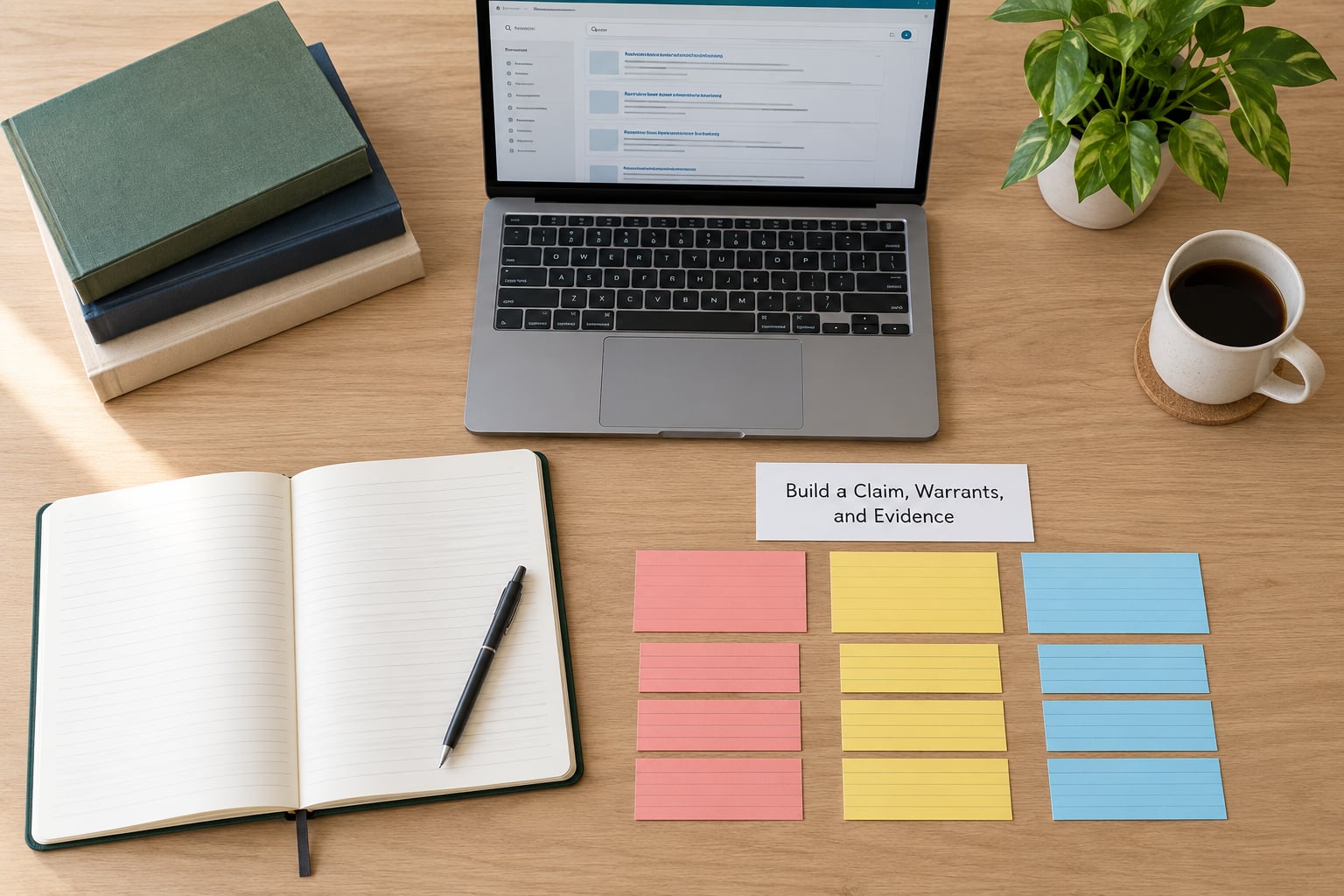
Your argument needs three connected parts: the claim you are making, the warrant that makes the evidence matter, and the evidence itself. If you cannot state why a source proves your point, you have collected information rather than built an argument.
The warrant is the quiet link that readers fill in for themselves, and it is where most student arguments break. A statistic about screen time says nothing about writing quality unless you supply the reason: screen time matters because the drafting process is the only stage a reader cannot recover later. Write that reason out explicitly, and the source starts doing work instead of merely appearing.
A usable thesis formula is: Although [counterposition], [your claim], because [reason supported by evidence]. Tested on the phone topic: “Although bans reduce classroom distraction, schools should allow phones during supervised study periods, because the academic benefits of unrestricted research outweigh the small loss in attention that bans are designed to prevent.” That thesis is arguable, specific and tells you which evidence you need.
Three weak theses to avoid: a fact (“Cell phone use has increased since the 2010s”), a generalization (“Banning phones is good”), and a question in disguise (“Should phones be banned?”). None of them can be proven wrong, which means none of them argue anything.
4. Create an Outline With a Logical Structure
Build your outline around claims, not sources. Listing sources as sections produces an essay that reads like a annotated bibliography with a conclusion stapled on. Instead, give each body section one claim and the two or three sources that support it.
A working structure: an introduction with context and thesis, two or three evidence-backed body sections, one counterargument section, and a conclusion that restates the position and names what follows from it. Each body section should follow the one before it logically: definitions first, then causes, then effects, then consequences.
A filled-in outline for the phone topic looks like this:
- Introduction: one sentence of context on classroom distraction, then the thesis stated in the last sentence.
- Body 1, bans reduce distraction: a classroom study on attention loss, plus a district audit on off-task behaviour.
- Body 2, research needs exist: a survey of students without home internet, plus an analysis on why unsupervised research is unequal.
- Body 3, supervision solves the enforcement problem: a policy analysis on classroom management under structured rules.
- Counterargument: exceptions erode the ban, conceded, then refuted with enforcement evidence.
- Conclusion: the position restated, plus one sentence on what schools should implement.
Notice that no section is titled after a source. Each is titled after what it proves, which is why the finished essay argues instead of listing.
5. Write Evidence-Based Body Paragraphs
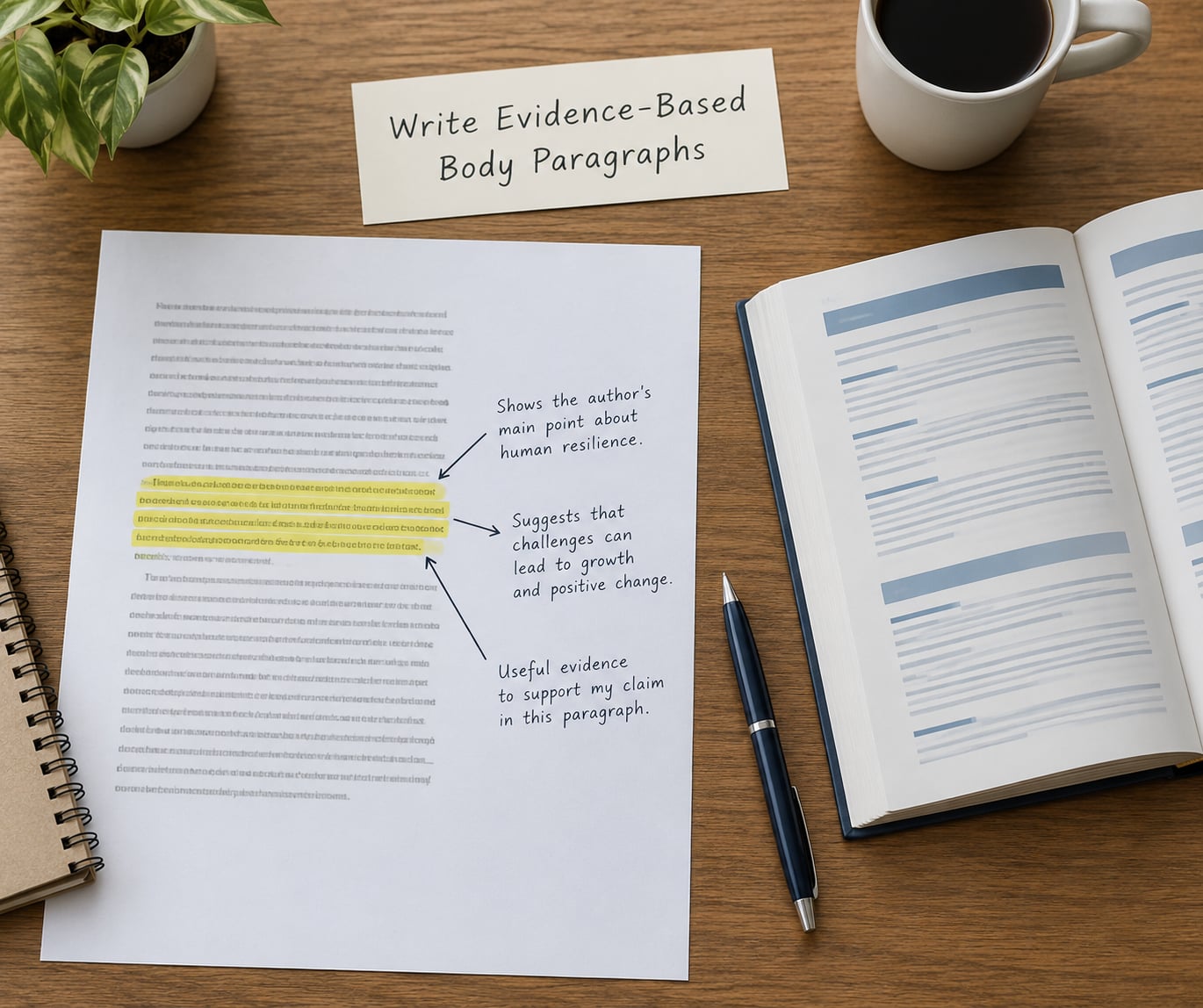
Each body paragraph follows the TEEL pattern: topic sentence, explanation, evidence, analysis, link. The topic sentence states the section’s claim. The explanation tells the reader why the claim is in doubt. The evidence is the source. The analysis explains how the evidence proves the claim. The link connects to the next section.
Introduce every source with a signal phrase that names the author and does work: “As Chen reports,” “According to a district audit,” “Rivera’s study found.” Never drop a quotation in bare. The phrase tells the reader whose idea this is and why it is here.
Quote sparingly and use the quote only for language you cannot improve on yourself. Keep quotations short, set off anything long as a block quotation, and always follow with analysis. Paraphrasing means rewriting the idea in your own sentence structure and your own words, then crediting the source; changing three synonyms while keeping the original word order is still plagiarism.
The underlying test is simple: after you finish the paragraph, every quotation you left in should be doing a job no paraphrase would do. Technical definitions, exact wording from a policy document, a striking phrase that carries your point, and disputed language you intend to analyse are worth keeping. Everything else reads faster and argues harder as your own sentences.
Here is the difference. Dropped in bare: “Students who take notes by hand retain more (Mueller 12).” Worked in: “Mueller’s classroom experiment found that students who hand-wrote lecture notes recalled roughly half as many misremembered details as those who typed them (12), which matters for exams that test application rather than recall.” Same source, but the second version explains what the finding does to the argument.
6. Address the Strongest Counterargument
A persuasive argumentative essay admits the best objection and defeats it. If you can find that objection in two minutes of conversation, your reader certainly can, and leaving it unaddressed makes the whole essay look naive.
Use the concede-and-refute move: state the opposing position in its strongest form, grant the part that is true, then explain why the rest does not hold. Writing “Some people think phones are fine, but they are wrong” builds a weak opponent nobody holds. Writing “Opponents argue that any allowance erodes the ban entirely, and that is fair, since rules with exceptions are hard to enforce, but supervised periods let schools hold the line while serving students who need research tools” takes the argument seriously.
If you cannot refute a point, narrow the claim instead of pretending it does not exist. That move reads as mature thinking rather than weakness.
Placement matters too. In longer essays, give the counterargument its own section near the end, immediately before the conclusion, so the reader sees you change your mind about the objection and then settle the question. In shorter essays, a paired paragraph works, provided the concession and the refutation stay balanced rather than the concession taking three sentences and the refutation one.
7. Cite Sources and Revise the Paper
In-text citations point to the source inside your argument; reference entries list the full details at the end. Both are required. A quotation with no in-text citation is not evidence, and an in-text citation with no reference entry is an incomplete source.
Yes, you should cite sources when writing an argumentative essay, every time you use someone else’s idea, data or wording, even when you paraphrase. MLA 9 uses author and page in parentheses, like (Chen 34) or (Mueller and Adeyemi 112). APA 7 uses author and year, like (Chen, 2024), and adds a page for direct quotations, like (Mueller & Adeyemi, 2024, p. 112). If no style was assigned, ask your instructor, then use the style your course has used all term.
Revise in five passes. First pass: does each paragraph prove one thing, and does the whole support the thesis? Second: is every source integrated and analysed rather than quoted and dropped? Third: does the counterargument get a fair hearing? Fourth: are citations consistent and present wherever borrowed material appears? Fifth: grammar, formatting and reference entries. Many students write a strong argument and lose marks in pass four.
Build the reference list from your notes rather than from memory, then verify each entry against the original source. Under MLA 9 an in-text (Chen 34) leads to a Works Cited entry beginning Chen, first name, then the article title in quotation marks, the container in italics, the publisher or journal, the year, and the page range. Under APA 7 an in-text (Chen, 2024) leads to a References entry beginning Chen, initials, the year in parentheses, the title of the work, and the source. Both styles are alphabetised by author surname and use a hanging indent.
Which Approach Should You Use?
Three argument structures suit different prompts. Aristotelian argues for one position and knocks down the others, Toulmin tests how well an evidence chain holds, and Rogerian finds the common ground first and argues from there. Most academic assignments want Aristotelian by default, so choose a different one only when the prompt calls for it.
| Approach | Shape | Best fit | Main risk |
|---|---|---|---|
| Aristotelian | Claim, evidence, refutation of the main opposing view | Persuasive essays, exam questions, prompts that ask you to take a side | A straw-manned opponent if you misread how strong the other position is |
| Toulmin | Claim, grounds, warrant, backing, qualifier | Analytical essays, science and business writing, prompts using “assess” or “evaluate” | The warrant goes unspoken, so the reader never sees the reasoning |
| Rogerian | Common ground, opposing concerns, shared ground, proposed position | Controversial policy topics, debates where both sides have real evidence | Becoming so conciliatory that the essay commits to nothing |
If you are unsure, ask one question: does the prompt want you to win, to weigh, or to persuade someone who may already partly agree? Win points to Aristotelian, weigh points to Toulmin, persuade points to Rogerian.
Common Mistakes
Most weak argumentative essays fail for the same handful of reasons, and each has a specific fix rather than a general “add more detail.”
- No thesis, or a thesis that cannot be disputed. Fix: write the formula from step 3 and test it by asking whether a reasonable person could disagree.
- Sources summarised instead of used. Fix: after each citation, add one sentence explaining what the evidence proves. If you cannot, drop the source.
- Unreliable evidence. Fix: apply the five-point check from step 2, and prefer peer-reviewed research over commentary on it.
- Quoting when you should be explaining. Fix: keep quotes under about ten words and paraphrase the surrounding argument in your own voice.
- Springboarding: quote, drop the quote, move on. Fix: a quote needs a signal phrase, an explanation and a link. Remove any quote that only repeats what the next sentence already says.
- A one-sided essay. Fix: add a counterargument section and take the best version of it.
- Too many quotations. Fix: if quoted material makes up more than a small share of the body, convert most of it to paraphrase and analysis.
- Inconsistent or missing citations. Fix: check every sentence containing borrowed material against your reference list, in both directions.
- Blocks of text with no transitions. Fix: give each section a link sentence so the reader always knows why the next paragraph is there.
Logical fallacies are the fastest self-edit. Look for appeal to authority (someone famous said so), false dilemma (only two options exist), slippery slope (one small step leads to catastrophe), straw man (attacking a weak version of the opposing view), hasty generalization, and circular reasoning (the argument assumes its own conclusion). Cut or repair each one you find.
Before you submit, read the draft once with this checklist beside you and tick what you can find in the text, not what you remember writing. The point is to catch what you stopped seeing after the fourth draft.
- Does the thesis appear in the introduction’s last sentence, and is it arguable?
- Does each body paragraph contain exactly one claim?
- Does every quotation have a signal phrase before it?
- Does every quotation have analysis after it?
- Is every factual claim backed by a source, with no borrowed ideas uncited?
- Do the in-text citations and the reference list match in both directions?
- Is the page format correct for quoted material in your chosen style?
- Is the strongest opposing view stated fairly and then addressed?
- Does every section link to the next, or does the reader have to guess why it is there?
- Is the conclusion more than a restated thesis?
- Does the whole paper answer the actual direction word in the prompt?
Working from a required reading list instead of choosing your own topic, a common high-school arrangement, has its own trap. Use every assigned source unless your instructor says otherwise, but give each one a job in your outline rather than a section of its own. A reading list shows you what the discussion contains, not how to organise it, and students who try to cover seven sources equally end up with seven summaries and no argument.
Frequently Asked Questions
How many sources should an argumentative essay use?
Match the count to the length. A 500-word essay usually needs three or four sources, a 1,000-word essay five to seven, and a 2,000-word essay seven to ten. Seven sources for a 2,000-word paper is reasonable, provided each one is discussed and analysed rather than dropped in a sentence. If your instructor gives a number, that number wins.
Can I quote sources in an argumentative essay?
Yes, and you should, especially for striking wording or a finding you want to state exactly. Introduce each quotation with a signal phrase naming the author, keep short quotations inside your sentence, set longer ones as a block quotation, and add your analysis immediately after. A quotation with no explanation is decoration, not evidence.
How do I paraphrase a source without copying it?
Close the source, write the idea from memory in your own sentence structure, then check it against the original for accuracy. Change more than synonyms: swap the order of ideas and use terms natural to your argument. Credit the source either way, because paraphrasing an idea still requires a citation.
Should every body paragraph include a citation?
In practice, yes. If a paragraph contains no citation, either it is your own reasoning, which is fine in moderation, or you are making a factual claim without support. Aim for one citation roughly every 100 to 150 words of body text so evidence appears steadily rather than in bursts.
How long should an argumentative essay be with sources?
Length is set by your instructor, and the common academic ranges run from 500 to 2,000 words. Whatever the number, leave room for a real counterargument section and a reference list. A shorter essay with five well-analysed sources beats a longer one padded with quotations.
How do I include a counterargument in an argumentative essay?
State the strongest opposing position fairly, concede whatever is genuinely true in it, then explain with evidence why the rest does not hold. Give it its own body section or a paired paragraph near the end. Avoid weak opponents, because readers can tell when a counterargument was built only to be knocked down.
Conclusion
Start by fixing your claim and then testing each source against it, because a source that does not prove your point is only delaying the draft. Do one concrete thing before you write the paper: outline a single evidence-backed paragraph with a topic sentence, one source, one analysis sentence and a link sentence.
If that one paragraph proves your thesis works, the rest is assembly. These steps still hold as 2026 arrives with its own quirks: claim first, evidence second, citation always.