Poetry is hard to understand because we read it with the wrong habits. Our brains are trained to hunt for facts, plots and sequential arguments, while poems squeeze feeling, image and idea into very few words. Meaning is carried by line breaks, sound and ambiguity as much as by the definitions of the words, so there is rarely one plain sentence you can point at and call the message.
That mismatch is why a poem can be five lines long and still resist you for a week. In a thread on r/Poetry, one reader put it plainly: she was in her thirties and still only understood the poems that rhymed or had a set number of syllables. On r/books, another described hunting for the rhyme scheme first, then realising the counting had pulled her attention away from the actual words.
Both readers were doing something reasonable with an unreasonable set of instructions. Reading poetry is a skill, not a test of intelligence, and most people are never shown how to practise it. Here is what is actually going on, and a method that works.
Table of Contents
- Why Poetry Is Hard to Understand: Six Reasons Readers Get Stuck
- Why Poetry Is Hard to Understand on the First Read
- How Do Poets Create Meaning in Difficult Lines?
- Which Poetry Techniques Often Cause Confusion?
- How Can You Read a Difficult Poem?
- When Does Historical or Cultural Context Help?
- When Should You Ask for Help With a Poem?
- Frequently Asked Questions
- Is every poem supposed to be hard to understand?
- Why does poetry use fewer words than prose?
- How do you analyze a poem when you do not understand it?
- Does a poem have only one correct interpretation?
- When should I look up the biography of a poet?
- Conclusion
Why Poetry Is Hard to Understand: Six Reasons Readers Get Stuck
- Compression. A novel spends four pages setting up a room. A poem spends one line and assumes you can hold it. Everything a poet wanted to say has to fit inside a very small container, so context, transitions and explanation get cut.
- We read literally by default. Prose tells you what happened. A poem usually shows you an image or a feeling and leaves the naming to you, which feels like the writer refusing to finish the sentence.
- Figurative language is standard, not decoration. Metaphor, simile and imagery are the working parts of most poems. A beginner who reads “the road split in yellow wood” as describing two roads in a forest misses that it is about a choice.
- Ambiguity is the medium. Poets leave words open on purpose. An image can support several meanings at once, and settling on one too early closes off the ones you had not seen yet.
- Syntax gets bent. Line breaks, inversion and dropped subjects break the tidy subject-verb-object shape your brain expects. A sentence can run across three lines before you learn who is speaking.
- Conventions arrive without instruction. A sonnet has fourteen lines because it does, not because the number carries a secret code. Unfamiliar forms feel like barriers when nobody has explained the convention.
The pattern in all six is that the poem is working, and the reader is looking in the wrong place. Change where you look and most of the confusion loosens.
Why Poetry Is Hard to Understand on the First Read
Some difficulty is deliberate. A poem that hands over its meaning in one pass has not really done any work. Line breaks that suspend a sentence, an image that resolves two ways, a rhyme that lands a beat late: those are choices, not mistakes.
Obscurity is different. Obscurity is when a text gives you nothing to hold, and that is rarer than beginners think. Most confusion that feels like a locked door is really a habit of reading that has not been tested against the poem yet.
University literature programs often use a three-readings method, and it works for everyone. Read once for the bare impression with no analysis at all. Read a second time marking what shifts, repeats or surprises you. Read a third time for sound, ideally aloud. A fourth pass aloud catches things the silent readings missed, because your ear registers repetition and pause faster than your eye does.
Readers report that things often click somewhere between the second and third read, sometimes years later. That is not failure. It is the ordinary timeline of learning a new form.
How Do Poets Create Meaning in Difficult Lines?
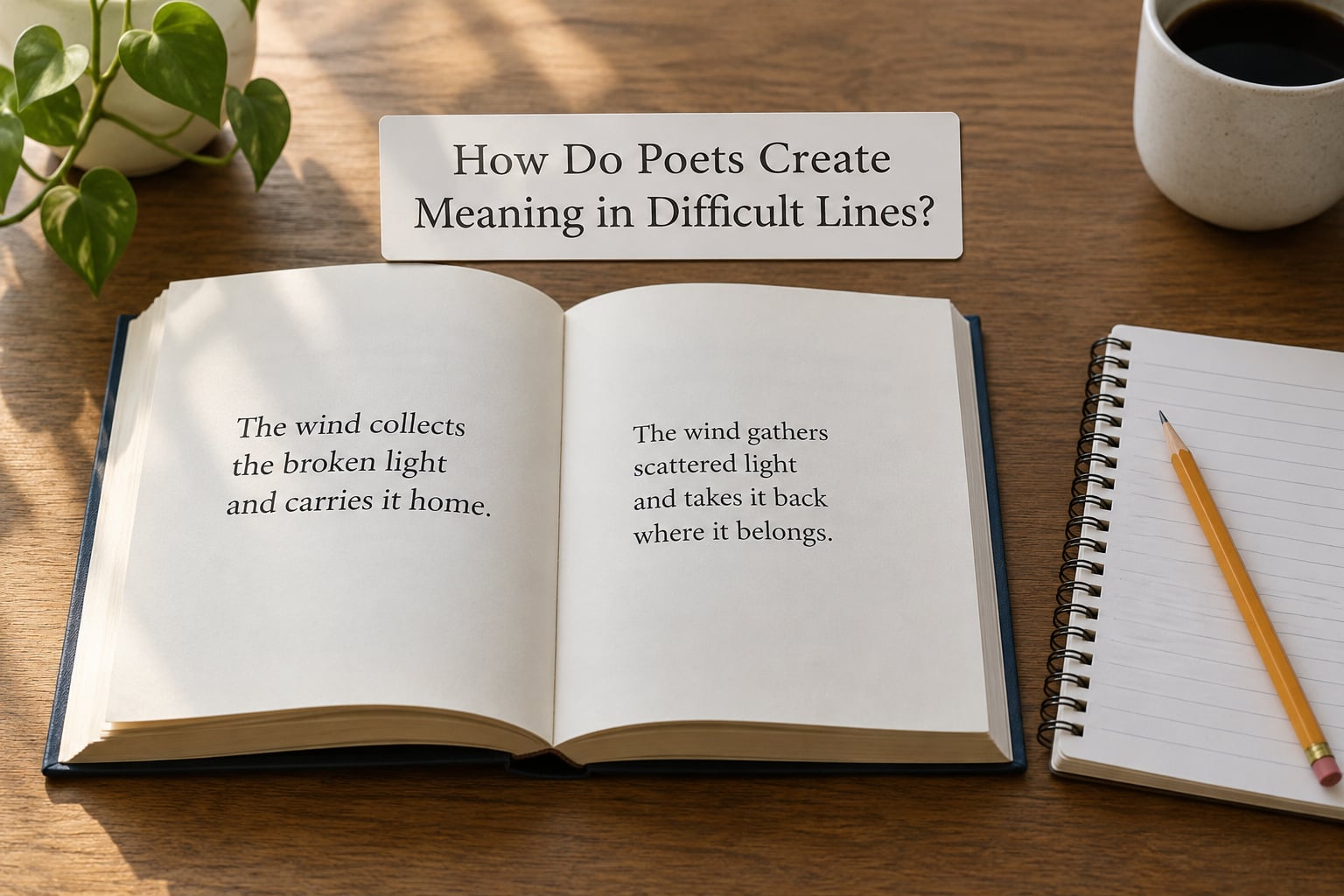
Meaning in a poem is distributed across several channels at once: what the words denote, what the images suggest, how the lines are broken, and how the lines sound. Read only the first channel and you get a paraphrase of the surface, which is often thin.
Emily Dickinson’s opening stanza, from a poem published in 1891, compresses an entire inner life into six lines:
I dwell in Possibility —
A fairer House than Prose —
More numerous of Windows —
Superior — for Doors —
Literal reading: the speaker lives somewhere better than ordinary prose. Figurative reading: the speaker lives inside a mind, and poems are the windows and doors into it. The dash after “Possibility” is doing work too, because it makes the claim feel like it is still arriving rather than already settled.
The same technique scales up. Diction sets the temperature, imagery supplies the world, sound supplies the pacing, and the break between lines supplies the suspense. When they agree, a poem feels inevitable. When they pull against each other, that tension is usually the point.
One more habit pays off fast: separate the speaker from the poet. The voice in a poem may be a grieving parent, a historical figure, a child, or a deliberately unreliable narrator. A poem where a speaker says “I” is not the author confessing anything. Conflating the two is one of the most common sources of misreading.
Which Poetry Techniques Often Cause Confusion?
Most of the vocabulary that makes poetry seem intimidating is a set of ordinary observations with technical names. Learn these eight and the glossary stops feeling like a wall.
| Technique | What it does | Why readers get stuck | Question to ask |
|---|---|---|---|
| Line break and enjambment | Marks where the poet wants you to pause | Reading stops at the end of a line, so meaning is missed | What happens if I carry the sentence across the break? |
| Stanza | Groups lines into blocks | The break feels arbitrary when the shift is tonal, not plot-driven | What changes between this group and the last? |
| Metaphor and simile | Says one thing by describing another | It gets read as a factual statement about the literal thing | What is being compared, and to what? |
| Imagery | Builds a sensory world | Detail is taken as plot rather than atmosphere | What can I see, hear, or smell here? |
| Volta (turn) | Marks a shift in argument or feeling | It is not labelled, so it passes unnoticed | Where does the poem change direction? |
| Caesura | A pause inside a line | It only exists in sound, so silent readers lose it | What does my voice want to pause on? |
| Meter and rhyme scheme | Sets rhythm and expectation | Counting syllables becomes the whole task | Does the sound carry meaning, or only shape? |
| Free verse | Uses no regular metre or rhyme | Readers see no structure and assume none is operating | What is organising the lines if not rhyme? |
Free verse deserves its own note because it is the modern default and the most common source of “there is nothing here.” Free verse still has structure: line length, repetition, stanza shape, and the placement of the turn. The structure is there, it just is not wearing a rhyme scheme.
How Can You Read a Difficult Poem?
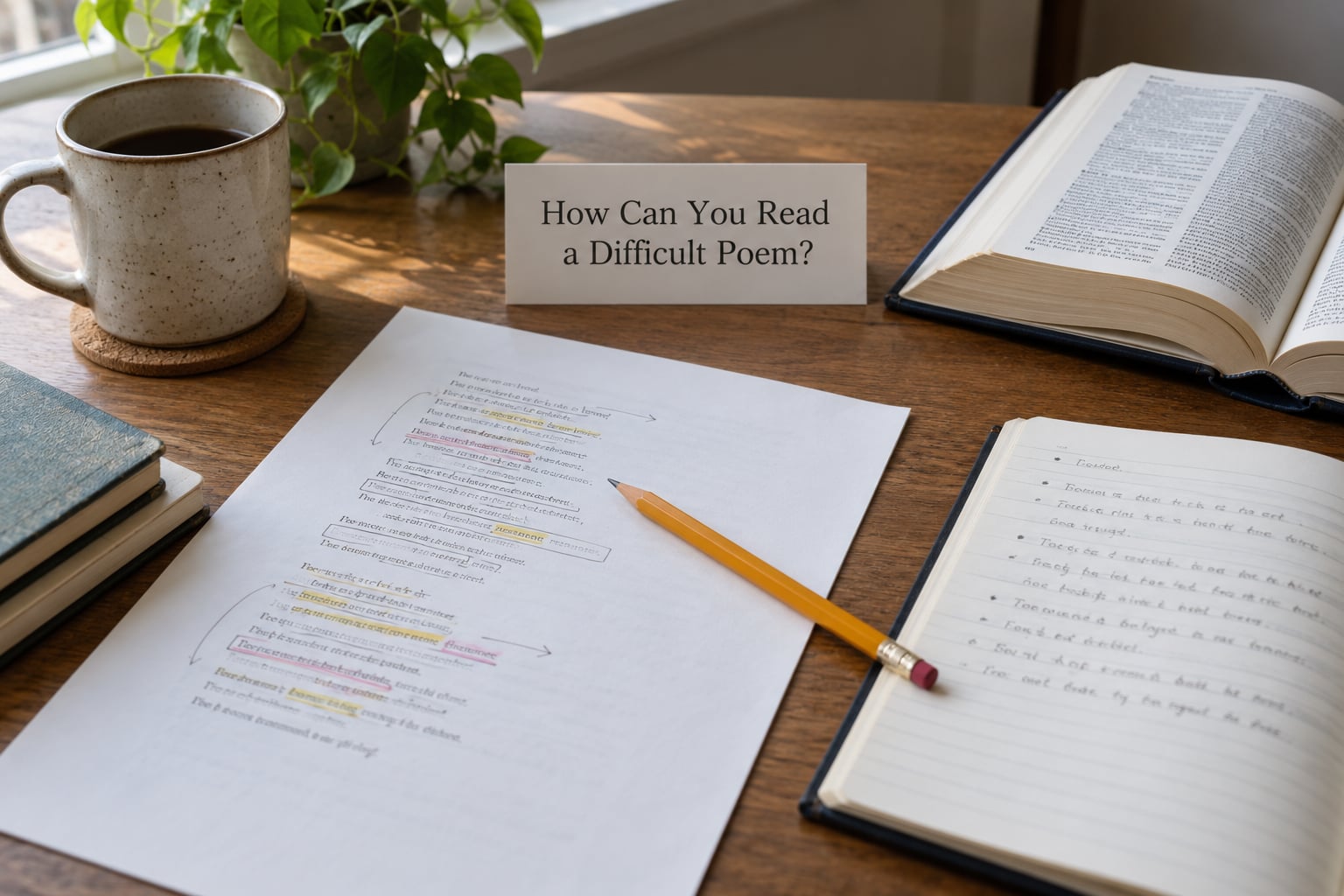
Use a fixed sequence so you are not improvising. Six steps, in this order, get you from blank to a defensible interpretation in about twenty minutes for a short poem.
- Read it aloud, twice. Your voice will stumble in the informative places. Where you naturally pause or run out of breath is where the poet put weight.
- Describe before you interpret. Write what happens in the poem using only literal language. “A person walks through a house at night and cannot sleep.” Resist meaning for this step; you are building the floor to stand on.
- Mark the shifts. Circle every place the poem changes direction, speaker, tense or time. Those marks are your evidence later.
- Track the images. List the repeated or vivid things and ask what each one does. An image that recurs four times is a structural element, not decoration.
- Look up only what blocks you. An unfamiliar word, a historical reference, a myth. Use a dictionary, not an essay on the poet’s life. Reading about a poet before you have read the poem tends to replace your interpretation with theirs.
- Test a reading against the whole. Say what the poem means in one sentence, then check whether every stanza supports it. If a stanza resists, your reading is probably too neat.
That last check is the real skill. Anyone can find a clever link between two lines. What matters is whether the reading holds for the poem you actually have, including the awkward stanza you would rather skip.
For longer work, annotate as you read. Underline the phrase that repeats, note the turn, and write your one-sentence reading at the bottom. Annotation turns confusion into something you can revise, and it is also the fastest route to material for an analysis essay.
When Does Historical or Cultural Context Help?
Context helps most when the poem refers to something you cannot look up in a dictionary: a war, a myth, a religious text, a social custom, or a word that has drifted out of everyday use. In those cases, five minutes with a reference will unlock a stanza that no amount of rereading could.
Context hurts when it replaces the poem. Knowing a poet’s biography is interesting and occasionally explains a theme, but plenty of poems contradict what the poet said in an interview. Reading the biography first tends to send you hunting for a statement the poem never makes.
A workable rule: read the poem first, note what it refuses to explain, then go and look up exactly that. Let the poem set the research agenda rather than the other way round.
When Should You Ask for Help With a Poem?
Ask when the gap is knowledge rather than sensitivity. If you cannot identify a word, a date, a myth or a language convention after trying, another ten minutes will not help and a teacher or study group will. The same goes when the assignment asks about a period, movement or form you have never met.
Bring a specific question rather than “I don’t get it.” Try: “What is happening in the fourth stanza, where the speaker seems to change?” or “Is this persona doing something the poem never explains?” Specific questions get useful answers, and they also show the teacher where your reading broke.
The other half of asking for help is knowing what you are asking for. Some poems are genuinely beyond a reader for now, and a good tutor will say so rather than hand you a reading that sounds authoritative.
Frequently Asked Questions
Is every poem supposed to be hard to understand?
No. Some poems are plainspoken and easy to read, and plenty of difficult poems are only hard because of a missing reference or an unfamiliar form. Difficulty is often an effect rather than a measure of quality. If a poem stays opaque after three readings, checking the technique glossary and asking one specific question will tell you whether you are missing a convention or genuinely facing a work meant to resist paraphrase.
Why does poetry use fewer words than prose?
Because density is the point. A poet spends a line on what a novelist would spend a page on, because the image, the line break and the rhythm are all carrying part of the meaning at once. Cutting words forces each one to work harder and stops the reader from skimming. That compression is also why poems feel heavier per word than prose, and why one vague line can undo the clarity of the other ten.
How do you analyze a poem when you do not understand it?
Work from evidence outward rather than from meaning inward. Read aloud, write a literal description of what happens, mark the shifts, and list the recurring images. Then test a one-sentence interpretation against the whole poem and see which stanzas resist it. Analysis built this way does not require understanding first, so it produces an interpretation you can refine later instead of waiting for a meaning to appear.
Does a poem have only one correct interpretation?
Good poems usually sustain several defensible readings, and the quality of an interpretation depends on the evidence you can point to rather than on matching a single right answer. In a classroom there may be an expected reading, so ask what the writer wants from you. In your own reading, hold the interpretation loosely and let a later stanza overturn it if the evidence demands.
When should I look up the biography of a poet?
Look up biography after you have read the poem, and only when the poem asks a question about the poet’s own life. Biographies explain circumstances, but plenty of poems contradict what a poet said in an interview, and knowing the life too early encourages you to hunt for a statement the poem never makes. If a poem refers to a specific event, myth or period, that reference is a better use of research time than the personal history.
Conclusion
Difficulty in poetry is usually a mismatch between reading habits and poetic form, not a shortage of intelligence on your side. The habit that fixes most of it is simple: read the poem aloud, describe only what happens, mark what shifts, and form one question before you look up anything.
Give a poem three reads before you decide it means nothing. More often than not, the meaning was there on the second.