Alliteration repeats the same consonant sound at the start of nearby words. Assonance repeats the same vowel sound anywhere in nearby words. One is a repetition you hear at the beginning of words, the other is a repetition you hear deep inside them, and confusing the two is the single most common error in poetry analysis.
Here is alliteration vs assonance explained the way it is actually tested: sound, not spelling, is the deciding factor. Read the two definitions below, run the read-aloud test on any line you meet, and the difference sticks within a lesson.
Both devices belong to a family of sound patterns that poets use to control rhythm, emphasis and mood. Once you can name which one a line contains, you can say what the poet gained by it, which is the part most answers leave out.
Table of Contents
- Alliteration vs Assonance at a Glance
- What Is Alliteration?
- What Is Assonance?
- Alliteration vs Assonance: The Key Differences
- How to Tell Alliteration and Assonance Apart
- Alliteration vs Assonance Examples in Poetry
- Alliteration vs assonance examples: how the same line does both
- Common Mix-Ups and Easy Memory Tricks
- Which Should You Choose?
- Frequently Asked Questions
- What is the difference between alliteration and assonance?
- Can a word have both alliteration and assonance?
- Is repeated vowel sound always assonance?
- Does alliteration have to use the same consonant letter?
- How can I identify these devices when reading a poem?
- Are consonance and assonance the same thing?
- Conclusion
Alliteration vs Assonance at a Glance
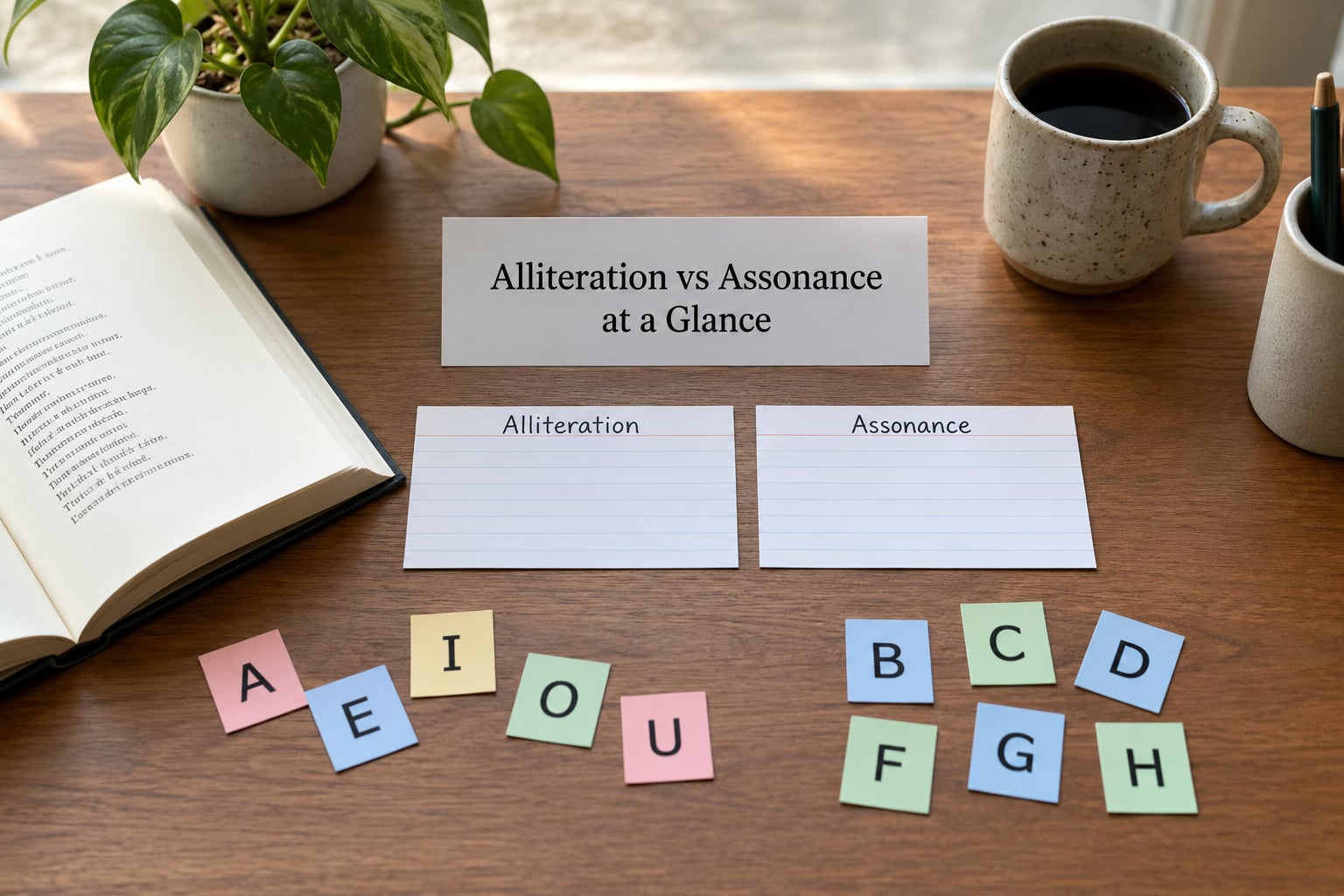
The table below is the whole distinction on one page. Read across the rows rather than down the columns and the two devices separate cleanly.
| Point of comparison | Alliteration | Assonance |
|---|---|---|
| What repeats | A consonant sound | A vowel sound |
| Where it repeats | At the first sound of each word | Anywhere in or at the end of each word |
| Spelling rule | Letters may differ as long as the sound matches | Letters may differ or match; only the sound counts |
| Typical effect | Emphasis, energy, memorability | Mood, musical flow, an internal echo |
| How it is heard | On the stressed first beat of each word | Across the line, often on unstressed syllables |
| Canonical example | Peter Piper picked a peck of pickled peppers (/p/) | The rain in Spain stays mainly in the plain (/a/) |
| Also called | Consonantal alliteration | Vowel rhyme, vocalic alliteration |
| Quick test question | Do the words start with the same sound? | Do the words share the same vowel sound? |
Two details in that table do most of the work. Position is the first split: a repeated consonant counts as alliteration only when it opens each word, while a repeated vowel can sit at the start, middle or end of a word and still count as assonance. The second split is that neither device requires matching letters.
What Is Alliteration?
Alliteration is the repetition of the same initial consonant sound in two or more nearby words. The sound has to arrive first in each word, and it has to be a consonant.
Here is how it works in practice:
- Peter Piper picked a peck of pickled peppers (repeated /p/ at the start of each word).
- Betty Botter bought some butter (repeated /b/, all four words opening on it).
- She sells seashells by the seashore (repeated /s/, a long run that makes the line hiss).
- William Blake’s “Tyger Tyger, burning bright” repeats the hard /t/ across the first two words and again in “bright”.
- Emily Dickinson’s “Tell all the truth but tell it a slant” opens Tell, truth and tell on /t/, while the two “the”s in the line start on /ð/, not /t/.
Now the caveat that trips people up. Alliteration is a repetition of sounds, not of letters. “Big blue balloon” is alliteration because both words begin with the /b/ sound, even though only one of them is spelled with a b. “Kind cat” is alliteration for the same reason. But “kind knight” is not, because the k in knight is silent and the two words do not share a first sound at all.
That is why “kind cat” and “kind knight” sit side by side in so many classroom handouts. The spelling looks identical. The sound is not.
A second point worth holding onto: alliteration usually lands on stressed beats. Poets place the repeated consonant where the line already has weight, which is why a run of alliteration can feel punchy rather than merely decorative.
What Is Assonance?
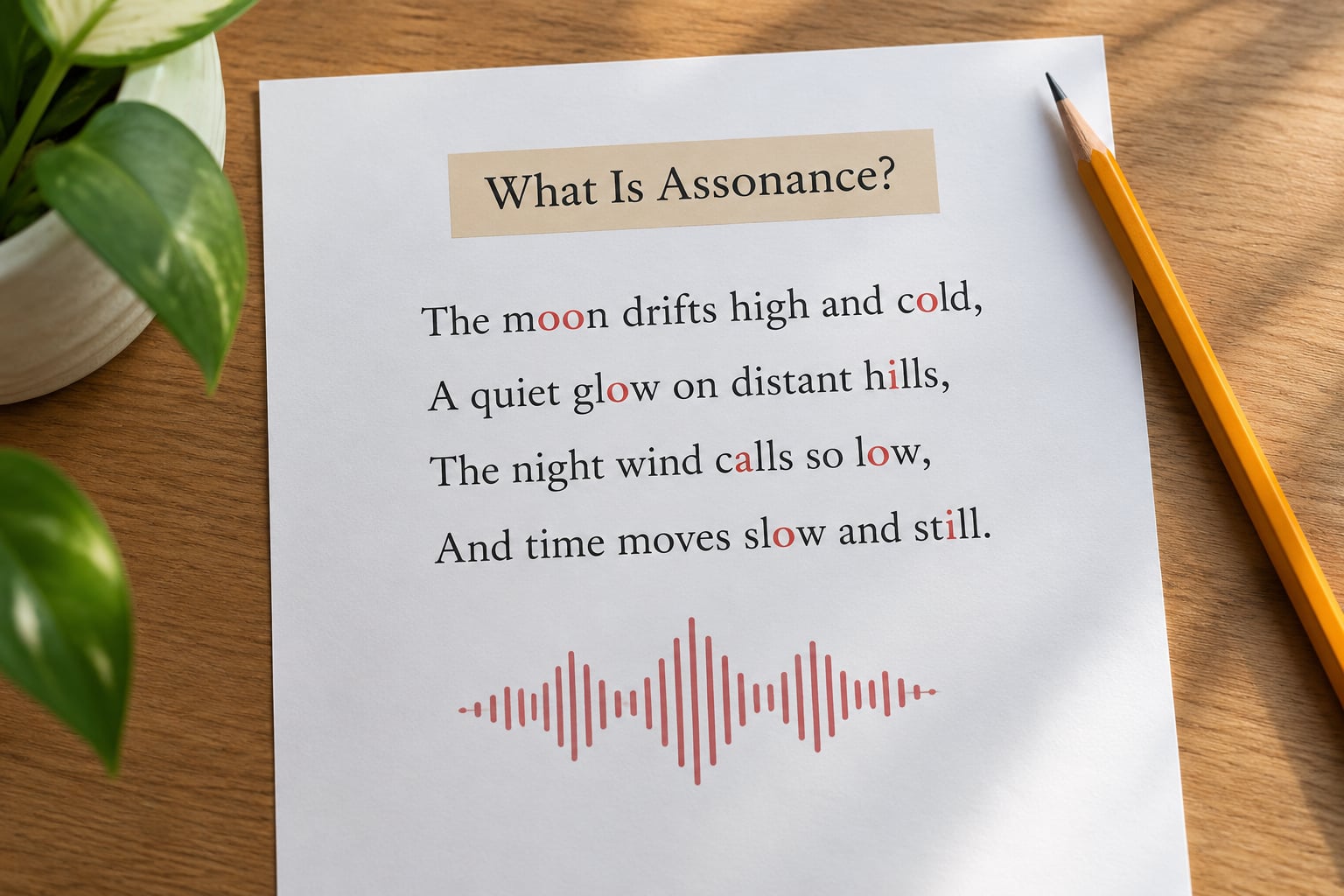
Assonance is the repetition of the same vowel sound in two or more nearby words, wherever the sound falls inside them. Because the position is free, assonance is the easier device to miss and the harder one to name correctly under test conditions.
Here is how it works in practice:
- The rain in Spain stays mainly in the plain (long /a/ carried through five words).
- Try as I might, the kite did not fly (long /i/ repeated across four words).
- Blue blood (the long /u:/ vowel in both words).
- “A Slumber Did My Spirit Seal” by Yeats, where the long /i:/ carries through slumber, spirit, seal, night and life.
- Brand names built on a single vowel, such as Coca-Cola, where the /o/ sound gives the name its bounce.
Note what is different from alliteration. Nothing needs to line up at the start of a word. Assonance can hide in the middle of a line, at the end of a word, or on a syllable nobody would stress, and it still counts.
Assonance is also not rhyme. Rhyme repeats a sound beginning from the final stressed syllable of a word, and it is heard at the ends of lines. Assonance repeats a vowel wherever it appears, including in the middle of a line. That is why “The rain in Spain stays mainly in the plain” is assonance even though the two end-words rhyme.
One more distinction. Assonance is not the same as consonance. Assonance repeats vowel sounds; consonance repeats consonant sounds anywhere in a word, not necessarily at the start. A teacher once described it neatly: assonance begins with a vowel, so it deals with repeated vowel sounds, and consonance begins with a consonant, so it deals with repeated consonant sounds within the word. Alliteration is the remaining case, where the repeated consonant sits at the start of every word.
Alliteration vs Assonance: The Key Differences
Four differences do the real work: what repeats, where it repeats, how the ear catches it, and what the poet gains.
1. The sound. Alliteration repeats a consonant. Assonance repeats a vowel. This is the simplest split and the one most tests turn on.
2. The position. Alliteration is positional. The repeated consonant must open each word, which is why “settle, soft, silt” works and “soft, settle, silt” is only partly alliteration. Assonance is positional in no way at all. A vowel at the start, middle or end of a word counts equally.
3. How you hear it. Alliteration announces itself. It arrives on the downbeat of every word, so you notice it on a first read. Assonance is subtler, because the repeated vowel often sits on an unstressed syllable and only becomes audible when the line is read aloud at a natural speed.
4. What it does for the poem. Alliteration is good for emphasis. It sharpens a key word, drives a rhythm forward and makes a phrase stick, which is why it dominates tongue twisters and picture books. Assonance is good for mood. Its repetition creates a sustained tonal colour that runs underneath the sense of the words, which is why it shows up in lyric poetry, in song lyrics and in the long vowel shapes of brand names.
Those effects overlap. A repeated consonant can also produce a mood, and a repeated vowel can also give a line punch. The devices are different in kind, not in usefulness.
A practical test settles most cases. Ask whether the repeated sound is a consonant at the beginning of each word. If yes, it is alliteration. If the repeated sound is a vowel anywhere in the words, it is assonance. Some lines answer yes to both questions, and that is not a mistake.
Emily Dickinson’s “Tell all the truth but tell it a slant” gives you alliteration on /t/ across the opening words and assonance on the short /a/ that runs through “all”, “truth”, “slant” and “that”. The devices are not mutually exclusive, and hunting for a single label when both are present is how students lose marks.
How to Tell Alliteration and Assonance Apart
Use a three-step routine and you will never swap them again. It takes about forty seconds per line and works on any poem, textbook extract or exam paper.
Step 1: Read the line aloud, at normal speed, without stopping. Sound devices are heard, not seen. If you are scanning the line with your eyes for repeated letters, you will get the wrong answer, because the spelling frequently disagrees with the sound.
Step 2: Find the sound that repeats. Circle the first word that sounds odd, repetitive or emphatic, then look at the next two or three words. Ask which single sound keeps turning up.
Step 3: Ask where the sound sits. If it is a consonant at the start of each word, you have alliteration. If it is a vowel, it does not matter where in the word it appears, and you have assonance. If you find a consonant repeating in the middle or end of words, that is consonance.
The read-aloud step is the one people skip, and it is the one that carries the whole routine. Eyes match on letters; ears match on sounds. Readers who work fast on poetry do the reading silently in their head first, which is faster than any diagram.
Here is the routine applied to a line. Take “The fair breeze blew the white foam flew”. The repeated /b/ sound opens breeze, blew and both instances of flew, so the line is alliterative, and the repetition gives it the rocking rhythm of a boat. Now take “Slowly the waves, white and wide”. The long /i/ sound in slowly, white and wide is a vowel, so the line is assonant, and the repetition of that vowel smooths the movement across the water.
When a line does both, name both and say what each one contributes. That single habit is worth more on an exam than recognising either device in isolation.
Alliteration vs Assonance Examples in Poetry
Examples stick faster than definitions, so here is a bank you can read aloud. The repeated sound is named after each line so you can check your own reading against it.
Alliteration:
- “Six silent swans swam slowly southward” (repeated /s/ across every word).
- “Great guns, galloping geese” (/g/ throughout, a phrase built purely to trip the mouth).
- Poe’s “Once upon a midnight dreary, I pondered weak and weary” (/w/ opening weak and weary).
- Blake’s “Tyger Tyger, burning bright” (/t/ across tyger, tyger and bright).
Assonance:
- “The rain in Spain stays mainly in the plain” (long /a/ through five words).
- “Blue blood, red blood” (long /u:/ and the short /e/ that follows it).
- Yeats’s “A Slumber Did My Spirit Seal”, where the long /i:/ recurs in slumber, spirit and seal.
- “Face the rain” (long /a/ in both, a phrase that sounds like weather and reads like it too).
Context changes what the repetition does. In a nursery rhyme, alliteration is play: the tongue is the point, and the words barely matter. In an elegy, the same device can be grief made audible, and the reader hears weight rather than fun. Assonance behaves the same way. The long /o/ in a line about a storm sounds unsettled; the same vowel in a line about a child sounds drowsy and warm.
Alliteration vs assonance examples: how the same line does both
Look at “The sleek sleeker sheep slid past the slope”. The /s/ opening sleek, sleeker, sheep, slid and slope is alliteration, and the /ee/ vowel in sleek, sleeker and sheep is assonant. Both are present, working on different parts of the same line.
Frost’s “The woods are lovely, dark and deep” is a cleaner case. Dark and deep open on /d/, which is alliteration, while the long /o/ shared by woods and lovely is assonance, and the /ee/ at the end of deep picks up lovely’s vowel sound again. One line, two devices, and the second one only shows up when you read it out loud.
Common Mix-Ups and Easy Memory Tricks
Four devices get swapped for one another, and a single table settles the lot.
| Device | What repeats | Where | Example |
|---|---|---|---|
| Alliteration | Consonant sound | Start of each word | Betty Botter bought some butter |
| Consonance | Consonant sound | Middle or end of words | A little lamp with a white flap |
| Assonance | Vowel sound | Anywhere in the words | The rain in Spain stays mainly in the plain |
| Rhyme | Sound from the stressed syllable out | End of words and lines | moon and June |
| Sibilance | S, sh, z or ch sounds | Anywhere | The seals sang softly |
| Onomatopoeia | A sound imitating a thing | A whole word | The kettle hissed |
Sibilance and onomatopoeia are worth adding to the list because they turn up in the same exam questions. Sibilance is a narrow, hissing subset of consonance. Onomatopoeia is not repetition at all; it is imitation, which is why “hiss” is onomatopoeia and “silence” is not.
Now the mix-ups that cost marks, and the fix for each.
Matching letters instead of sounds. The fix: say it out loud. “Big blue” is alliteration; “kind knight” is not.
Treating every repeated vowel as rhyme. The fix: rhyme lives at the end of a line and starts from the stressed syllable. Repeated vowels in the middle of a line are assonance.
Missing assonance because nothing looks repeated. The fix: underline the vowel letters and then say the line. Repeated letters are rare; repeated vowel sounds are everywhere.
Counting near-misses. The fix: if the vowel sound changes, it is not assonance. “Open” and “often” are near neighbours, not matches. Hold the line to one clean sound.
Forcing alliteration into every stanza. The fix: alliteration earns its place when it emphasises. Used in every line, it becomes noise and the reader stops hearing it.
For a memory routine that sticks, teach it as a sequence rather than a pair. Alliteration is a sound at the door, consonance is a sound in the hall, assonance is a sound in the air, and rhyme is the sound at the end of the road. Four images, four positions, and students who can place the sound can name the device.
Which Should You Choose?
Pick the device that matches what you need the line to do, not the one that sounds cleverest.
Choose alliteration when you need emphasis, a punchy rhythm, or a phrase that will be remembered. It suits tongue twisters, children’s writing, slogans and any line where one word should hit harder than the rest.
Choose assonance when you need mood, continuity of tone, or an undercurrent that binds a line together without repeating a word. It suits lyric poetry, song lyrics, haiku and limericks, where a single held vowel can carry the emotional colour.
When you are analysing rather than writing, use alliteration as the signal that a poet wanted you to notice a specific word, and assonance as the signal that a poet wanted you to notice a feeling. That framing turns a definition into an argument, which is what an exam answer needs.
If you are revising your own poem, pick one sound and hunt for same-meaning words that carry it. A fourth consonant in a line of alliteration, or a third long vowel, is usually enough to make the pattern audible. Change one word, not the whole line.
Frequently Asked Questions
What is the difference between alliteration and assonance?
Alliteration repeats a consonant sound at the start of nearby words. Assonance repeats a vowel sound anywhere in nearby words, including the middle and the end. So Peter Piper picked a peck of pickled peppers is alliteration, and The rain in Spain stays mainly in the plain is assonance. The sound decides, not the spelling.
Can a word have both alliteration and assonance?
Yes, and lines do it constantly. In Tell all the truth but tell it a slant, the opening t sounds are alliteration and the repeated a vowel is assonance. A single word can also carry both, if it begins with a consonant and contains a vowel that matches its neighbours. Name both devices when both are present rather than forcing one label.
Is repeated vowel sound always assonance?
Not always. If the repeated vowel carries matching consonants from the stressed syllable to the end of a word, that is rhyme. Rhyme is heard at the ends of words and lines, while assonance is heard wherever the vowel falls, including mid-line. Try as I might, the kite did not fly is assonance; might and kite rhyme as well, which makes it both.
Does alliteration have to use the same consonant letter?
No. Alliteration repeats a sound, not a letter. Big blue balloon is alliteration because all three words begin with the b sound, even though the spelling of balloon begins differently. The reverse also holds: kind knight looks like alliteration on paper, but the k in knight is silent, so the two words share no opening sound and it is not alliteration at all.
How can I identify these devices when reading a poem?
Read the line aloud at normal speed without stopping. Find the sound that repeats, then ask where it sits. A consonant at the start of each word is alliteration. A vowel anywhere in the words is assonance. A consonant in the middle or end of words is consonance. Reading aloud matters because the ear matches on sounds while the eye matches on letters, and those two often disagree.
Are consonance and assonance the same thing?
No. They are opposites in one respect: consonance repeats consonant sounds, assonance repeats vowel sounds. Consonance can appear anywhere in a word, while alliteration is the special case where the repeated consonant opens each word. The pair is easy to separate once you hold the test question: is the repeated sound a vowel or a consonant, and where in the word does it sit?
Conclusion
Alliteration repeats a consonant sound at the start of nearby words. Assonance repeats a vowel sound anywhere in nearby words. Everything else in this guide is a detail hanging off those two sentences.
Start with one exercise: take a poem you have already read and read three lines of it aloud, marking only the sounds that repeat. Write down whether each one is a consonant at the start of a word or a vowel anywhere in a word. Ten minutes of that is usually enough to make alliteration vs assonance permanent, and it is the first thing to do with any new poem.
Once the sounds are named, close reading gets easier. You stop asking what the device is and start asking what it did, which is where the real understanding of a poem lives.