To teach close reading step by step, choose one short, demanding text, read it multiple times for a different purpose each time, and have students annotate, discuss, and write a claim backed by evidence from that text. One lesson runs 45 to 60 minutes, or split it across two or three days.
Close reading is a skill most students arrive at already half-trained. They have read texts before, of course, but they have rarely been taught to slow down and return to the same paragraph three times with a different question each time. That returning is the whole method.
The sequence below works for fiction, poetry, primary sources, science explanations, and speeches. Change the questions, keep the shape.
Table of Contents
- What You Need
- Step-by-Step: How to Teach Close Reading Step by Step
- 1. Set a Purpose and Choose the Text
- 2. Preview the Text and Model Thinking
- 3. Ask Students to Read and Annotate
- 4. Move From Observations to Evidence
- 5. Build Meaning Through Discussion
- 6. Have Students Write an Analytical Response
- 7. Revisit and Reflect
- Common Mistakes
- Frequently Asked Questions
- What are the 5 steps of close reading?
- How long should a close reading lesson last?
- What text should I use for close reading?
- What is the difference between close reading and guided reading?
- What is the 5-4-3-2-1 reading strategy?
- What is the difference between the 5 R’s of reading and the 3-2-1 rule?
- Conclusion
What You Need
You need three things ready before students arrive: the text, printed with room to write in the margins, and a clear purpose for each read. Everything else is optional.
The text. Short and rich beats long and flat. For grades 3 to 5, aim for one to two paragraphs. For grades 6 to 8, two to four paragraphs or one whole poem. For high school, a full short story, a speech, or a chapter-length excerpt works. Poetry and short speeches are my go-to choices because the compression leaves no filler to hide behind.
Complexity that is reachable. The text should sit a little above what students read comfortably, usually within a year or two of their grade band on a Lexile scale. If they cannot get into it at all, they will spend the lesson decoding instead of analyzing.
Printed copies with margins. Annotation happens on paper, not in a workbook. Half an inch of margin on all four sides is enough. If you must use a digital text, the annotation tools in most reading platforms work, but paper is faster for first-time annotators.
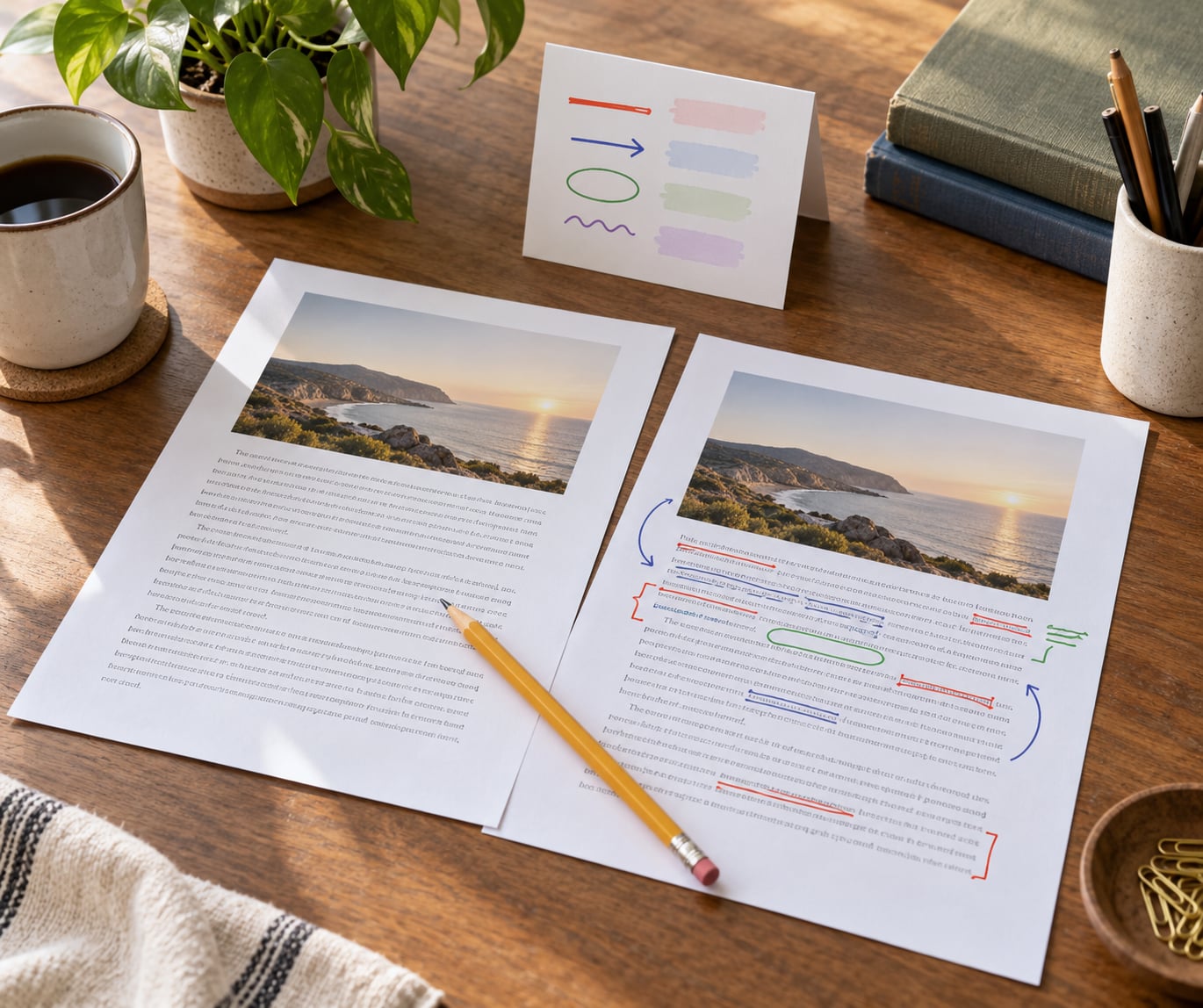
An annotation key on the board. Pick three or four symbols, no more, and keep them the same all year. Mine are: box for a word or phrase that carries weight, question mark for something I do not yet understand, star for a pattern I notice more than once, and an arrow between two lines that seem connected.
Discussion norms posted where everyone can see them. Short, concrete, and enforceable. Something like: every claim comes with a word or line from the text; we build on someone else’s idea rather than restarting it; disagreeing is fine, arguing is not.
You do not need a worksheet. If you hand out a worksheet with blanks to fill, roughly half your students will hunt for sentences to copy instead of reading closely, and that failure mode is the single most common complaint I see from teachers running close reading in history and science classrooms.
Step-by-Step: How to Teach Close Reading Step by Step
The table below gives you the timings at a glance. Add them up and you have a single 50-minute lesson; split them and you have three shorter meetings that work better for younger students.
| Step | Purpose | Time | Student task |
|---|---|---|---|
| 1. Set purpose, choose text | Frame the work | Planning | Know why this text |
| 2. Preview and model | Show how a reader thinks | 5 minutes | Watch and listen |
| 3. Read and annotate | First pass for key ideas | 10 minutes | First read, mark up |
| 4. Observations to evidence | Attach marks to patterns | 12 minutes | Sort and connect |
| 5. Discussion | Build interpretation together | 15 minutes | Talk with evidence |
| 6. Written response | Make a defensible claim | 15 to 20 minutes | Write the claim |
| 7. Revisit and reflect | Notice thinking changed | 5 to 8 minutes | Compare and revise |
1. Set a Purpose and Choose the Text
Decide what you want students to be able to do after the lesson, then pick a text that makes that possible. It sounds obvious, but many close reading lessons fail here: the text drives the lesson instead of the goal driving the text.
Write the purpose in student language on the board before anyone opens the text. “By the end, you will be able to explain how the author builds tension in this scene and prove it with two pieces of evidence.” Specific enough to guide a claim, open enough to allow disagreement.
Give students the background knowledge they need and no more. If it is the Gettysburg Address, two sentences about the war’s outcome changes how they read the second half. Background knowledge is a gift, not an answer key.
2. Preview the Text and Model Thinking
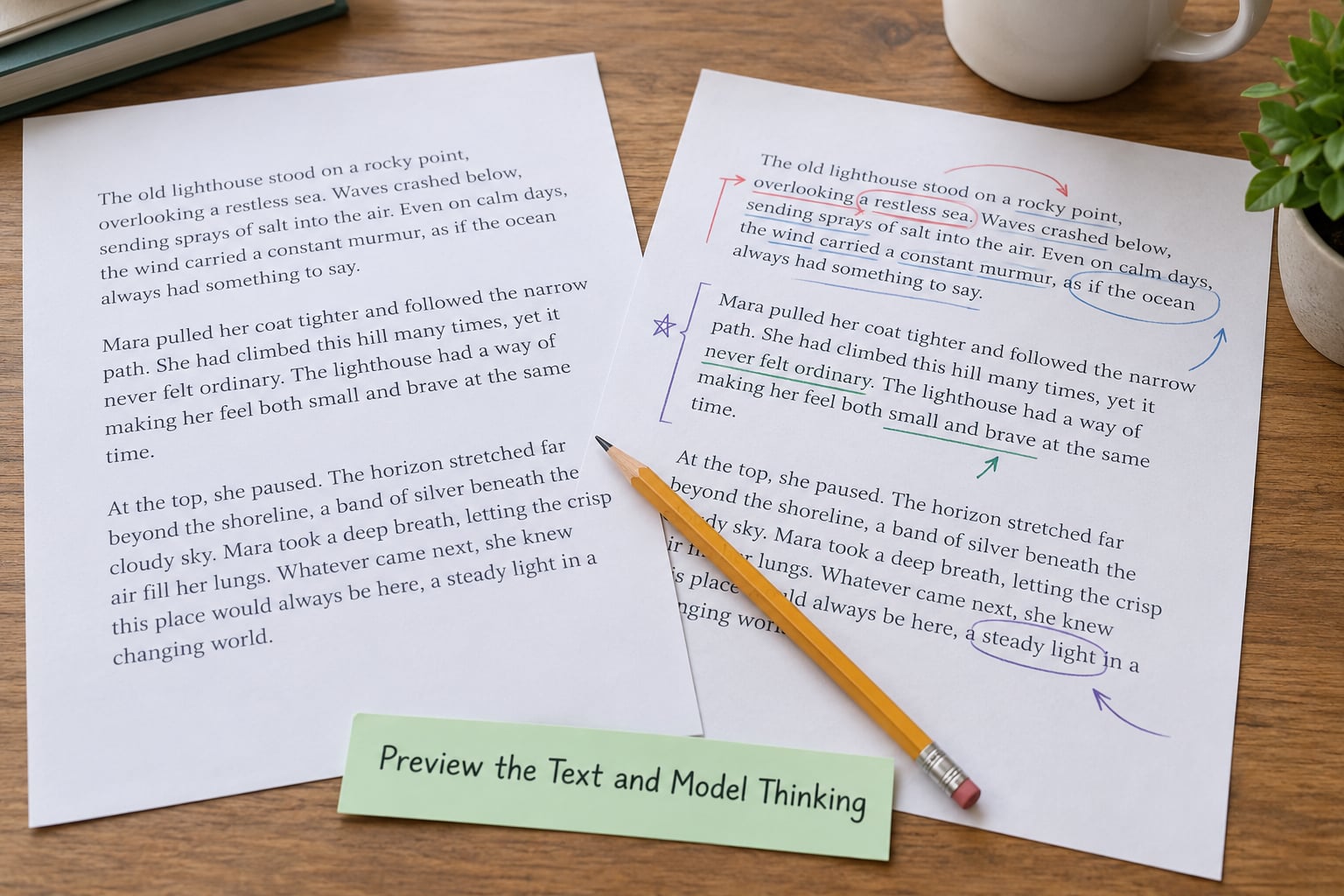
Read the first paragraph aloud while students follow with their eyes but not their pens. Then say what you noticed as a reader, out loud, in real time. “Here is the sentence that surprised me. I underlined nothing else on this page because the first sentence is doing all the work.”
That is the think-aloud, and it is the step that separates close reading from independent reading. You are not teaching interpretation yet; you are teaching noticing. Model for five minutes, then hand the pen over.
Say the annotation key aloud as you model so the symbols are attached to actions in their memory: box the word that made you stop, question mark anything you would ask the author, star the second time a pattern shows up.
3. Ask Students to Read and Annotate
Students read silently and annotate at the same time. Ten minutes covers about four paragraphs for most middle school readers, less for struggling readers, more for strong ones in dense nonfiction.
Give a first-reading task that cannot be completed by skimming. “Circle every sentence that tells you something about place or time” forces a real pass through the text. “Mark every place the narrator sounds certain” forces attention to word choice.
What students do not do on this read: infer. The first read is about what is on the page. Save interpretation for the third read, or you will get twenty different answers built on imagined plotlines.
Tell them the read has a purpose before it starts, not after. Students who are told to read the passage three times with no reason for any of them stop caring by the second pass.
4. Move From Observations to Evidence
This is the step most lessons skip, and skipping it is why close reading turns into underlining without thinking. Ask students to compare notes with a partner and write down what they marked, without interpreting yet.
Then push them one level: what pattern does your marking show? Three boxed words that all describe the same person is a pattern. One boxed word is an observation. Repeated structure, a shift in tone after a line break, a change in who holds the power in the scene: these are patterns, and patterns are what close reading is actually hunting.
Sentence frames work well here and they keep the rigor intact for multilingual learners. “I marked three words that all describe ____, which suggests ____.” Or: “The writer moves from ____ to ____ in this paragraph, so the mood shifts.” The frame scaffolds the language, not the thinking.
5. Build Meaning Through Discussion
Ask questions in a fixed order, from literal to interpretation to claim. If you start with the interpretive question, half the class goes silent and the other half guesses.
- Literal: What did the writer actually say here? Point to it.
- Pattern: What repeats? Where does the tone change?
- Craft: Why that word instead of a plainer one? Why that sentence length?
- Interpretation: Based on your markings, what is the author doing in this section?
- Claim: What is your thesis about this text, and which two pieces of evidence carry it?
Make students accountable to the text and to each other. Post the evidence rule and hold it: if a student says “it feels sad,” the follow-up is “which line makes you say that?” The second question is the one that teaches reading.
Step back and let students pose questions, which is harder than it sounds. Instead of asking five questions yourself, put three on the board and take one from the room. An ELA teacher I know calls this clipboard cruising: walking the room with a checklist and listening for whether student talk actually carries evidence. It works better than any scripted question set I have tried.
6. Have Students Write an Analytical Response
Fifteen to twenty minutes, one paragraph, four moves. State a claim, quote or cite specific evidence, explain how that evidence supports the claim, and connect it to the author’s purpose, craft, or the larger idea.
Insist on specific evidence. Not a summary of the plot, not “the author shows,” but a word, a phrase, a structural choice, with the line it sits on. The sentence frame “The author writes ____, which shows ____” gets beginners over the hump.
For younger students, skip the paragraph and give them three written statements to complete. The skill being built is the same one.
7. Revisit and Reflect
Five minutes at the end, and it is the step most likely to be cut for time. Do not cut it. Hand the passage back and ask students to find one thing they marked in the first read that means something different now.
That question takes thirty seconds per student and it does more for reading growth than an extra ten minutes of discussion would. It makes the shift from reader to analyst visible to the student who is still building that shift.
Collect the passages. Look for whether claims are tied to evidence, not for whether everyone agrees. That is your check for understanding, and it doubles as the assessment for the next lesson’s opening.
Common Mistakes
Blanket highlighting. If every line is marked, nothing is marked. Cap the annotation key at three or four symbols and tell students the goal is about eight to ten marks on a full page. Fewer marks force choices.
Worksheet-answer hunting. This is the big one, and it comes from r/historyteachers: guided reading activities where students scan for a sentence to copy instead of reasoning about the text. The fix is structural. Remove the blanks, give them claims to argue instead, and add a rule that every written response must name the specific word or line it relies on. When there is nowhere to copy from, they have to think.
Teacher monologue. If you ask all the questions, you are running a quiz, not a discussion. Write three questions, take one from the class, and use silence deliberately. The first ten seconds after a question feel unbearable and are where the actual thinking starts.
One read and done. Multiple readings with different purposes are the method itself. If you only have one period, cut the length of the text instead of the number of reads.
Unknown vocabulary taking over. When three words block everything, give a gloss on the board and move on. Vocabulary in context is one lens among many, not the whole lesson.
No exit criteria. Decide before the lesson what a successful analytical paragraph contains, and say it out loud. Without that, students guess what you want and some of them guess that shorter is better.
Frequently Asked Questions
What are the 5 steps of close reading?
The five steps are: read for key ideas and details, read closely for structure and craft, ask text-dependent questions, discuss and build interpretation, then write an analytical response supported by evidence. Some frameworks fold the first read for gist into the same step and split discussion into its own. The order matters more than the count: each read has one job, and no read repeats the previous read’s purpose.
How long should a close reading lesson last?
A full sequence runs about 50 minutes, and you can split it across two or three short meetings. Younger students benefit from three 15 to 20 minute sessions rather than one long block. The text length matters more than the clock: whatever passage you choose should be finished, annotated, and discussed inside the time you have.
What text should I use for close reading?
Choose a short text with real density: poetry, a speech, an essay excerpt, a primary source, or two to four paragraphs of fiction. Aim slightly above the grade band rather than far above it. Skip anything where the difficulty is decoding rather than meaning, because students who cannot read the words have no attention left for the structure or the craft.
What is the difference between close reading and guided reading?
Guided reading is teacher-led and focused on decoding, fluency, and comprehension support at a reading level the student can access. Close reading uses a text above the comfortable level and focuses on how the text works: structure, word choice, and evidence. They are not interchangeable, and most students need both across a week.
What is the 5-4-3-2-1 reading strategy?
It is a summarizing strategy, not a close reading method. Students read a text and write five words that describe it, four facts they learned, three questions they still have, two inferences they can draw, and one sentence summarizing it. It is useful as a warm-up or an exit ticket, but it never replaces repeated, purposeful reading of the same passage.
What is the difference between the 5 R’s of reading and the 3-2-1 rule?
The 5 R’s are reading, rereading, recalling, reflecting, and reacting, a framework for building a reading habit over time. The 3-2-1 rule is a single response protocol: three things learned, two questions, one summary. Both are reflection routines, while close reading is a longer process built on multiple readings for different purposes.
Conclusion
Close reading is not a worksheet or a reading log. It is a short text, read more than once, with a different purpose each time, and students who have to show their thinking out loud before you will believe it.
Start tomorrow with one paragraph, three annotation symbols, and one question that can only be answered from the text itself. Ask students what they marked, then ask what pattern the marking shows. That single shift from observations to evidence is where close reading actually begins.