A Socratic seminar is a structured, student-led discussion where students ask open-ended questions about a shared text and respond to each other with evidence, while the teacher facilitates from outside the circle instead of leading. Running one takes about two hours of prep plus one class period, and the hard part is facilitation, not paperwork. Teachers who post a predictable structure, teach question-writing first, and stay quiet during discussion report far calmer rooms than those who wing it.
This guide covers how to run a Socratic seminar in English class end to end: what to prepare, six steps from text selection to grading, the failure modes that trip up first-time facilitators, and answers to the questions teachers actually ask in department meetings.
If you are a substitute or a first-year teacher with no established discussion culture, start with the middle school version described in the mistakes section. It runs 25 minutes instead of 45 and has far more built-in structure.
Table of Contents
- What You Need to Run a Socratic Seminar
- A focused text, not a whole novel
- One essential question
- Student-written open-ended questions
- Discussion norms
- A participation record you can actually grade
- Reflection material
- Step-by-Step: How to Run a Socratic Seminar in English Class
- 1. Choose a Focused Text and an Essential Question
- 2. Have Students Write Open-Ended Questions That Demand Evidence
- 3. Set Student Roles and Participation Expectations
- 4. Establish Discussion Norms and the Seminar Structure
- 5. Facilitate the Seminar Without Giving the Answers
- 6. Assess Thinking and Participation
- Common Mistakes in Socratic Seminars
- The teacher takes over and answers questions
- The questions are too broad to discuss
- Three students do all the talking
- Students give opinions with no text behind them
- Differentiating the seminar without splitting it
- Frequently Asked Questions
- How long should a Socratic seminar last?
- Are Socratic seminars debates?
- Do I write the Socratic seminar questions or do the students?
- How do I get shy students to participate in a Socratic seminar?
- How do I grade a Socratic seminar fairly?
- What do I do when the room goes completely silent during a Socratic seminar?
- Conclusion: Start Small This Week
What You Need to Run a Socratic Seminar
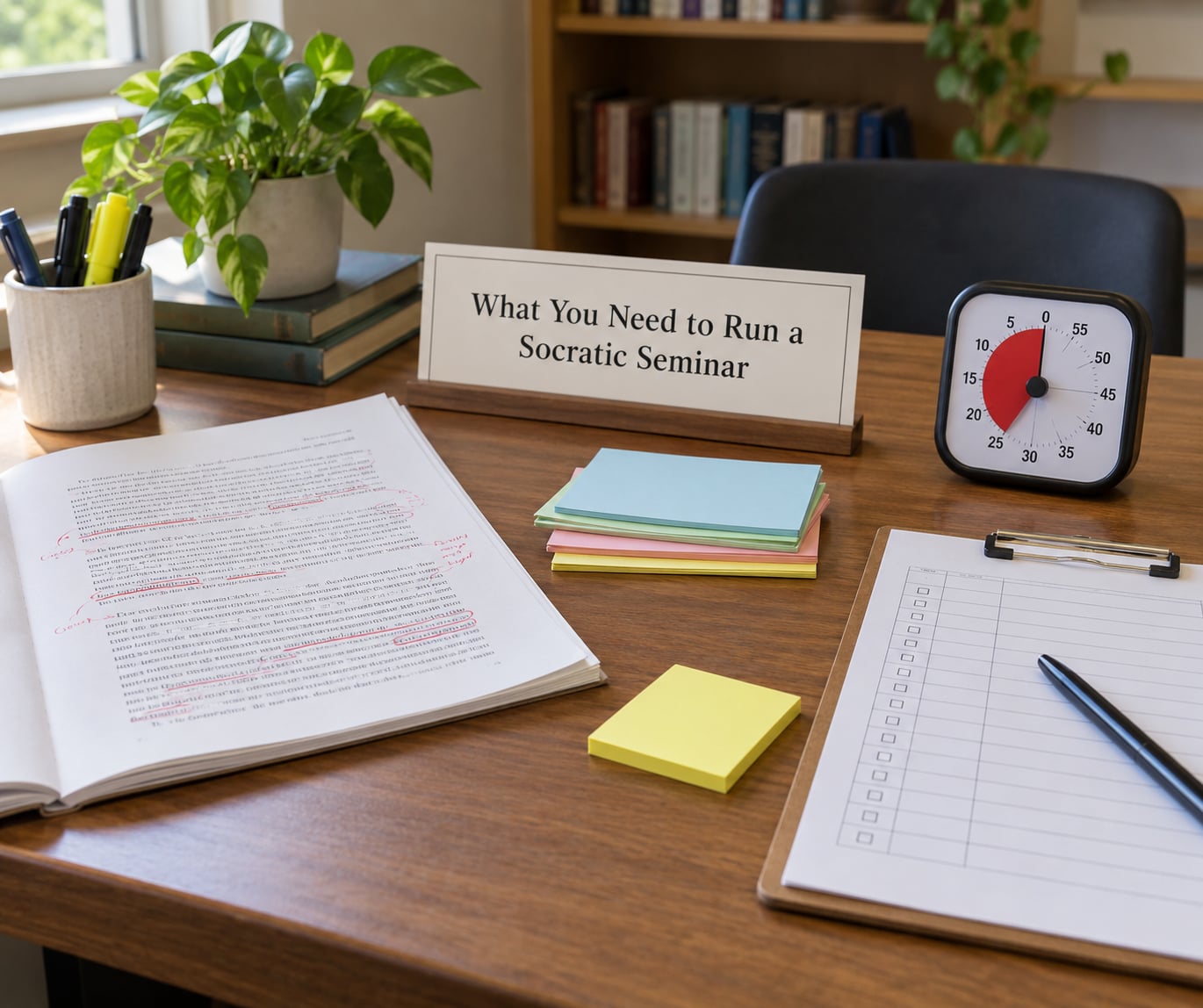
Everything below can be ready in two hours, most of it reusable from one unit to the next. If you have a text, one question, and a way to track who spoke, you have enough to run a seminar.
A focused text, not a whole novel
The most common setup error is handing students an entire book. A seminar works best on something short enough to reread the night before: a short story, a poem, a chapter, a documentary transcript, or two contrasting passages. Longer texts get split into smaller groups, which is a different activity with a different set of problems.
Pick a text with genuine disagreement in it. If you can write two defensible opposite claims about it and neither one is stupid, the seminar will sustain itself. A text where the teacher already knows the right answer will stall by minute eight.
One essential question
A single driving question anchors the whole session. Write it as a genuine question, not a prompt for a correct response.
- Weak: What is the main theme of this story?
- Strong: Does the narrator’s ending justify what she did in chapter four?
Ask yourself whether two students could disagree with each other and both be working from the text. If yes, you have a workable question.
Student-written open-ended questions
Students bring three to five questions each, written down. This is the single highest-leverage preparation step and the one most often skipped or faked. Written questions do three things: they force reading, they give quiet students a script to enter with, and they stop the discussion from collapsing into one or two confident voices.
Discussion norms
Four or five short statements, posted where everyone can see them, written with the class rather than handed down. Typical content: we respond to ideas rather than people, we bring the text with us, we ask before we agree, and we let a speaker finish.
A participation record you can actually grade
A roster with a small grid, one row per student and one column per talking slot, works fine. A clipboard tally sheet is the classic tool. Either way, write down names as students speak, not afterwards from memory, because your memory of a fast 40-minute conversation is worse than you think.
Reflection material
Five minutes at the end only counts if students write something down. A half-sheet with two prompts is enough: one idea that changed my thinking, and one line of text evidence that best supports my claim.
Step-by-Step: How to Run a Socratic Seminar in English Class
1. Choose a Focused Text and an Essential Question
Teacher action: Choose the text and the one question the session will orbit. Read it twice yourself and mark three passages that could support different positions.
Student action: None yet. This step is yours.
How you know it worked: You can state your own position on the question in one sentence, and you can imagine at least one student arguing against it. If you cannot, the text is too thin for a seminar.
Text selection changes depending on the unit. For a novel study, a single chapter around a turning point works better than the whole book, and teachers report the strongest seminars come right after an emotionally charged moment in a novel, a big reveal, or a controversy the class has already argued about. For poetry, one poem read aloud twice. For nonfiction, a passage where the author makes a claim you could reasonably dispute.
Avoid satire, twist endings, and anything where the ending explains itself. Students spend the session trying to guess the answer rather than building one.
2. Have Students Write Open-Ended Questions That Demand Evidence
Teacher action: Teach question types in a ten-minute mini-lesson, then let students write. Students who need a starting point get question stems, not your finished questions.
Student action: Write three to five open-ended questions and star the two they most want to ask.
How you know it worked: When you read the questions, most of them could not be answered yes or no, and most point at a specific line, image, or moment.
Without this step, students write questions like “What happens in chapter three?” That is a comprehension question, and it earns a single sentence. The fix is not to correct them but to model the difference out loud.
| Instead of this | Try this | Why the second one works |
|---|---|---|
| Did the author like the character? | Where does the author show sympathy for this character, and where does the tone shift? | Forces students to locate two pieces of evidence rather than guess at intent |
| What is the theme? | Which moment best proves that this character’s choices cost something? | Makes the answer arguable, so more than one defensible answer can win |
| Is the ending sad? | Why does the final paragraph end on an open question instead of an answer? | Pushes interpretation past feeling into craft |
Six question types cover nearly everything you need, and they are useful to teach directly: clarification questions, assumption questions, evidence questions, viewpoint questions, implication questions, and counterpoint questions. Print them on the question sheet and students will write from the list when their own ideas stall.
On the question of who writes the questions: students do, always, with your mini-lesson underneath them. Teachers who write the questions for the class take away the one preparation step that builds independent readers, and students notice immediately. Your backup plan is a bank of six to eight strong questions of your own, which you hand to two or three students who arrive with nothing. Hand them over quietly and never announce it.
3. Set Student Roles and Participation Expectations
Teacher action: Decide how participation is tracked and tell students before the seminar, not during it.
Student action: Sit in the circle with their marked questions in front of them.
How you know it worked: Students can tell you what is being graded before they walk in.
Two approaches work well. The first gives every student one job for the session: facilitator keeps the discussion moving, evidence finder supplies the text, connector links two earlier speakers, challenger presses on a weak claim, questioner poses the next prepared question. Roles keep participation from collapsing into the loudest voice, and they rotate if you run more than one seminar.
The second approach drops roles and relies on the tally sheet. It is simpler and scales better for a first seminar with students who have never done one. Whichever you pick, say plainly that everyone speaks at least twice.
Some schools run the seminar in small groups of four to eight with the rest of the class on independent work. It loses the whole-class energy but it is far easier to assess, and with 34 students in one circle you will spend most of the period managing logistics instead of thinking.
4. Establish Discussion Norms and the Seminar Structure
Teacher action: Post the norms, then run the clock yourself. Students notice when the teacher is watching the time.
Student action: Refer back to the posted norms when a conversation goes sideways.
How you know it worked: The discussion self-corrects at least once without your intervention.
Build the norms with the class in ten minutes before the seminar. Ask what a good conversation sounds like, then turn their answers into four statements. When a student breaks a norm later, you can point at the chart instead of arguing with them in front of everyone.
Here is a 45-minute period broken into clock time. No competitor I found publishes an actual breakdown, which is why teachers keep guessing at this.
| Time | What happens | Teacher role | Student role |
|---|---|---|---|
| 0-3 min | Frame and review norms | Restate the question and the no-intercepting agreement | Listen, arrange chairs if needed |
| 3-8 min | Open with a first question | Pose the starter question and sit down or stand outside the circle | Answer in 20 to 30 second turns |
| 8-28 min | Core discussion | Track participation, re-launch twice if needed | Pose their own questions, build on each other with evidence |
| 28-32 min | Timeout and pivot | Pause, name what has not been asked yet, hand the floor to quiet students | Hear the redirect, hold their strongest remaining question |
| 32-40 min | Final round | Ask each remaining silent student for one sentence | Speak once, even briefly |
| 40-45 min | Written reflection | Collect sheets, name one strong moment aloud | Write about one idea that changed and one piece of evidence |
How long should a Socratic seminar last? For a full class period, 40 to 45 minutes of structured discussion is the standard. Shorter periods of 25 to 30 minutes work if you cut the closing reflection and keep the same opening. More than 55 minutes rarely improves the talk, because attention drops and the strongest voices get stronger.
One habit worth building: tell students in advance that you will not answer questions during the seminar. Students consistently report higher engagement when they know the teacher is not going to jump in, and it removes the temptation to ask you instead of asking each other.
5. Facilitate the Seminar Without Giving the Answers
Teacher action: Facilitate. Track, wait, and re-launch. Do not participate.
Student action: Ask, answer, quote the text, disagree with reasons.
How you know it worked: You can stay quiet for the entire core discussion and the room does not stop.
Stand or sit outside the circle. That physical choice is doing more work than it looks like, because it removes you as the person who ends every exchange.
Three facilitator moves cover most situations. First, request evidence: when a student makes a claim, say “Where in the text?” Second, wait. After you ask a question, count five full seconds before you rescue the silence, which feels much longer to you than it does to the students. Third, hand the floor by name when the confident few have taken three turns in a row.
When the room goes quiet, do not fill it yourself. Read a student question aloud and say “Who has a different answer?” or split the circle: “Everyone turn to your neighbor for thirty seconds. Come back with one thing they said that you hadn’t thought of.” Small groups re-engage a room that whole-circle talk has stalled.
If the discussion does stall badly, the timeout move exists for this. Stop, name what has not come up yet, then hand the floor to a specific student who has not spoken. That is facilitation, not rescue, and students feel the difference.
When you do have to speak, keep it to four words or fewer. “Evidence?” “Whose idea?” “Keep going.” Anything longer turns you back into the teacher at the front of the room.
A useful comparison to hold in your head:
| Format | Who drives | Student talk time | Best used for |
|---|---|---|---|
| Socratic seminar | Students | High | Interpretation, argument, text evidence |
| Whole-class discussion | Teacher | Low to medium | Checking comprehension quickly |
| Literature circle | Small groups | High, in parallel | Sustained reading over many meetings |
| Debate | Two sides | Medium | Position-taking and rebuttal, not open interpretation |
6. Assess Thinking and Participation
Teacher action: Score preparation, reasoning, evidence, and response to peers. Not raw talk time.
Student action: Write the reflection and self-assess.
How you know it worked: Two students with equal preparation but different confidence can land similar grades.
The fairest approach separates preparation from participation. Give the written questions real weight, roughly half the grade, and let the seminar itself carry the rest. Teachers who do this report it protects quieter students without letting disengaged students coast, because the written work still shows whether they read the text.
On the participation side, grade these five things instead of counting comments:
- Preparation: three to five open-ended questions, written and specific to the text.
- Use of text evidence: claims supported by a quote, a detail, or a moment.
- Quality of reasoning: the why behind the claim, not just the claim.
- Response to peers: building on, disagreeing with, or questioning someone else’s idea.
- Reflection: a written record of one changed idea, submitted after the seminar.
A simple 4-point scale on each line works and takes about four minutes per class to score from your tally sheet. Teachers on teacher forums describe a trick worth stealing: place a checkmark on your roster while the student speaks, and use it as a prompt for whom to call on in the final round rather than as a grade.
You can also run the seminar as the culminating assessment instead of an essay or test, which is where the speaking and listening standards finally get graded. Pair it with a written constructed-response paragraph and you have evidence for both the discussion and writing standards.
Finish with the reflection before students leave the room. It takes five minutes, it gives absent students a make-up task they can complete from the LMS discussion prompt, and it gives you a paragraph you can quote when a parent asks whether the class period was wasted.
Common Mistakes in Socratic Seminars

Every failure mode below has a fix you can use mid-sentence, not just after class. The pattern is the same each time: the problem is a structural one, so the fix is a structural one too.
The teacher takes over and answers questions
Why it happens: Teachers are trained to be the expert in the room, and silence feels like a problem to solve rather than a stage to sit through.
The fix: Announce before the seminar that you will not answer questions, then physically move outside the circle. When you catch yourself explaining, stop mid-sentence and hand the question to a student: “Maya, can you answer that?”
The questions are too broad to discuss
Why it happens: Broad questions feel fair in the planning phase and turn out to be unanswerable in practice. “What does this story mean?” produces silence and a few generic answers.
The fix: Narrow to a question about a choice, a moment, or a technique. “Which moment best proves that this character’s choices cost something?” is arguable and specific, and any student can answer it with a passage from the text.
Three students do all the talking
Why it happens: Faster processing means faster speaking. Unless participation is structured, the same three voices dominate every circle.
The fix: Use roles, use a final round where every remaining student gets one sentence, or run the inner-outer circle variant where an inner group discusses for four minutes while the outer group observes and takes notes on who contributed. Then swap.
Students give opinions with no text behind them
Why it happens: Nobody was taught that an opinion without evidence does not count in this room.
The fix: Make evidence a norm and enforce it with one question. “What makes you say that?” repeated calmly will change the conversation faster than any handout.
The table below is the short version. Bring it to your first seminar on a folded page in your hand.
| Problem | Why it happens | What to do in the moment |
|---|---|---|
| Awkward silence | Students check whether the teacher will fill it | Wait five seconds, then read a student’s question aloud and ask for a different answer |
| Teacher-led talk | Habit and the discomfort of quiet | Point to the circle, not yourself, and hand the question to a named student |
| One voice dominates | Faster processors speak first and often | Final round with every quiet student required to speak once |
| Unprepared students | No reading done, no questions written | Hand them two questions from your own bank quietly, without announcing it |
| Surface-level questions | No mini-lesson on open-ended question types | Interrupt the pattern once: “Which type is that one?” then move on |
| Talk collapses at minute 12 | The first easy answers are spent | Pivot to a new question, a paired share, or a written one-minute response |
Differentiating the seminar without splitting it
Most accommodations cost nothing extra once the structure is in place.
Shy or anxious students: Give sentence starters on the table, not in their hand, so they are available to everyone. Let them pass once without penalty, then bring them back in the final round. Student feedback on participation anxiety consistently points to one thing that helps most: knowing in advance exactly what the structure is, so nothing is a surprise.
Absent students: Post the essential question and three prompts in the LMS and require a written response. Some schools run the seminar small-group while the rest of the class works independently, which gives absentees a smaller group to join on their return.
IEP and 504 plans: Pre-teach the six question types, allow questions to be drafted in writing or with a partner first, and give the written preparation a protected share of the grade. Check your individual plan, because several require that speaking be assessed in a small group rather than whole-class.
Multilingual learners: Permit the questions to be written in a student’s strongest language and then revised into English, and pre-teach four or five text-dependent sentences from the passage that they can reuse. Sentence frames such as “On page ___, the text shows ___, which suggests ___” do most of the work.
Elementary and primary grades: Cut the time to 20 to 25 minutes, use one question instead of an essential question plus three more, and let students ask questions orally to a partner before writing any of them down. The written preparation stage is often the whole lesson by itself.
If you are running this for the first time and want a model to show students, expect a common complaint from teachers searching for one: most classroom videos run slow and feel staged. Showing two minutes of real student discussion with the teacher’s silence visible is more convincing than any polished clip.
One last case: if you are a substitute inheriting a seminar plan, you cannot build culture in one period. Circle three of the prepared questions, tell students you will pick from them, and sit down. Letting students run the rest is exactly how a substitute can pull it off.
Frequently Asked Questions
How long should a Socratic seminar last?
Plan for 40 to 45 minutes of discussion in a standard class period. Break that into about 3 minutes framing, 5 minutes opening, 20 minutes core discussion, 4 minutes pivot, 8 minutes for a final round where quiet students each speak, and 5 minutes of written reflection. For a 30-minute period keep the same shape and cut the reflection to three minutes. Going longer rarely helps, because attention drops and the strongest voices get stronger.
Are Socratic seminars debates?
No. A debate has two sides competing to win, and the format rewards volume and speed. A Socratic seminar is a discussion in which several readings of one text can all be defensible, and students earn standing by supporting claims with text evidence and building on each other. Tell students this explicitly before the seminar, because the moment students treat it as a contest, the analysis stops.
Do I write the Socratic seminar questions or do the students?
Students write them, always, and you teach them how first. Give a ten-minute mini-lesson on open-ended question types, supply question stems, and require three to five written questions before the seminar. Students who arrive with nothing get two questions from your own prepared bank, handed over quietly. If you write all the questions, you remove the one preparation step that builds independent readers.
How do I get shy students to participate in a Socratic seminar?
Give them a structure rather than a spotlight. Sentence starters on the table, a clear role such as evidence finder, and the guarantee that everyone speaks at least twice all reduce the pressure. Let a student pass once without penalty, then bring them back in a named final round. Several teachers report that participation anxiety drops most when students know exactly what is coming before the seminar starts.
How do I grade a Socratic seminar fairly?
Separate preparation from participation. Give the written questions roughly half the grade, then score the seminar itself on five things: preparation, use of text evidence, quality of reasoning, response to peers, and the written reflection. Count these from a roster you marked during the talk, not from memory afterwards. Equal preparation should produce equal grades regardless of how confident a student is.
What do I do when the room goes completely silent during a Socratic seminar?
Wait five full seconds before you do anything, then change the format instead of answering. Read one of the student’s questions aloud and ask who disagrees, pair students for a thirty-second neighbor share, or ask everyone to write one sentence before anyone speaks. If you catch yourself explaining the text, stop mid-sentence and hand the question to a named student. Silences are normal and rarely mean the room has nothing to say.
Conclusion: Start Small This Week
Pick one short text you already love, write one arguable question, and give students a single class period with four norms on the board. Teach the question types on Monday, run the seminar on Wednesday, grade the written reflection on Friday.
Do not wait for the perfect novel unit or the discussion culture you do not have yet. The first seminar will be messy, the second one better, and by the fourth most teachers tell me the circle runs itself.