
Literature circles work when you hand the conversation over and stay out of it. Pick one text, sort students into groups of four to six, give each student a role with a real job, and set three scheduled meetings with reading assigned by chapter instead of page. You walk around, listen, and keep a short record of what each group actually said.
Here is the whole method in one line: literature circles are small student-led discussion groups where students read the same text, take assigned roles, and talk using evidence while the teacher facilitates instead of lecturing.
Below is the setup I would hand a first-year teacher, plus the fixes for the problems that come up in week two.
Table of Contents
- What You Need
- Materials and preparation
- Step-by-Step: How to Run Literature Circles in Six Steps
- Step 1: Choose a Text and Set a Purpose
- Step 2: Model a Literature Circle Discussion
- Step 3: Create Groups and Assign Roles
- Step 4: Teach Students to Prepare Before Meeting
- Step 5: Run the Circle Discussion
- Step 6: Assess Learning and Reflect
- Common Mistakes
- The interview trap
- Side conversations
- One student doing all the talking
- A weak discussion director
- Students did not finish
- Discussion questions that cannot be argued about
- Frequently Asked Questions
- What are literature circles and how are they used in elementary school?
- What is the point of literature circles?
- How many students should be in a literature circle?
- How do you keep literature circles engaged when students go quiet?
- How do you assess or grade literature circles?
- What activities can you do in a literature circle?
- Conclusion
What You Need
Everything here can live in one folder, digital or paper. Gathering it before the unit starts is what makes the difference between circles that run themselves and circles that need a teacher talking for 90 percent of the time.
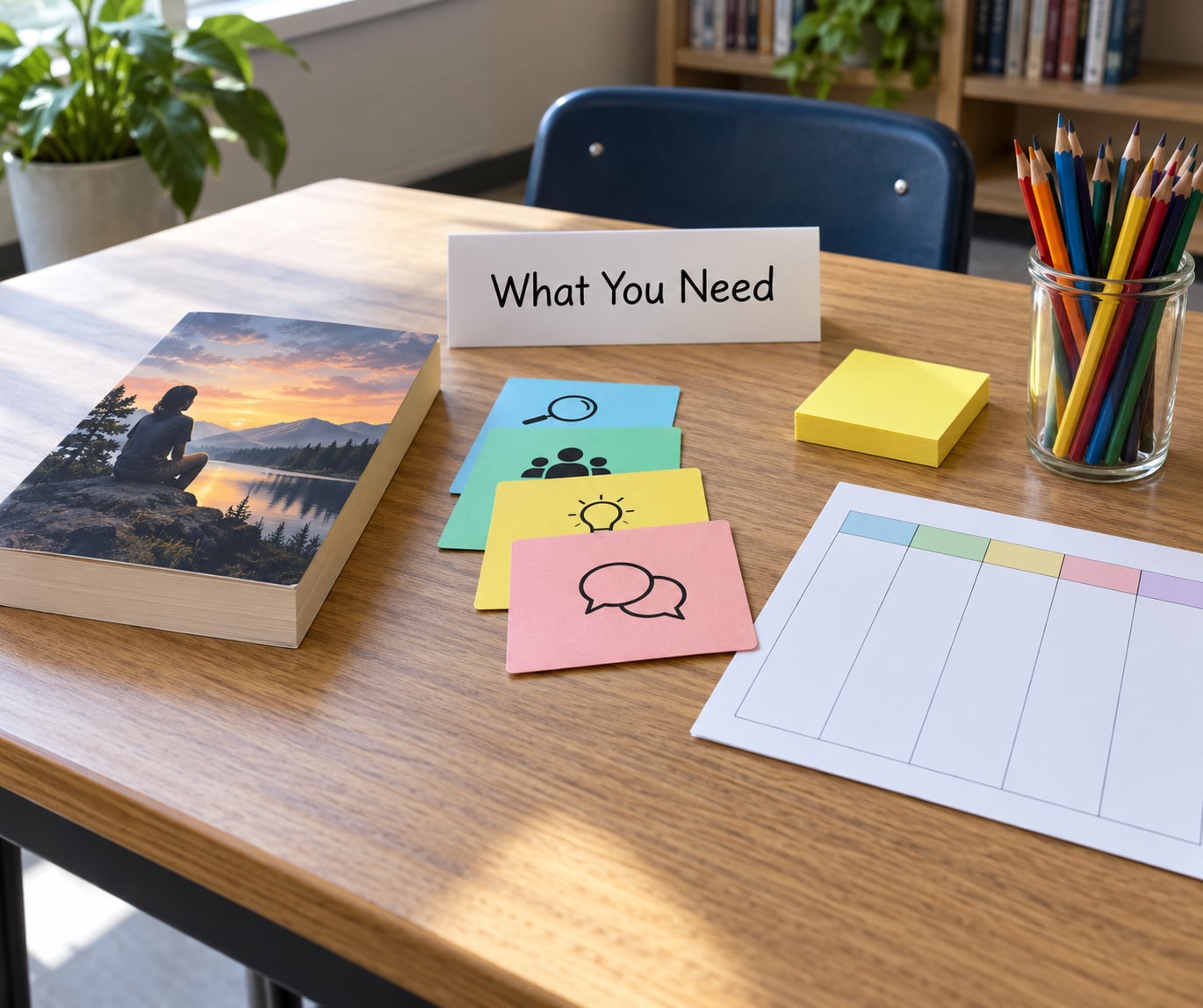
Materials and preparation
- The text itself. A novel, short story collection, poem set, play, or nonfiction title that fits your unit. Plan on four to five options if students will choose.
- One role card per student. Printed on card stock or slid into a shared deck, with the role name on the front and the job on the back.
- A reading plan. Chapter or section assignments with dates, so every group is on the same page on the same day.
- Three to five discussion questions per meeting, written before the unit begins.
- A recording page for each group: a running list of what was discussed, or one form per student.
- An assessment tool you will actually collect. Reflection slips, role sheets, exit tickets, or a short follow-up paragraph all work.
A note on text access: if any student will not have a copy at home, order classroom sets early or use the ebook lending feature most school accounts already include. A student without a book at home reads nothing, and then shows up to the discussion with nothing to say.
Step-by-Step: How to Run Literature Circles in Six Steps
Each step hands the next one more independence. If you skip ahead, the groups stall on the floor you left them on.
Step 1: Choose a Text and Set a Purpose
Choose one text and attach it to a question, not just a chapter list. “What does this narrator want from the reader?” gives a group something to argue about for three meetings.
Matching the text to your unit matters more than novelty. A first unit works best with something short and familiar: a novella, a linked collection of short stories, a graphic novel, or a set of ten poems. Save the 400-page doorstop for the third unit, when students already trust the routine.
Step 2: Model a Literature Circle Discussion
Model the moves before you assign the roles. Ten minutes of your own discussion, out loud with think-aloud narration, saves three weeks of stalling.
Show four things specifically:
- Citing evidence: “On page 14 she says X, and I think that means Y.”
- Asking a real question: not “What happened next?” but “Why did he lie there?”
- Listening and building: “I agree with Maya, and I want to add something.”
- Disagreeing kindly: “I read that line differently, because of the word she chose.”
A fishbowl demonstration works well here too. Three students hold a discussion in the middle of the room while everyone else listens with a job: watch for evidence, count the turns, note one question worth stealing. Then trade.
Step 3: Create Groups and Assign Roles
Four to six students per group. Fewer than four runs out of voices, and more than six reliably turns into two side conversations plus a circle.
On whether you assign or let students pick: let students pick group members, and assign the role. Have them list three names and turn it in, then shuffle yourself. Letting students choose every variable sounds supportive and usually produces cliques.
Group by interest rather than by reading level. That runs against the usual instinct, but a group of readers who each want to talk about the same book will sustain a discussion that a strictly leveled group often will not. Keep reading support outside the circle instead: the audiobook version, chunked annotation, or partner reading at the same text.
Six roles that cover the work:
- Discussion Director opens the meeting, hands out turns, and keeps the group on the questions. The hardest job — assign it first, rotate it first.
- Summarizer reports the group’s agreed-upon events or ideas so far. Catches anyone who skipped the reading.
- Question Keeper collects questions from the group’s reading log and asks two of them.
- Connector links the text to something outside it: another book, an event, their own life.
- Vocabulary Officer shares two words the text made important and what shifted the meaning around them.
- Evidence Finder supplies the quoted lines the group leans on most.
Fewer students? Merge Connector and Vocabulary Officer. More students? Add a Timekeeper and a Quiet Partner whose job is a written response the group reads aloud.
Step 4: Teach Students to Prepare Before Meeting
Preparation is the part students skip, and skipped preparation is what turns a discussion into a recap of who did what. Teach a preparation routine once, then check it.
Three habits cover most needs: read the assigned section, mark one passage worth talking about, and write one question and one opinion about it. Students can do this in the margin of a printed text or in a shared note. Aim for under ten minutes so it survives contact with a busy week.
The related 3-2-1 reading rule works as an alternative: three responses to what you read, two questions you have, one connection to something else. It fits the same slot.
Step 5: Run the Circle Discussion
Give every group the same twenty-minute structure. Consistency is what frees your attention to actually listen.
- First two minutes: each student reads one marked passage aloud.
- Next twelve minutes: discussion director moves through the three prepared questions, using the evidence on hand.
- Last six minutes: the group picks the two threads that mattered most and writes them on the recording page.
Meet three times per text. Two meetings get thin by the end; four meetings run out of new material.
Your job in those twenty minutes is circulation and listening. Sit with a group for two full minutes before you say anything, note who spoke and what they said, and hold your comments for the end unless a group stalls completely.
Step 6: Assess Learning and Reflect
Do not grade the discussion itself. Grade what each student produced around it, and keep the collection light enough that you will actually do it.
Four low-prep options that work:
- Exit ticket, two minutes: one claim, one piece of evidence, one question it raised.
- Role sheet: the student’s job filled out with specifics. Weak evidence here usually means weak preparation.
- Discussion summary: the group’s recording page, submitted by one name or all of them.
- Follow-up paragraph: 150 words answering one evaluative question. Best for high school, best for evidence.
The summary page tells you most in the least time. If a group’s page is vague, you know the meeting was vague, and you know before the next one.
Common Mistakes
Every one of these shows up in the second week. Each has a specific fix rather than a pep talk.
The interview trap
One student asks a question, another gives a one-word answer, and the circle ends. Start meetings with everyone reading a marked passage aloud, which removes the turn-taking decision entirely. Then have the Question Keeper ask a prepared question so it never depends on the director improvising.
Side conversations
Groups above six almost always split. Shrink the group, then change the seating so students sit in a small circle or a square with backs to the room rather than side by side. A five-minute speaking and listening task where they must agree on one summary of the meeting usually resets it.
One student doing all the talking
Give the Question Keeper explicit authority to call on people by name. Ask every student for the exit ticket individually, so quiet participation still shows up on paper. And rotate the Director role every meeting rather than every unit.
A weak discussion director
Give the Director a script instead of a title: open with the first question, ask each person for their passage, prompt once when a response stops, and close at the summary step. Then practice it once during your modeling day. Weak facilitation is usually missing instruction, not a lazy student.
Students did not finish
This will happen, and it is a planning problem rather than a discipline problem. Plan meetings by chapter so a slip has a small cost. For students who finish early, give them the Evidence Finder task plus a short comparison question about the previous book. For students behind, hold their meeting with you at lunch for ten minutes.
Discussion questions that cannot be argued about
“What did the author mean?” gets shrugs. Questions with a position inside them work better: which character made the worst decision and why, whether the ending was earned, whether you would have told the narrator something different. Mix literal, interpretive, and evaluative questions in each set so nobody can coast on recall.
One more thing worth planning for: your first unit is a training run. Expect to coach more in week one than week six, and build that in rather than treating it as a sign the format is failing.
Frequently Asked Questions
What are literature circles and how are they used in elementary school?
Literature circles are small student-led groups that read the same text and discuss it using assigned roles. In elementary school, groups are usually three or four students, texts are short (a picture book, a poem, a chapter of a novel), and roles are picture-based: reader, reporter, question asker, illustrator. Sessions often run 15 to 20 minutes once or twice a week.
What is the point of literature circles?
The point is to move the conversation, the accountability and the text-dependent speaking practice away from the teacher and onto the students. Students defend claims with evidence, summarize what they read, and notice their own reading habits through reflection. The teacher gets the same outcomes plus the freedom to run guided reading with small groups while circles work.
How many students should be in a literature circle?
Four to six. Below four, you run out of roles and the energy drops; above six, groups reliably split into side conversations. If your class does not divide cleanly, make one larger group with a Timekeeper and a Quiet Partner who contributes a written response the group reads aloud.
How do you keep literature circles engaged when students go quiet?
Give every student one passage to read aloud in the first two minutes, which removes the decision to speak. Then use the Question Keeper to ask prepared questions so the discussion does not depend on the director inventing prompts. Finish with a written summary of the two threads that mattered most, which gives silent students something concrete to add to.
How do you assess or grade literature circles?
Grade the artifacts, not the conversation: exit tickets, role sheets, group recording pages, and a short follow-up paragraph. The group summary page is the fastest signal, since a vague page usually means a vague meeting. Avoid assigning one grade per group, which rewards talkers and hides everyone else.
What activities can you do in a literature circle?
Open with a passage round, run a three-question discussion, close with a group summary, then add written follow-ups: a literary analysis paragraph, a debate-style argue-for-or-against prompt, a character map, a book talk for another class, or a creative extension such as writing the missing chapter. Rotate the four or five you use most.
Conclusion
Start smaller than you think you need to. One short familiar text, one discussion you model yourself in front of the class, one preparation routine, and three meetings three weeks apart is a complete first unit.
Run it, collect the summary pages, and let the second unit be the one where you talk less.