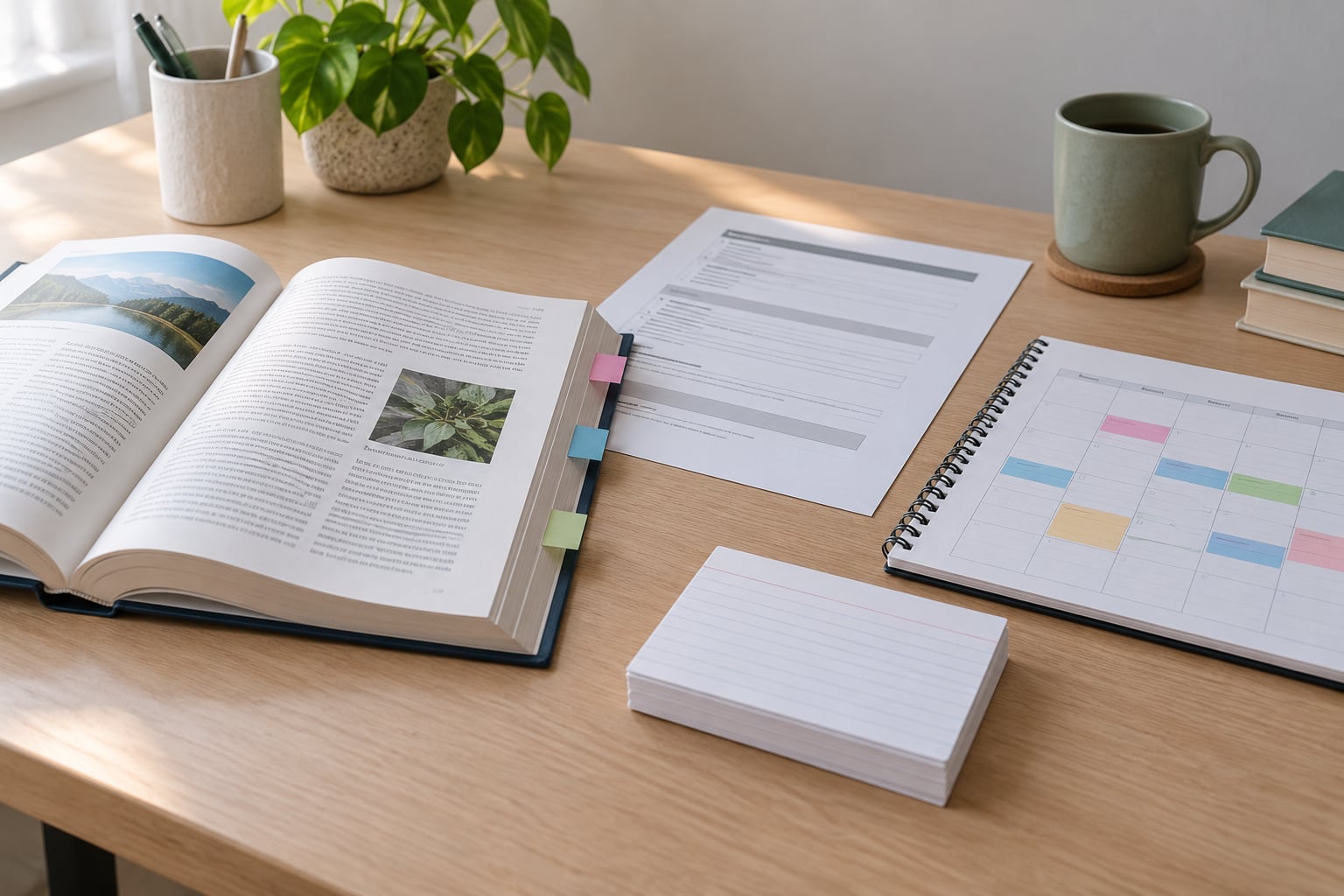
You are not going to finish a 700-page backlog the night before an exam, and the students who do well are not the ones who stay up longest. How to catch up on reading before a test is a triage problem first and a reading-speed problem second: decide what earns a full read, what earns a skim, and what you will cover with lecture notes and a study guide instead. One week is enough for most reading lists, as long as you spend the first hour deciding where your hours actually go.
What follows is the routine I give my own students, and it holds up whether you have three days or thirty usable hours. It rests on one idea that most study advice quietly skips past: rereading feels like studying, and it is not.
Table of Contents
- What You Need
- How to Catch Up on Reading Before a Test: Step by Step
- Set the Scope Before You Read a Single Page
- Prioritize What Is Most Likely to Be Tested
- Read in Focused, Purposeful Passes
- Turn Reading Notes Into Recall Practice
- Use the Last Session for Review, Not Rushing
- What If You Still Cannot Finish Everything?
- Common Mistakes
- Frequently Asked Questions
- How can I catch up on reading when I have only one day before the test?
- What should I read first if there is more material than time?
- Is it better to skim or read every word before a literature test?
- How do I remember details after reading a long chapter?
- Should I make notes while catching up on reading?
- What if I cannot finish all the assigned books before the test?
- Start With One Prioritized Reading Session
What You Need
You need four things before you can estimate anything, and gathering them takes about an hour.
- The reading itself. Get every unit physically or digitally in front of you. A backlog you have never looked at is impossible to schedule.
- The syllabus or assignment sheet. This is the single most useful document you have, because it tells you which units were flagged as examinable.
- Test logistics. Date, start time, location, format, percentage of your grade, and how many questions come from each unit.
- Lecture notes and any past exams. If you attended a single session, those notes are worth more per minute than the chapters you will skim.
Two tools make the rest work. A timer, because untimed reading expands to fill whatever space you give it. And a place to write, one page per unit, because a summary you never wrote is a summary you never made. Put your phone in another room. Not face down on the desk. Another room.
How to Catch Up on Reading Before a Test: Step by Step
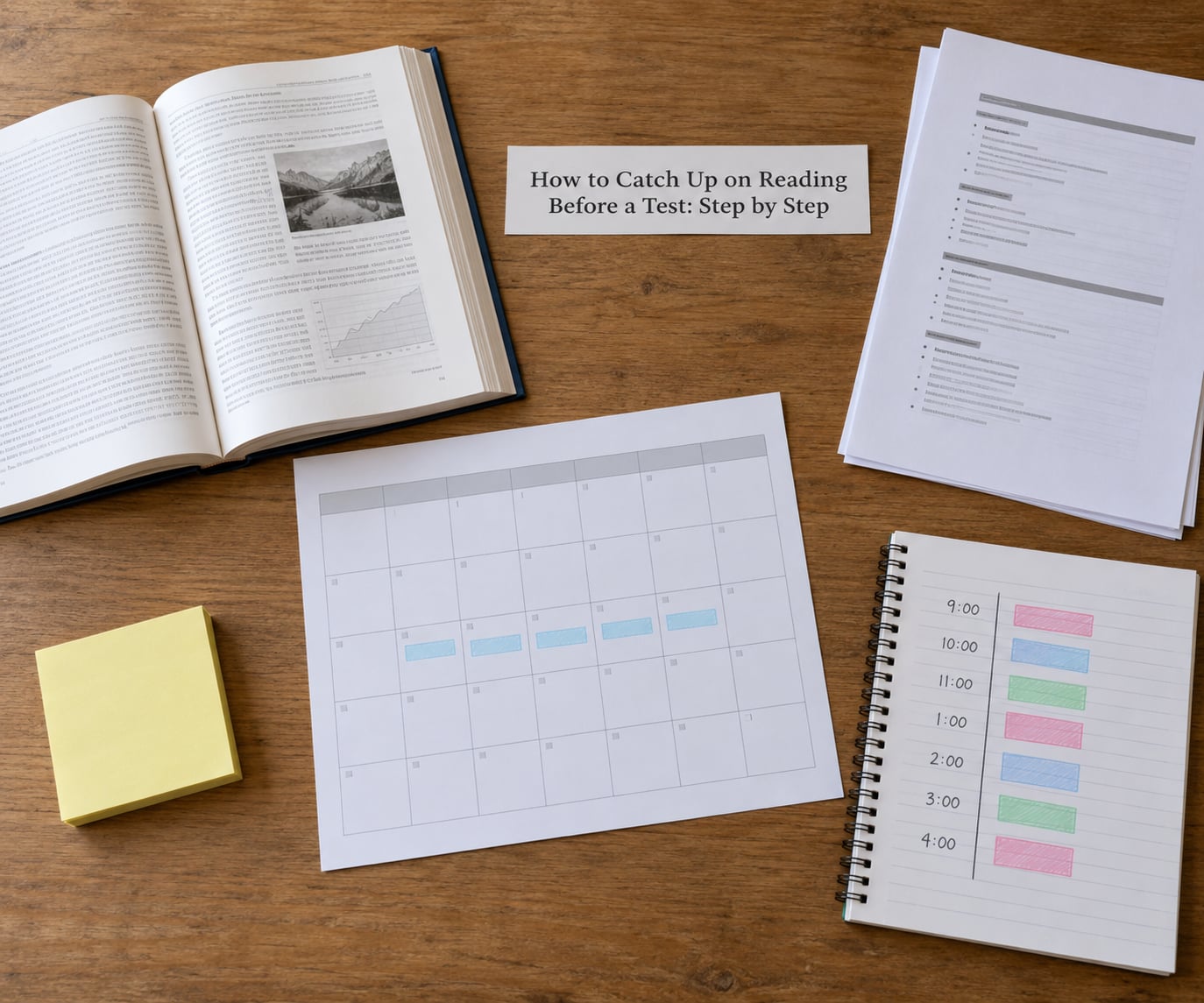
The order matters. Students routinely start reading at step four, which is why they run out of time still not knowing what matters.
Set the Scope Before You Read a Single Page
Count your usable hours first, not your hours until the test. Take the time between now and the exam, then subtract sleep, meals, classes, work, and the hour you need for actual review on test day. If the test is at 9am Tuesday, sitting down at 6pm Monday, you have roughly 26 hours awake. Twelve to fifteen of those are realistically usable for focused work, and 10 of those is a good target if you want to sleep.
Now convert hours into pages with a realistic rate. A focused reader gets roughly 20 to 30 pages an hour on dense textbook prose, 40 to 60 on narrative nonfiction, and 80 to 120 while skimming for structure. Measure yourself once on a ten-page stretch and use your own number rather than mine.
Finally, split those hours into sessions of 30 to 50 minutes with real breaks, and decide where you stop. “I will read through Thursday evening” is not a stopping point. “I will finish the full-read tier by Wednesday at 9pm” is. Deciding the end in advance is what stops the panic spiral at 1am.
Prioritize What Is Most Likely to Be Tested
Spend 30 to 45 minutes ranking your units before you read any of them. The ranking signals, in rough order of usefulness: explicit syllabus flags like “we will assess chapters 1 to 7,” anything your instructor said on the first day of class, chapters that carry a large share of the questions on a past exam, material your class spent the most time discussing, and concepts that keep recurring across units.
Dates matter less than people think. A chapter from month one is not automatically low value just because it is old, and the newest chapter is not automatically high value just because it is recent.
Then sort every unit into one of three tiers. This is the step that gets skipped and it is the whole ballgame.
| Tier | What goes here | Time per unit | What you do | Likely exam coverage |
|---|---|---|---|---|
| Tier 1: Read in full | Syllabus-flagged chapters, primary texts, anything the class argued about | Your measured page rate times the page count | Three-pass close reading, one-page summary, self-testing | Most short-answer and essay questions |
| Tier 2: Skim for structure | Supporting chapters, secondary sources, familiar background | 10 to 15 minutes per chapter | Headings, first and last paragraphs, summary and end-of-chapter questions, diagrams | Multiple choice, fill-in, ordering |
| Tier 3: Skip and supplement | Anything peripheral, duplicated, or clearly outside the test scope | 20 to 30 minutes per unit | Study guide, lecture notes, a classmate’s one-page summary, then five self-test questions | Recognition, vocabulary, broad strokes |
A useful sanity check: your Tier 1 list should be short enough that you can name every item from memory. If Tier 1 is most of the reading, you have not actually triaged, and you will be reading cover to cover under pressure. That is the failure mode this whole method exists to prevent.
Read in Focused, Purposeful Passes
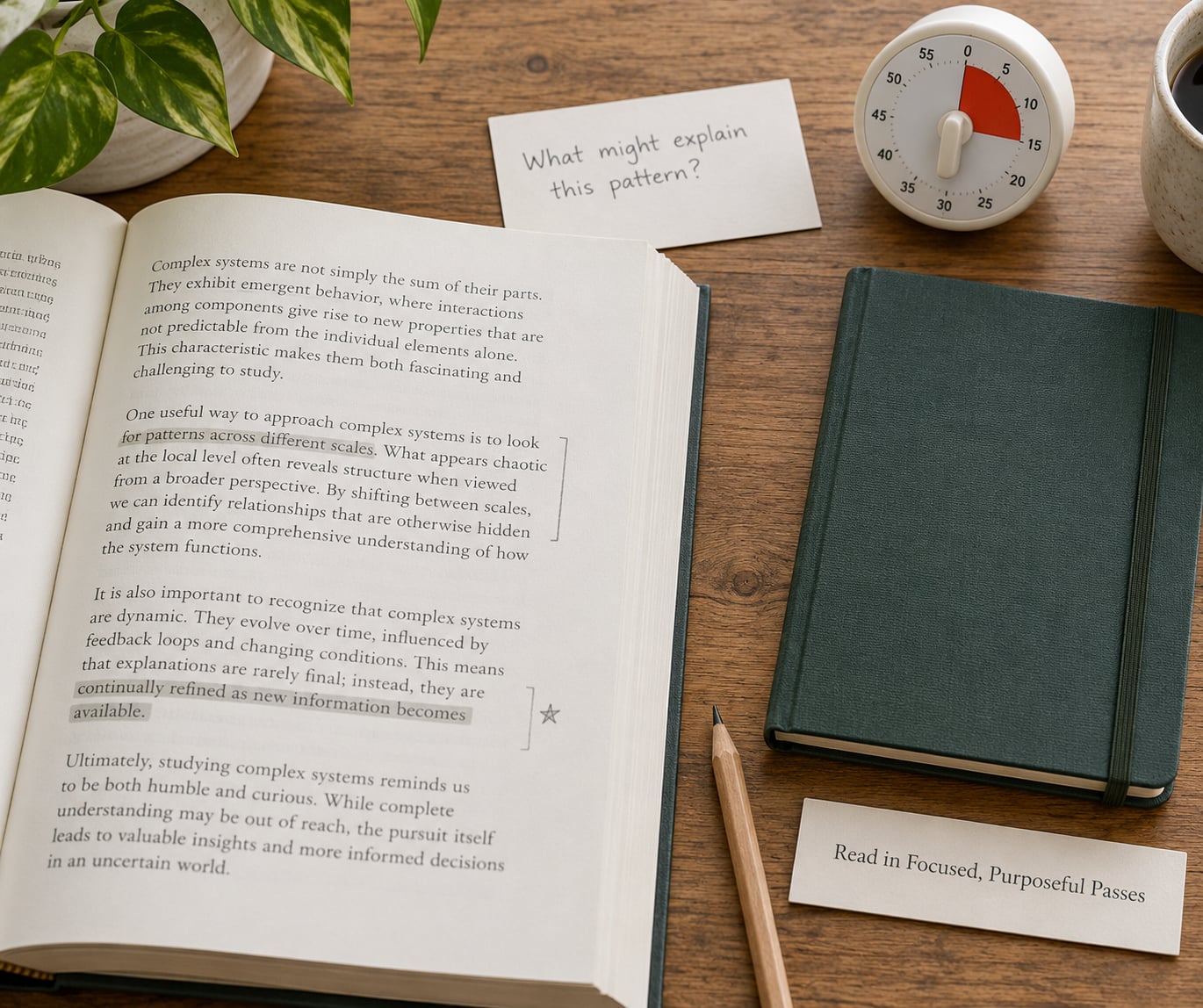
Reading a chapter once, carefully, and hoping it sticks is the default, and it is why students finish a chapter and cannot answer a single question about it. Three passes get far more out of the same pages.
Pass one, comprehension. Read straight through at your normal pace, aiming only to follow the argument. No notes, no highlighting, no stopping. If a paragraph confuses you, mark the page and keep going. This pass usually runs 25 to 40 pages an hour for narrative material and much slower for dense argument.
Pass two, structure and detail. Go back through and capture the skeleton: the thesis of each section, the named theories, the dates, the definitions you would be embarrassed to get wrong on a test. This is the pass that produces your one-page summary, and it is the one most students skip because they are tired by now. Do it anyway.
Pass three, theme and central idea. For a novel, essay, or case, this is where you ask what the whole unit is arguing and how the pieces serve it. For a textbook chapter, ask what problem the chapter was written to solve.
Run the passes in 30 to 50 minute study bouts. Set one specific goal before each bout, write it at the top of the page, and check it at the end. The goal might be “capture section headings and five testable definitions.” A vague goal produces a vague session.
Checkpoint honestly at the end of each bout. Close the book and write three sentences: what this chapter argued, what evidence it used, and what a test question on it would look like. If you cannot write the third one without looking, you have not finished the unit yet, and now you know that while there is still time to fix it.
Turn Reading Notes Into Recall Practice
This is the step that decides whether the reading survives contact with the test, and the reason it matters is simple. Rereading builds recognition: the text feels familiar, so you feel prepared. The test demands recall: you must produce the answer with the book closed. Familiarity is not the same skill, which is why students reread a chapter three times and then sit down to a blank page.
Convert each unit into something you have to use, not something you have seen. A one-page summary written in your own words is the minimum. Better options built on top of it:
- Closed-book questions. After each chapter, write five questions and answer them without looking. This is self-testing, and it is the single highest-value study move available to you.
- Flashcards for the retrievable bits. Definitions, dates, named theories, vocabulary in a foreign language. Facts first, ideas second.
- Concept maps. One box per concept, arrows for relationships. Good for anything with structure, like a period of history or a philosophical argument.
- Explain it out loud. If you cannot explain a concept to an empty room in two minutes, you have not learned it. The Feynman technique, borrowed from physics tutoring, is simply that test applied to yourself.
Space these sessions out rather than cramming them. Two short recall sessions on separate days beat one long one, because forgetting between sessions is exactly what makes the next effort productive. A 20-minute session tonight and another on Thursday costs less time and works better than 40 minutes tonight.
If you are the kind of reader who has to write while reading to stay engaged, do exactly that, and treat it as the retrieval practice rather than as note-taking for its own sake. Students who write while they read report the same thing: they do not have to remember the material later, because they already used it.
Use the Last Session for Review, Not Rushing
The final stretch is where most of the damage gets done. Students feel the gap closing, open a chapter they have not touched all week at midnight, and read three pages an hour while learning nothing. That session buys almost nothing and costs you the sleep that consolidates everything you read earlier.
Set a hard cutoff for new material, roughly 12 to 18 hours before the test. After that, no new chapters. Use the remaining time for retrieval only: work through your self-test questions, redraw the concept maps from memory, and reread your one-page summaries rather than the originals. This feels less productive than reading and is more productive than reading.
Fill the gaps you find. Every question you cannot answer points to a specific paragraph, and a 15-minute targeted reread of that paragraph is efficient. Going back to cover everything is not.
Protect sleep. Seven hours is the floor, and the trade is not close: an extra ninety minutes of rereading at 1am loses more than it gains. If you are reading at 3am, you have passed the point where reading is working. Stop, write down the three things you most want in your head, and sleep.
Morning of, do one 20-minute retrieval session on your summaries and stop. Do not open a chapter you have not read yet. You will not read it well, and starting the test with a defeat is a bad way to begin.
What If You Still Cannot Finish Everything?
Sometimes the backlog is genuinely larger than the hours, and no method closes that gap. When you are in that spot, triage harder instead of pretending the difference is effort.
Move anything you have not started from Tier 2 into Tier 3 and cover it with a study guide and lecture notes. Learn the recurring examples rather than chasing every instance, because instructors reuse the same case, poem, or experiment across several questions. If a chapter is background you already have from another class, read the summary and the headings only.
Then ask, directly and early. A two-line message asking what the test will cover, or whether chapters 8 to 12 are fair game, costs you nothing and sometimes buys you half a reading list. Ask it in the first 48 hours, not the night before.
Finally, be honest in how you use the material. If you skimmed a novel, write about the passages you actually read rather than pretending to have covered the whole book, because a specific close reading of two chapters scores better than a vague summary of twelve. And a study guide alone will not carry an essay question. Use it to orient yourself, then go back to the text for the passages you cite.
Common Mistakes
Passive rereading. The most popular and least effective method on the menu. Fix: close the book after every unit and write five questions from memory, then check yourself. The discomfort you feel while checking is the point.
Highlighting everything. If a page has more highlight than margin left, you have highlighted nothing. Fix: highlight only on pass two, and only definitions, named theories, and the thesis of each section.
Reading cover to cover in publication order. Chapter 1 might be worth 2% of the test and chapter 11 might be worth 15%. Fix: rank units first, read in priority order, not page order.
Starting with the hardest material. It feels responsible and it kills your first session. Fix: start with a Tier 1 unit you already partly understand. One clean session builds the momentum for the dense ones.
Skipping the review stage entirely. Reading is treated as studying, and then the student sleeps. Fix: reserve the last third of your available hours for closed-book self-testing. If your schedule has no review block in it, the schedule is wrong.
Trying to finish and cram in the same night. The reading is unfinished and now you are also sleep-deprived, which is the worst possible condition for retrieving anything. Fix: set the cutoff, and accept a smaller amount of well-learned material over a larger amount you skimmed at 2am.
Asking nobody. Students routinely guess at scope when a single question to the instructor would settle it. Fix: one message, early, listing the units you plan to cover in full and asking what is out of scope.
Frequently Asked Questions
How can I catch up on reading when I have only one day before the test?
With one day, triage ruthlessly. Pick three Tier 1 units from your syllabus flags, read those properly using the three-pass method, and move everything else to skimming or study-guide coverage. Spend your last two hours on closed-book self-testing, not new reading, and protect your sleep. One well-read unit plus recall practice beats six skimmed ones.
What should I read first if there is more material than time?
Read what the instructor flagged first: chapters named on the syllabus, anything covered heavily in class, and units that carry several questions on a past exam. Then rank by how much you can extract per hour, not by page count. A 40-page chapter you can fully summarize is worth more on test day than a 200-page section you skimmed once on the bus.
Is it better to skim or read every word before a literature test?
Read in full anything you will be asked to write about. Skimming gets you plot structure, character names, and setting, which handles recognition questions, but it does not give you the quoted details an essay needs. If you are behind, read three chapters properly and skim the rest rather than reading ten chapters poorly, then be honest about which passages you actually covered.
How do I remember details after reading a long chapter?
Do not rely on rereading. Close the book, write five questions from memory, then answer them and check. Space the same self-test across two or three days rather than cramming it. Details stick best when you have to pull them out, not when you read them again, so the retrieval attempt is doing the work and the checking is only the feedback.
Should I make notes while catching up on reading?
Make notes, but only on the second pass, and only in your own words. A one-page summary per unit is the target: thesis, key evidence, definitions, and two likely test questions. Notes written during the first pass slow you down and interrupt comprehension, and copying the text teaches you nothing you can use later.
What if I cannot finish all the assigned books before the test?
Ask your instructor early what is in scope, then triage the rest into full reads, structural skims, and study-guide coverage. Use lecture notes, a classmate’s summaries, and your own memory of class discussion to cover the gaps. If an essay question covers something you skimmed, write from the passages you did read and say what the wider text does rather than guessing.
Start With One Prioritized Reading Session
Do not plan the whole week tonight. Plan one session.
Open your syllabus, find the test date and the units flagged for assessment, and count the hours you have between now and the cutoff you choose. Put the top two or three units into Tier 1 and everything else into Tier 2 or Tier 3. Set a timer for 40 minutes.
Read the first unit’s most important chapter for comprehension, then close the book and write down what it argued and what a test question on it would look like. That last step is the whole method in miniature, and it is worth doing tonight regardless of how much else you get through.