
To start a book club at school, you need very little: one adult who will show up every week, a small group of five to eight students, a book everyone can actually get hold of, and a short written plan for how the meeting runs. A first meeting can be ready in about two hours of preparation, and the club can be running the following week.
Most clubs do not fail on the wrong book. They fail on logistics — a room that double-books, a sign-up sheet with forty names and a meeting that gets two attendees, a discussion where one student does all the talking. This guide walks through the launch in order, then fixes the things that regularly go wrong.
A book club is often called a literature circle, and searching for that term turns up a lot of classroom reading material if you want to go deeper on the format.
Table of Contents
- What You Need
- Step-by-Step: How to Start a Book Club at School
- 1. Set the Goal: How to Start a Book Club at School
- 2. Choose a Pilot Book and Discussion Approach
- 3. Recruit Students and Establish a Welcoming Routine
- 4. Plan the First Meeting
- 5. Facilitate Discussion Without Taking Over
- 6. Keep the Club Active and Sustainable
- Your First Term, Week by Week
- Common Mistakes
- Frequently Asked Questions
- How many students should be in a school book club?
- How long should a school book club meeting last?
- Do all students have to read the same book?
- How do you include shy or reluctant readers in a book club?
- What books work best for the first school book club meeting?
- How can a teacher keep a book club discussion focused?
- Conclusion
What You Need
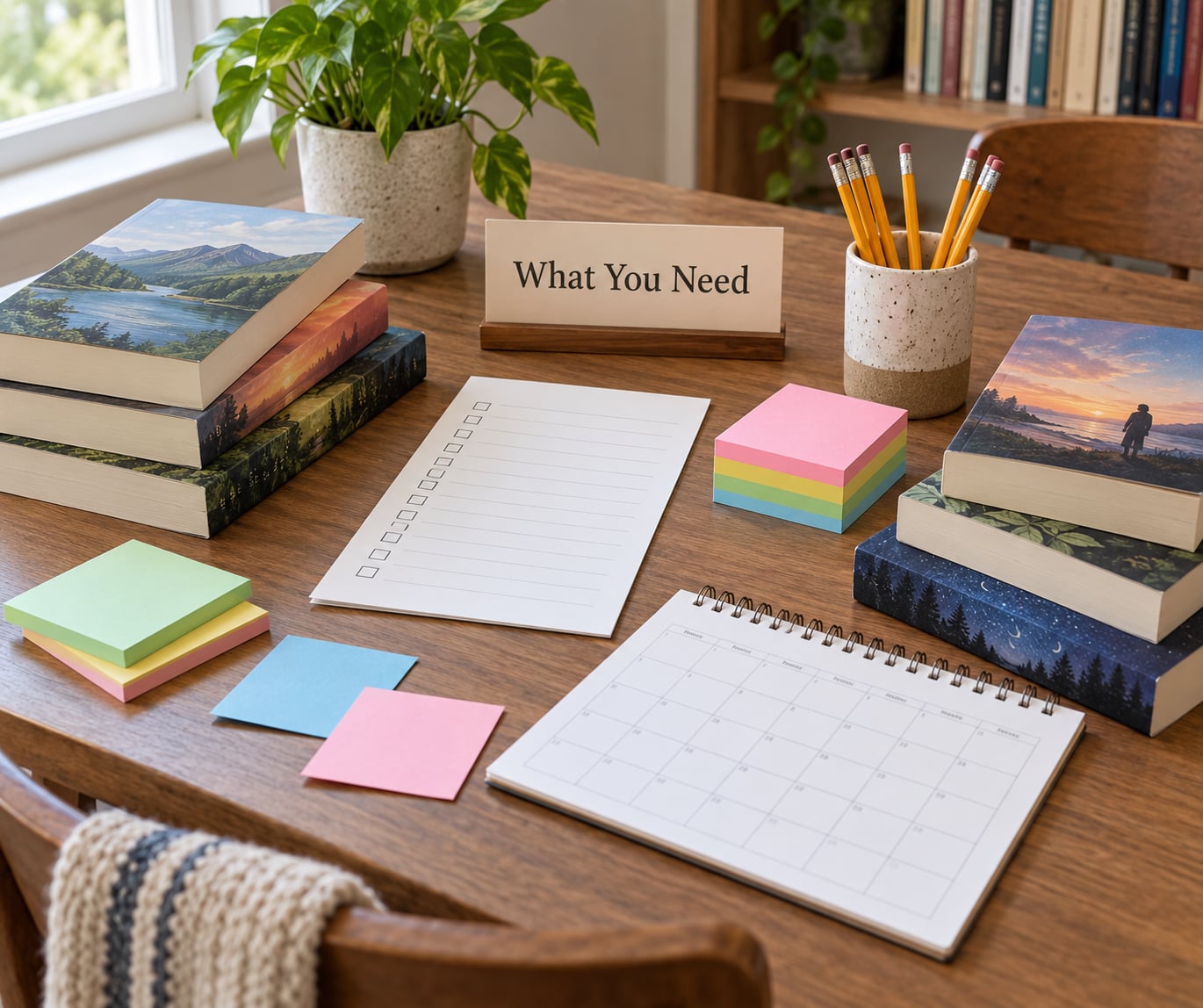
Start small. A group of six is easier to run than a group of twenty, and a group of six that survives the first term is worth far more than a group of twenty that dissolves in three weeks.
- An adult sponsor. A teacher, media specialist, or reading specialist who will be in the room every meeting. If two adults can share the role, even better.
- A consistent room and time. The same spot, the same slot, every week. Changing rooms or times is the fastest way to lose a group.
- One book, with copies available. School library stock, a class set, or student copies borrowed from a public library.
- A one-page plan. Ground rules, a meeting agenda, and five to eight questions ready before students arrive.
- A sign-up route. A form, a spreadsheet, or a notebook — anything that captures a name and a contact.
- A meeting length that fits the age group. See the table below.
None of this requires a large budget or a literary background. Teachers running this for years report that the whole launch cost is usually a handful of photocopies and whatever snacks you bring.
Meeting length by age band, as a starting point rather than a rule:
- Grades K–2: about 30 minutes. Mostly picture books and read-alouds.
- Grades 3–5: about 45 minutes. Chapter books, graphic novels, short early readers.
- Grades 6–8: 45 to 60 minutes. Longer novels, graphic novels, nonfiction.
- Grades 9–12: 60 to 90 minutes. Full novels, memoirs, poetry collections, assigned texts.
These figures match what several published guides to starting a school book club settle on, and they reflect how much sustained conversation a given age can actually hold.
Step-by-Step: How to Start a Book Club at School
1. Set the Goal: How to Start a Book Club at School
Write one sentence describing what the club is for. That sentence is the whole design document, and it decides almost everything else.
Four versions that work well in schools:
- Reading for enjoyment. Students pick what they read and talk about it because they want to.
- Community and belonging. A club for students who do not have a shared social space yet.
- Supporting a unit. The club runs alongside a class novel study and gives students a smaller space to go deeper.
- Supporting a specific need. Reluctant readers in grades 3–8 who test well but do not finish novels.
Pick the one that matches your group, then choose a schedule, a group size, and a meeting length that fit your school day. An elective-period club that meets once a week for 45 minutes is the easiest to sustain. A club that meets before school needs a far more committed group.
Keep the sentence visible. When someone asks why a student is not doing homework during club time, the sentence is your answer.
2. Choose a Pilot Book and Discussion Approach
Choose one book everyone reads, unless the group spans very different reading levels — then a small set of two or three titles on the same theme works better than one difficult book.
For the first book, look for three things:
- Short enough to finish. Under 200 pages for middle school, shorter for upper elementary. A book nobody finishes is a bad first choice.
- Wide appeal. Adventure, mystery, or something with a strong premise. Teachers report that a spooky or surprising premise draws sign-ups that a quiet literary novel will not.
- Divisible. It can be read in weekly chunks that end on something people want to talk about.
When you are matching a book to a reader, the five-finger rule is a quick classroom check: open to a random page, read a paragraph, and hold up one finger per gap where you lose the thread. Four or five fingers means it is too hard for independent reading. One teacher in a popular thread about starting a club in grade 3 described exactly this problem — strong test scores, no willingness to read novels — and the fix was choosing graphic novels and shorter formats rather than lowering the club’s expectations.
Decide your discussion approach in the same breath. One title for everyone keeps discussion focused. Book clubs by choice keep reluctant readers in, at the cost of a harder-to-facilitate room.
3. Recruit Students and Establish a Welcoming Routine
Interest at sign-up is easy. Turnout is the hard part, and this is where most school book clubs quietly fail. The gap shows up constantly in teacher discussions online: abundant sign-ups, thin attendance.
Recruit in three passes rather than one:
- Name the experience, not the book. “Thursday lunch, bring whatever you are reading” pulls more students than a poster listing a title and a page count.
- Recruit in person. Ninety seconds in a homeroom or at the door of a classroom does more than a week of hallway posters. Posters confirm the club exists; people explain why it is worth joining.
- Set the size honestly. Tell students the group is capped at eight. A cap creates the sense that a place was earned, and it protects the discussion.
Then set expectations in writing before the first meeting. A sign-up form that asks for a name, a contact, and one question — “what kind of thing do you like to read?” — does more work than you would expect, because the answers tell you what to put in front of the group.
Write the club guidelines with students rather than for them. Four lines is usually enough:
- One person talks at a time.
- We argue with the book, not with each other.
- Everyone gets a turn. Passing is allowed; interrupting is not.
- What is said in the room stays in the room.
Aim this routine at the students who usually get missed: multilingual students, students with dyslexia or an IEP, and readers well below or above grade level. Offering a choice of role — discussion leader, connector to another book, question keeper, note-taker — gives quiet students a legitimate way to participate without being put on the spot.
4. Plan the First Meeting
First meetings decide whether the club has a second one. Here is a structure that fits 45 minutes and can be trimmed for younger groups.
- Welcome, 5 minutes. Introductions with one fact each. No speeches.
- Why this club exists, 5 minutes. Read your one-sentence purpose aloud.
- Excerpt, 10 minutes. Read a chapter or a few pages aloud, even if everyone has already read them. Hearing the opening read together settles the room faster than any instruction.
- Guided discussion, 15 minutes. Start with reaction questions, then move to meaning questions.
- Choose the next book, 5 minutes. Show three or four titles and take a vote. This is the ritual students remember.
- Next steps, 5 minutes. Confirm the meeting time, how to get the book, and who is bringing what.
The first-meeting agenda ends with a date on the calendar and a decision already made. Students who leave knowing exactly what happens next are the ones who come back.
5. Facilitate Discussion Without Taking Over
The adult’s job is to keep talk moving, not to perform it. The failure teachers describe most often is the group sitting in silence while the facilitator decides to fill it with lecture — which teaches students that the adult, not the book, is the point.
A few question types, in order of how easily they get an answer:
- Reaction: What did you like most? What did you like least, and why? Almost everyone has an answer.
- Predict: What did you think would happen next? Were you right?
- Evidence: Which part of the book tells you that? This is the question that moves a group past preference.
- Connection: Did anything remind you of your own life, or of another book?
- Alternative: Which character would you be? Who would you cast in the film version?
- Author: What would you ask the author?
Keep disagreement on the text. When two students clash, the move that works is “point to the line that convinced you” rather than asking either of them to back down.
Watch for the two failure patterns. When one student dominates, hand the next question to someone by name or use a round-robin where everyone speaks once before anyone speaks twice. When the room goes quiet, ask a question about a specific scene instead of the whole book, and give a silent ten seconds of thinking time before you take answers.
6. Keep the Club Active and Sustainable
A club lasts when the students own part of it. Rotate book selection so different members pick the next title, and give one or two students real responsibility — setting up the room, leading the first ten minutes, keeping the vote count.
Keep the cycle predictable: a meeting every week or every two weeks at the same time, a new book every cycle, a vote at the end of each cycle. Regularity is what turns a series of gatherings into a club.
Communicate with families once at the start and once mid-year, not weekly. One note that says when the club meets, where, and that no preparation is needed at home prevents most parent friction.
If your administrator is unsure whether this counts, frame it honestly. A student-led book club can sit inside instructional time when it has a documented purpose, a text everyone is reading, and a record of participation. An elective club without those does not. Ask the question before the term starts rather than after.
For timing, work backwards from when you want the club healthy. Signing up takes two weeks of visibility, the first book needs time to be read, and the first cycle should end in a vote. A term is short.
Your First Term, Week by Week
- Week 1: Confirm the adult sponsor, room, time, and group size.
- Week 2: Visit classes, post the sign-up sheet, open sign-ups.
- Week 3: Choose the first book from what students signed up for, and confirm every student can get a copy.
- Week 4: Write the guidelines with the group and prepare the first-meeting agenda.
- Week 5: Hold the first meeting.
- Weeks 6–7: Weekly meetings on the first book, each ending with a vote on what is next.
- Week 8: Hand selection to the students and start the second cycle.
Common Mistakes
Nearly every stalled club is doing one of these things. Each has a fix you can apply in the next meeting.
Picking a book that is too difficult. Students who get stuck stop talking, because they have nothing to say. Fix: use the five-finger check on a random page, and drop the reading level two notches from grade level rather than matching it.
Letting one voice carry the room. Fix: round-robin once per meeting, and give the facilitator a physical signal — a raised hand, a card — for “everyone has spoken.”
Meeting with no structure. A free-form discussion with no time limit drifts into a social hour or a lecture. Fix: keep a timed agenda visible where you can see it and let students hold the timer.
Running the club as a lesson. If it feels like homework, attendance drops fast. Fix: keep any accountability light — participation, not a grade per meeting — and protect at least ten minutes for something that is simply enjoyable.
Ignoring the no-shows. Fix: send one group message on the day of the meeting, start every meeting at the same time, and let the group itself text a friend who missed it. Students will chase a peer before an adult will.
Over-preparing. Teachers often delay starting because a full unit of reading seems required. Fix: aim for five good questions and one page of notes. Discussion survives on questions, not on preparation.
Never giving students a choice. Fix: put three titles on the table every cycle and let them vote. Choice is the cheapest motivation available.
A few facilitation habits worth keeping: ask one question and then wait, redirect praise toward the book rather than the student, let the group decide its own norms where possible, and end every meeting on the same beat — the next title and the next date.
Frequently Asked Questions
How many students should be in a school book club?
Five to eight students is the sweet spot. Small enough that everyone speaks each meeting, large enough that the conversation sustains itself without the facilitator carrying it. Six is a common starting number. If more students sign up, run two groups rather than one big one, or keep one larger club for older readers who can handle a bigger room.
How long should a school book club meeting last?
Match the meeting to the age. Plan about 30 minutes for grades K–2, 45 minutes for grades 3–5, 45 to 60 minutes for grades 6–8, and 60 to 90 minutes for grades 9–12. Younger groups need activity built into the time. Older groups can hold a long conversation once the routine is established.
Do all students have to read the same book?
Usually yes, especially for a first cycle. A shared text keeps the discussion focused and gives quieter students something to contribute without doing extra work. When reading levels differ widely, run two or three titles on the same theme and meet separately once or twice, then compare notes in a whole-group session.
How do you include shy or reluctant readers in a book club?
Give every member a role, so participation is not the same as speaking up. Question keeper, connector, summariser, and timekeeper all count. Start with reaction questions they can answer from memory, use written sticky-note answers before anyone speaks aloud, and pick a first book with a premise that pulls reluctant readers in, like a mystery or a graphic novel.
What books work best for the first school book club meeting?
Choose something short, under about 200 pages for middle school, with a strong premise and clear weekly stopping points. The first book is a recruitment tool as much as a reading experience, so pick for appeal rather than for literary ambition. End every session on a question or a cliffhanger so students want to come back.
How can a teacher keep a book club discussion focused?
Keep a timed agenda on the table and let students run the timer. Start with reaction questions, move to evidence questions that require a line from the book, and keep disagreement about the text rather than about the person. When one student dominates, use a round-robin so everyone speaks once before anyone speaks twice.
Conclusion
To start a book club at school, do five things in order. Write one sentence saying what the club is for. Choose one short book everyone can get hold of. Invite six students in person, with a cap on the group. Write four ground rules with them before the first meeting. Then hold that first meeting with a timed agenda that ends with the next title and the next date already chosen.
Everything after that is maintenance: keep the room, the time, and the voting ritual steady, and fix the problems in the Common Mistakes list as they appear. A club that survives its first term is the one students ask to keep.