
Show, don’t tell is the practice of letting a reader experience a scene through what a character does, says, notices and senses, instead of handing them a summary like “she was nervous.” If you want to know how to show not tell in writing, the whole job comes down to one move: find the sentence that names a feeling, then replace the name with the evidence a reader can see.
That sounds obvious once someone says it. Most drafts are full of sentences where the writer does the reader’s interpreting, and the result reads flat, like a summary of a story rather than the story itself. The fix is mechanical. You mark the telling sentences, rewrite each one with specific action, dialogue or sensory detail, and check that a reader could still work out the feeling without being told.
Here is the same sentence rewritten eleven ways so you can see the range before you start on your own draft.
| What the draft tells | What the revision shows |
|---|---|
| She was nervous. | She checked her watch for the fourth time in a minute and pushed the door open, then shut it again without going in. |
| He was angry. | He set the mug down hard enough that the coffee jumped the saucer, and did not say anything for a while. |
| The room was scary. | The lamp in the corner buzzed and went out. Nobody moved to fix it, and the door at the far end stayed ajar, breathing cold air into the room. |
| She felt sad. | She read the last page twice, closed the book, and set it on the table face down. Then she started on the dishes. |
| The crowd was excited. | People stood on the seats. Cups came up above heads, and somebody at the back whooped loud enough to crack. |
| He was relieved. | He let out a breath he’d been holding and sat down on the kerb, elbows on his knees. |
| She was disappointed. | She nodded once, said “of course,” and hung the coat back on the hook by the door. |
| The fight was awkward. | Both of them looked at the table. He turned his cup a quarter turn. She took her phone out, put it down again, and picked it up. |
| She was curious about him. | She asked about the scar, then asked what year he got it, then looked at his hands while he answered. |
| The house had been empty a long time. | A charger lay where someone had dropped it. The kettle still had water in it, gone cold. |
| He was proud of her but would never say so. | “You did that yourself, then,” he said, and went back to folding the chairs without looking up. |
Notice that none of those rewrites explains the emotion. The revisions simply supply the evidence and let the reader conclude what it means. That conclusion-making is the whole effect, and it is why showing tends to hold attention while telling slides past.
Table of Contents
- What You Need
- How to Show Not Tell in Writing: Step-by-Step
- 1. Identify Telling Sentences
- 2. Replace Generalities With Specific Actions
- 3. Add Dialogue and Body Language
- 4. Use the Five Senses
- 5. Reveal Emotion Through Choice and Context
- 6. Read the Revision aloud
- Common Mistakes and Quick Fixes
- Frequently Asked Questions
- What is the literary technique of show, don’t tell?
- How do I show and not tell?
- How does show don’t tell work in writing?
- What are some common show not tell phrases to rewrite?
- Is show don’t tell bad advice?
- How do I show a character’s thoughts without an info-dump?
- Conclusion
What You Need
You need three things, and the third is optional. Have a finished draft, at least a rough one. The trick does not work well on sentences you are still inventing, because you cannot tell whether a sentence is telling when you wrote it to find out what happens next.
Then have something to mark it up with: a printed page and a pen are genuinely better than a laptop for this, because underlining and circling forces you to commit to a judgement. A second document or a phone photo works if that is all you have.
A dictionary or thesaurus covers the third need, which is finding a better verb than the one you defaulted to. And a published novel you trust is worth having nearby, mostly as a calibration reference. You are not copying passages, you are checking how much detail per page your favourite writers spend before moving on.
Budget an hour for a short piece and two or three for a novel chapter. The pass is slow the first time because you are reading for a different purpose, and speed comes back fast.
How to Show Not Tell in Writing: Step-by-Step
1. Identify Telling Sentences
Underline every broad statement in the chapter: anything that names an emotion, sums up an event, or explains a setting instead of putting the reader inside it. “He was lonely.” “The party had been going for hours.” “She realised the truth about her brother.” Each one is a summary the reader has to take on trust.
Then run a second pass for filter words. A filter word is any verb of perception or thought that puts your character between the reader and the experience. The most common ones are was, were, is, are, had, and have, but they are not the worst offenders. The real time-wasters are felt, saw, heard, noticed, realised, decided, wondered, and remembered, because they announce the moment instead of performing it.
“She felt a chill” is a tell. “The hair on her arms lifted” is a show. Same information, but the second version puts the reader inside her skin rather than describing her from the outside.
One practical trick from writing circles is to circle every emotion word in a different colour. When a paragraph is mostly circles, you have found your rewrite list, and the work becomes mechanical instead of overwhelming.
2. Replace Generalities With Specific Actions

Take one underlining and ask a single question: what did this person’s body actually do? Nerves live in the hands and the jaw. Fear lives in the throat and the urge to leave the room. Relief shows up as weight leaving the shoulders. You are not inventing character; you are translating an abstraction into the physical facts that produce it in real life.
Specificity is the other half of the job. “She was upset” and “she was very upset” and “she was unbelievably upset” all say the same thing. Replacing any of them with one odd, precise detail does more work than all three together, because a reader remembers the thing they can picture.
Details only count when they come from your point-of-view character. A crack in the ceiling is free scenery until someone in the room looks up at it, and the person looking up is what makes it a story.
Watch for the sentence that looks like action but is really a summary in disguise. “He packed quickly, angrily, and with trembling hands” performs three emotions at once and explains none of them. Three concrete actions in sequence will carry all three feelings without naming one.
3. Add Dialogue and Body Language
Dialogue is the easiest place to show, because people rarely say what they mean. The gap between what a character says and what they are doing is subtext, and it is where most of a scene’s tension lives.
“It’s fine,” she said, and folded the receipt into a square, then a smaller square, then a smaller one. The words tell you almost nothing. The receipt tells you everything, and you did not have to write the word “nervous” anywhere.
The most common mistake in dialogue is using an adverb in the tag. “She said quietly,” “he answered angrily,” “they whispered nervously” — these are telling sentences wearing a costume. The adverb describes the delivery instead of letting you show it, and it is the single crutch that makes dialogue sound wooden.
Two fixes work. Either replace the adverb with a verb that carries the meaning on its own, so she said nothing and pressed her lips together, or cut the tag entirely once each speaker is clear from context. You will lose the occasional moment of confusion without it, and gain pace everywhere else.
Body language does the same job in silence. Posture, hands, where a character looks and what they do with an object when nobody is talking all carry information, and none of it needs a paragraph of explanation.
4. Use the Five Senses
Sensory detail makes a setting feel like a place you could stand in. The trick is that readers rarely need all five senses in every paragraph. You need one or two chosen well, and you need them to belong to your viewpoint character rather than to an omniscient camera.
A drill that gets used a lot: write five lists headed sees, hears, smells, tastes, touches. Fill each with five things your character could notice in the current room. Then write the scene using the lists without ever using the five sense verbs, so the detail has to arrive through something else.
“The kitchen smelled of onions” is direct but flat. “Someone had left onions in a pan, and the smell had got into the curtains” is the same information with a person and a history attached. The second version tells you someone was cooking an hour ago and left, which is a whole small story for free.
Sound is the most underused sense in amateur fiction, and the one that does the most for tension, because sound arrives before sight. A tap running in the next room, a phone buzzing in a coat pocket, a door closing two floors down — each one puts a character somewhere specific and gives them something to react to.
One warning: smell is the sense most likely to tip into purple prose. Three accurate sensory details beat ten florid ones every time, because you want the reader to notice the room, not admire your vocabulary.
5. Reveal Emotion Through Choice and Context
The most convincing emotion in fiction is never the loudest one. It shows up in what a character chooses to do with the information in front of them, and in how the surroundings press in on that decision. If someone opens a door they have been avoiding, that is a whole relationship summarised in one verb, and no adjective can improve it.
Internal thought is where most writers get stuck, usually because they believe they must show a character’s thought process in full. You do not. You have three options, and the third is the one writers use least.
First, you can let thought arrive as a physical reaction without naming it. Second, you can let another character ask the question the reader is already asking, so the answer comes out in dialogue. Third, you can drop into the character’s voice for a sentence or two and then come back out, which is the technique writers call free indirect discourse: narration that slides into the character’s own phrasing without quotation marks or tags.
Free indirect discourse is the most efficient of the three, because it carries thought without the machinery of “she thought.” If the surrounding narration is in plain third person and a line arrives in the character’s own cadence, the effect is immediate. A character who thinks in short blunt sentences should get those sentences at the moment of impact, not a paragraph before it.
Backstory is the other place writers over-share, and the fix is usually to stop summarising it and start triggering it. Instead of a paragraph explaining why a character left home at nineteen, put them in a kitchen that looks like a barracks and let them open the wrong cupboard. The memory arrives when the object does.
And if the reader needs the information more than they need the scene, tell them. More on that in a moment.
6. Read the Revision aloud
Read the revised section out loud, preferably standing up, at the speed of someone hearing it for the first time. Your ear catches flat sentences faster than your eye does. Listen for a line that could have appeared in a summary, a paragraph where you describe rather than show, and any stretch where nothing physically happens.
Use one question as the filter, because it is the most reliable test I know: am I explaining this to the reader, or am I giving them details to interpret? If you are explaining, the sentence can almost always be rewritten. If you are giving details, leave it alone even if it is not beautiful.
When you finish, run these six checks on the section in order.
- Circle the emotion words. Every one gets either deleted or replaced with a physical detail.
- Search for filter verbs. Was, were, is, are, had, have, felt, saw, heard, noticed, realised, decided, wondered, remembered. Cut them where a direct verb works.
- Check the adverbs. Anywhere an adverb is doing the job of a verb, replace it with the verb.
- Read every dialogue tag. If removing it creates no confusion, remove it.
- Ask whose eyes we are in. Any detail the viewpoint character could not perceive does not belong in the scene.
- Read aloud once more. Anything you stumble over is usually over-built.
One more pass at the end of the chapter: mark every sentence that gives information the reader could not infer. Those are your candidates for a rewrite on the next pass, and they are usually clustered rather than scattered, which means one good hour can clear a page.
Common Mistakes and Quick Fixes
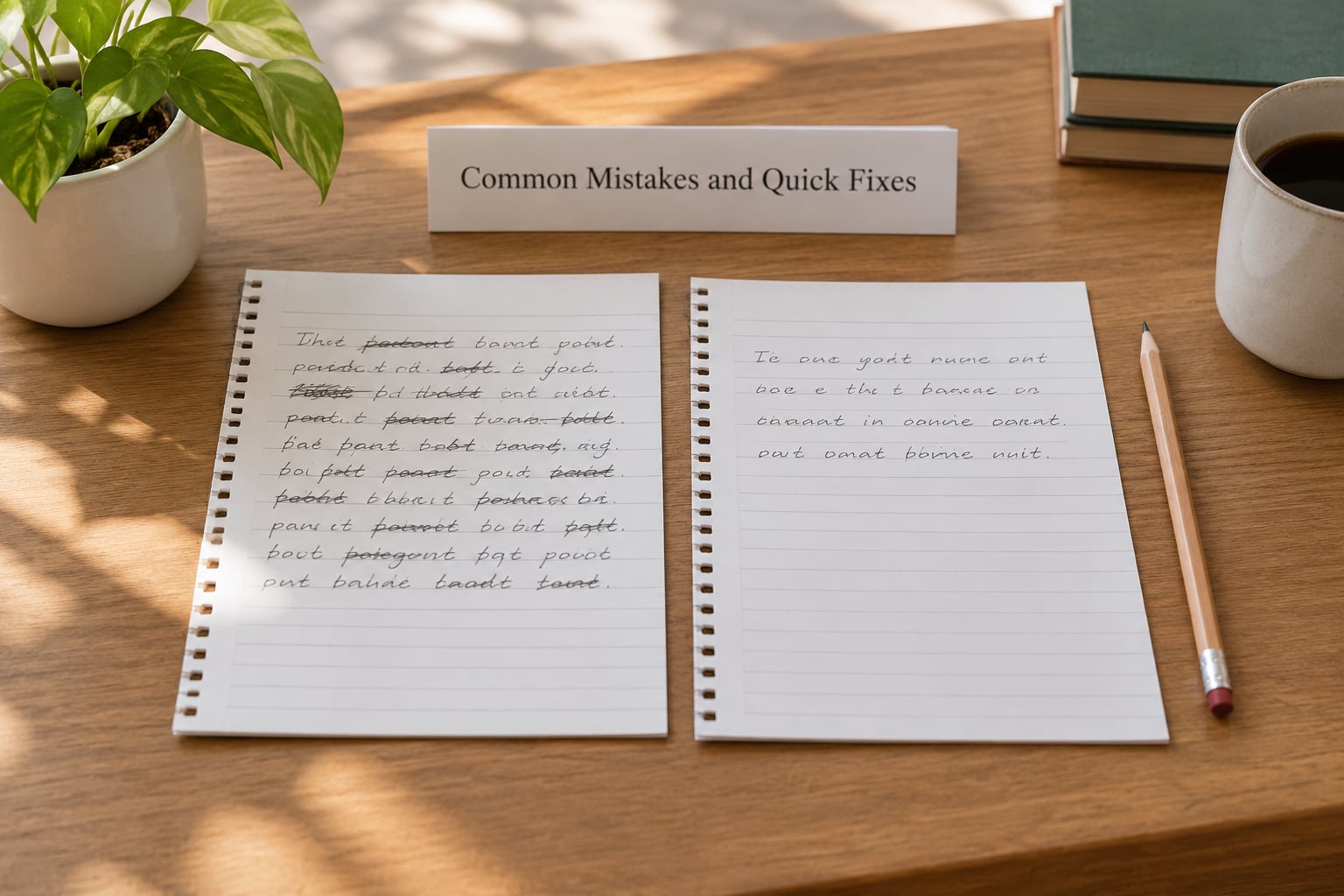
Over-correcting into purple prose. The most common failure mode, and the one that makes readers put a book down faster than bland prose does. A single paragraph rewritten with a detail in every sentence stops being a scene and becomes a catalogue. Fix: cut every third detail in the passage and see if anything is lost. Usually nothing is, and the remaining details have room to land.
Adding an adjective and calling it showing. “She said sadly” is telling with an extra word attached. Fix: ask what sadly looks like from the outside. If you cannot answer that, the emotion has not been worked out yet, and the sentence is not ready.
Stacking sensory details that no one would notice. Real people notice three things in a room, not nine, and they notice the same three under stress. Fix: keep the details your character would actually register, and let the rest go. A detail that only exists to decorate is the fastest route to a paragraph nobody believes.
Using adverbs as dialogue tags. This is the most common crutch in amateur dialogue and the easiest to fix mechanically. Fix: replace the adverb with a verb, or delete the tag and add a beat of action instead.
Wandering point of view. Showing makes this worse, because detail is intimate and it is easy to slip into another character’s head. Fix: after each detail, check whose perception it is. Anything the viewpoint character could not know or feel belongs in a different scene or in a later discovery.
Details that pull attention away from the beat. A long, beautiful description in the middle of a confrontation stops the scene dead. Fix: put the heavy description before or after the exchange, not inside it, and keep the strongest image for the moment of highest pressure.
Telling so much the story reads like instructions, showing so much it stalls. This is the balance problem writers keep arguing about, and it is real. Fix: aim for showing in the moments that matter to the story, and speed through everything else in a clean summary. A scene where nothing changes for three pages needs telling, not more detail.
One more thing worth saying plainly, because the rule has been repeated so often for so long that people apply it like a commandment: show, don’t tell is old advice, not modern dogma, and it is not a ban on telling. Every writer on the r/writing and r/Screenwriting threads who argues about this eventually lands in the same place — it is better to show, not tell, unless it is better to tell. The skill is judging which one you are looking at, and that judgement comes from reading widely, not from a rule.
For a classroom or critique-group version of this, the useful move is to make the feedback mechanical. Instead of telling a student “you are telling,” hand them a pen and ask them to circle every emotion word on the page. The sentence they struggle to fix is the sentence that was not doing enough work, and they usually see it themselves.
Frequently Asked Questions
What is the literary technique of show, don’t tell?
Show, don’t tell means conveying a character’s emotion, setting, or action through concrete behaviour, dialogue, and sensory detail rather than stating it outright, so the reader draws the conclusion themselves. Instead of writing that a character was nervous, you write the physical facts of nervousness: a checked watch, a door opened and shut again. The technique gives readers evidence instead of conclusions, which is why it produces immersion rather than summary.
How do I show and not tell?
Circle every emotion word in your draft, then rewrite each one using what the character’s body does, what they choose, or what they say. Replace filter verbs like felt, saw, heard, noticed and realised with direct action. Cut adverbs out of dialogue tags, add one sensory detail from your viewpoint character, and finish by reading the passage aloud. If a reader can name the feeling from your details alone, the revision worked.
How does show don’t tell work in writing?
Telling hands the reader a conclusion: the character was angry, the room was tense, the meeting changed her. Showing supplies the evidence for that conclusion and lets the reader reach it, which puts them inside the scene instead of outside it watching a summary. Because the reader does the interpreting, they participate emotionally rather than being told what to feel, and scenes written that way tend to hold attention better.
What are some common show not tell phrases to rewrite?
The usual suspects are emotional labels and perception verbs: was nervous, felt sad, was relieved, was disappointed, saw the car, heard a noise, noticed the smell, realised the truth. Each one can be replaced by the behaviour, object or sound that produced it. ‘She felt sad’ becomes setting a book face down and starting the dishes. ‘He saw the car’ becomes giving the car a specific, noticed detail the character could register.
Is show don’t tell bad advice?
No, but it is advice rather than law, and it gets overapplied. The rule exists because summarising is easier than writing a scene, so it earns its place in early drafts and in emotionally loaded moments. It stops earning its place in transitions, background history, world-building the reader needs quickly, and anywhere a scene has gone on without changing anything. The useful question is not whether you are showing but whether this moment needs to be lived or reported.
How do I show a character’s thoughts without an info-dump?
Three tools work. Let the thought surface as a physical reaction rather than a named feeling. Let another character ask the question the reader is asking, so the answer arrives as dialogue. Or slide into the character’s own phrasing for a sentence or two without quotation marks or tags, which is free indirect discourse, then return to the narration. For backstory, trigger the memory with an object in the present scene instead of summarising the history.
Conclusion
The method is short enough to keep in your head: mark the telling sentences, replace each general statement with what a body does or a person says, add one sensory detail from your viewpoint character, cut the adverbs and the filter verbs, then read it aloud to see if you explained anything you could have shown. What you are really doing is moving the work from your sentence into the reader’s head, one detail at a time.
That is the practical answer to how to show not tell in writing, and it is short enough to do in one sitting. Start with a single sentence tonight. Find one underlining in whatever you are drafting, and rewrite it using action, sensory detail, or dialogue. Then move to the next one. That is the fastest way I know to hear the difference in your own prose.
Updated for 2026.