Varying sentence length means deliberately mixing short, medium, and long sentences in the same passage so the prose has rhythm and so the points that matter land harder than the description around them. Most drafts don’t fail for lack of good ideas. They fail because every sentence runs 18 to 22 words, and the reader’s ear tunes out somewhere in paragraph three. This guide gives you a repeatable revision process rather than a general reminder to mix things up, and it takes about 30 minutes for a short essay or an hour for a chapter.
The uniformity is usually invisible to the person writing it. On the page it reads fine, maybe even elegant. Then an editor circles a paragraph and writes monotonous in the margin, and the writer cannot see what the editor saw, because the pattern is only visible from the outside, as a rhythm rather than as individual sentences.
One thing to clear up first: long sentences are not a defect. Writers on writing forums push back hard against blanket advice to shorten everything, and they are right. A 40-word sentence carrying three linked clauses can move an argument forward beautifully. The problem is never length on its own. The problem is a paragraph where every sentence is roughly the same length, so nothing stands out and the pacing goes flat.
Table of Contents
- What You Need — Three Things and Nothing More
- Step-by-Step: How to Vary Sentence Length Across a Draft
- Read the Draft for Repeated Patterns
- Combine Sentences Where Ideas Belong Together
- Split Sentences That Carry Too Much
- Create a Deliberate Short-Medium-Long Rhythm
- Use Sentence Openers Without Repetition
- Read the Revision Aloud and Check the Flow
- Common Mistakes
- Tips for Maintaining a Natural Rhythm
- Frequently Asked Questions
- How short should a sentence be in academic writing?
- Is it bad to use several short sentences in a row?
- How do I vary sentence length without making my writing sound artificial?
- What is a good sentence length for clear writing?
- Can sentence fragments be used effectively in essays?
- How does sentence length affect paragraph flow?
- Conclusion
What You Need — Three Things and Nothing More
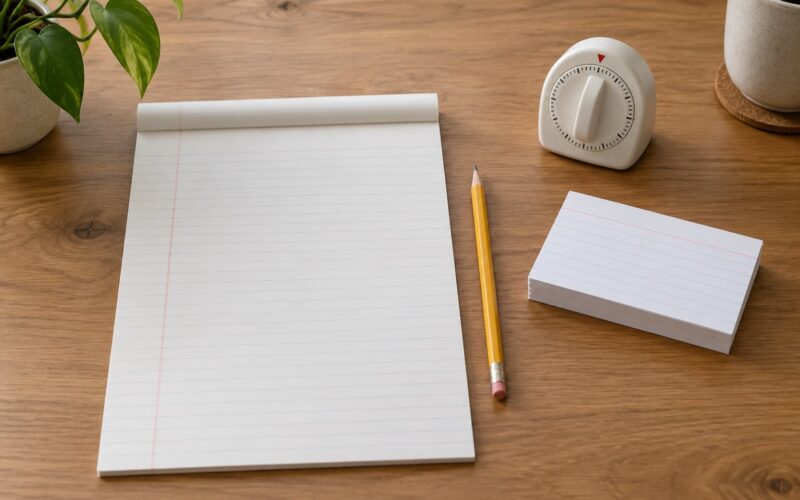
The whole method works with a completed draft, a printed or clearly displayed copy, and a pencil. That is genuinely it. You are going to bracket sentence boundaries, write a number next to each one, and cross out or join things by hand, and all of that goes faster and more honestly on paper than on a screen, where the eye skims over its own prose.
A ruler is nice for the counting pass, since it keeps your eye moving down a column at the same speed instead of speeding up over the sentences you already know by heart. Beyond that, no special software is required. If you would rather measure electronically, a word processor’s word-count tool applied sentence by sentence gives the same numbers, though you have to count them one at a time anyway.
Step-by-Step: How to Vary Sentence Length Across a Draft
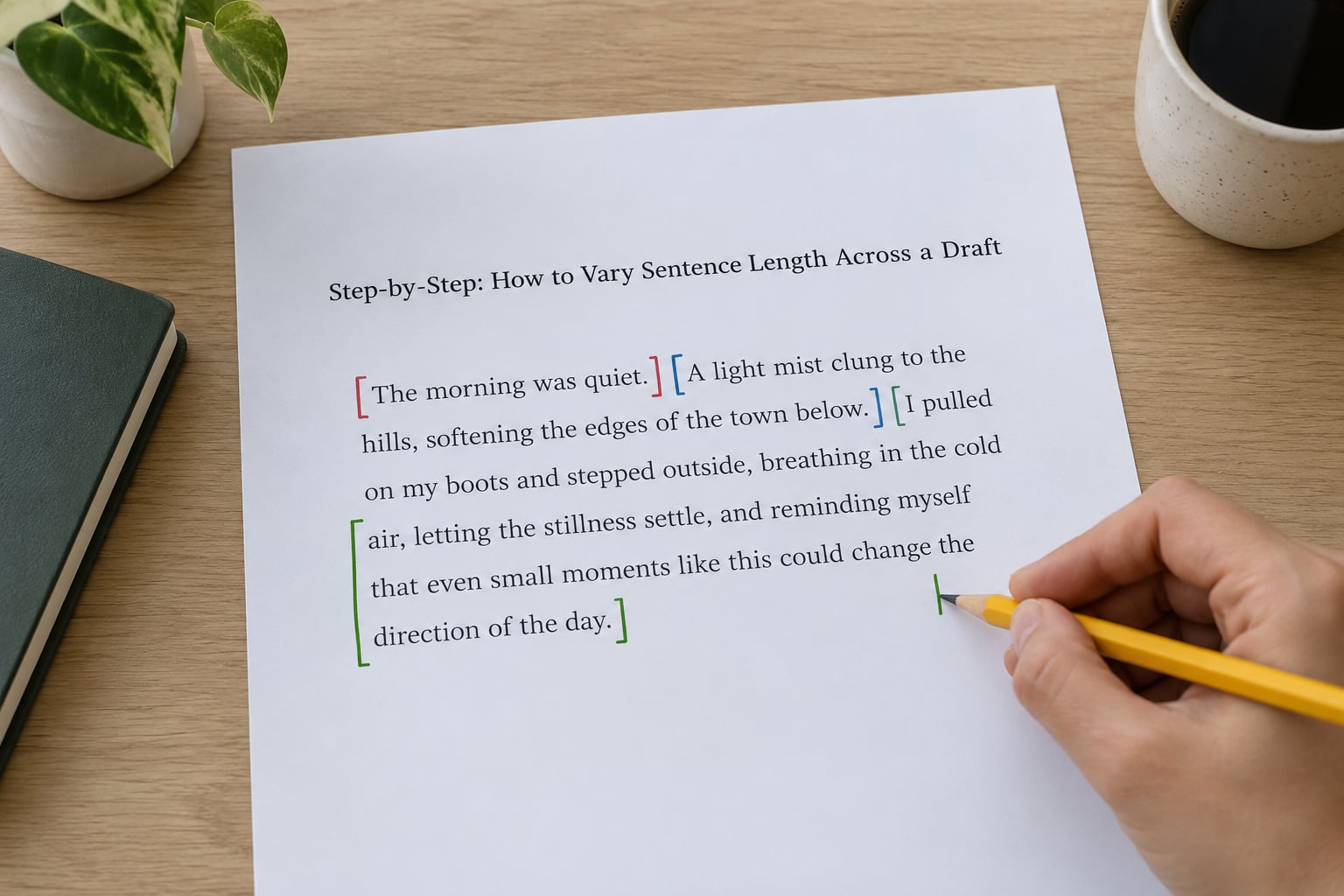
Work in six passes, in this order, and change nothing but sentence length and sentence boundaries until you reach the last step. Diagnose before you edit, because a draft revised from the first sentence onward tends to lose its thread, and you will end up with a page that is varied but no longer says what it started out saying.
Read the Draft for Repeated Patterns
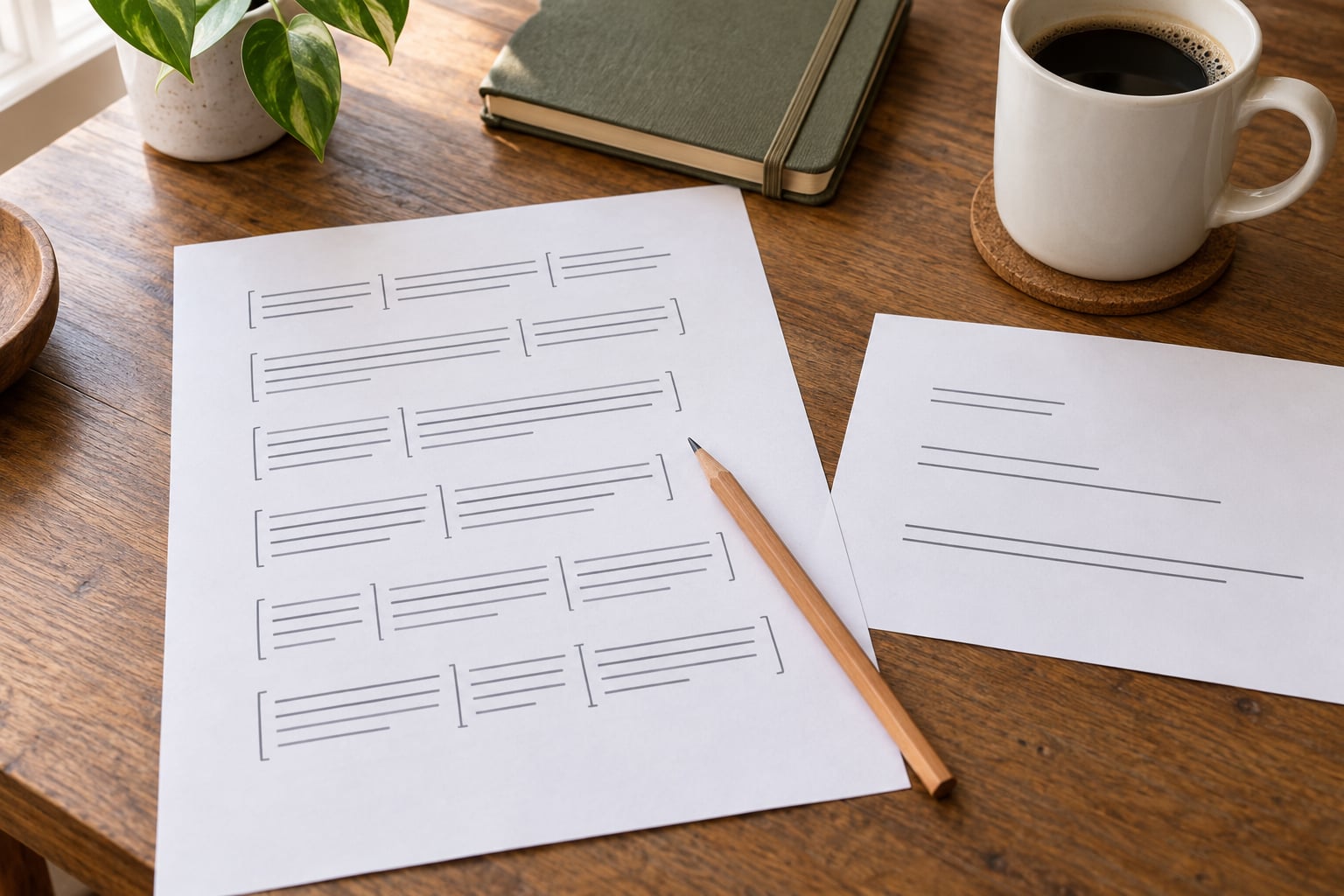
First pass: mark every sentence boundary with a bracket, then write the word count beside it. Use these bands. Four or five words is a fragment or a hit. Six to fifteen is short. Sixteen to twenty-five is medium. Twenty-six or more is long.
Now look at the column of numbers rather than the column of words. What you are hunting for is a run, meaning three or more consecutive sentences in the same band. Three short sentences in a row chops. Three long sentences in a row drifts and blurs. Three medium sentences in a row is the most common problem and the least obvious one, since medium sentences read as perfectly normal on their own.
A useful target for a paragraph is roughly one sentence under eight words, two or three in the sixteen-to-twenty-five range, and one over thirty, though not every paragraph needs that spread. What you are checking for at this stage is presence, not a quota. Leave the numbers where they are and move on.
Combine Sentences Where Ideas Belong Together
Second pass: find runs of three to five short sentences and ask, for each pair, do these two ideas actually belong in one breath? If they do, join them. If they don’t, leave them apart, because choppiness with the joins forced is worse than the original choppiness.
Four tools do the joining work. Coordination with and, but, or so links two equal ideas. Subordination with although, because, while, or since makes the shorter idea dependent and marks its importance. A semicolon joins two complete sentences that are closely related in meaning. A colon introduces a list or an explanation that the first clause sets up.
Before joining, after joining:
He opened the door. The room was dark. Nobody had turned on a lamp. She stepped inside and found the window open.
He opened the door and found the room dark, the lamp off, the window open, and nobody waiting for him.
That revision went from four short sentences to one 27-word sentence. Notice that the join also did something length alone cannot: it turned four neutral statements into one sentence with a list that ends on the fact that mattered.
Two sentences that should not be combined usually have nothing syntactically connecting them, and the give-away is that you need meanwhile, later that week, or in another part of town to make the link work. Those are transition problems, and you solve them by writing a real transition or by letting a paragraph break sit between them.
Split Sentences That Carry Too Much
Third pass: take every sentence over about 35 words and split it. The natural break points, in rough order of usefulness, are before a coordinating conjunction that joins two complete ideas, before a subordinate clause such as which or although, before a list of three or more items, after a colon, and at the boundary between two independent clauses that can stand alone.
Original, 42 words:
The committee, having reviewed the proposal twice, decided that the timeline was unrealistic given that the budget had already been cut by a third and that the team would need to hire two more engineers before any of the new features could be built.
Version one, split at the first boundary and 25 words:
The committee reviewed the proposal twice and decided the timeline was unrealistic. The budget had been cut by a third, and the team would need to hire two more engineers before any new features could be built.
Version two, 6 words then 14, which puts the verdict last:
The timeline was unrealistic. The budget had been cut by a third, and the team would still need to hire two more engineers before anything new could be built.
Version two is usually the stronger one, because the short sentence is the one the reader remembers. Both are better than the original. Neither is universally right, which is the point: the split is a choice about emphasis, not a rule.
When you split, watch for a stranded modifier. Moving the team would need to hire two engineers into its own sentence can leave before any new features could be built floating without an anchor, and readers then attach it to the engineers rather than to the project.
Create a Deliberate Short-Medium-Long Rhythm
Fourth pass: place the contrast on purpose. Two orderings do different work, and which one you want depends on the job.
Long then short uses the long sentence to build and the short one to land. It suits a reveal, a verdict, or the end of a paragraph. Short then long uses the short sentence as a hinge. It suits an opening, a pivot into explanation, or the start of a new movement in an argument, because the reader leans forward to find out what the longer sentence will do.
The wrong order is the one that works against the meaning. A long sentence that ends the paragraph dissipates. A short sentence that opens a long one can feel like a shrug followed by an essay unless the long sentence clearly answers it.
This is also where the 2-3-1 rule comes from, since it appears in People Also Ask and almost nobody explains it. The rule says a paragraph reads well when it moves from longer sentences to shorter ones in a rough ratio of two long, three medium, one short, with the short one usually last. A worked example at 24, 19, 22, 17, 11, and 6 words:
- Two long or medium-long sentences that set up the situation, roughly 20 to 30 words each.
- Three middle sentences of roughly 15 to 20 words that develop it.
- One short sentence, usually five to eight words, that closes the movement.
Treat it as a diagnostic shape rather than a formula. A paragraph that ends on a medium sentence with no short one anywhere often feels unresolved, and appending a short sentence at the end is a quick test: if the paragraph snaps shut, you found the missing beat.
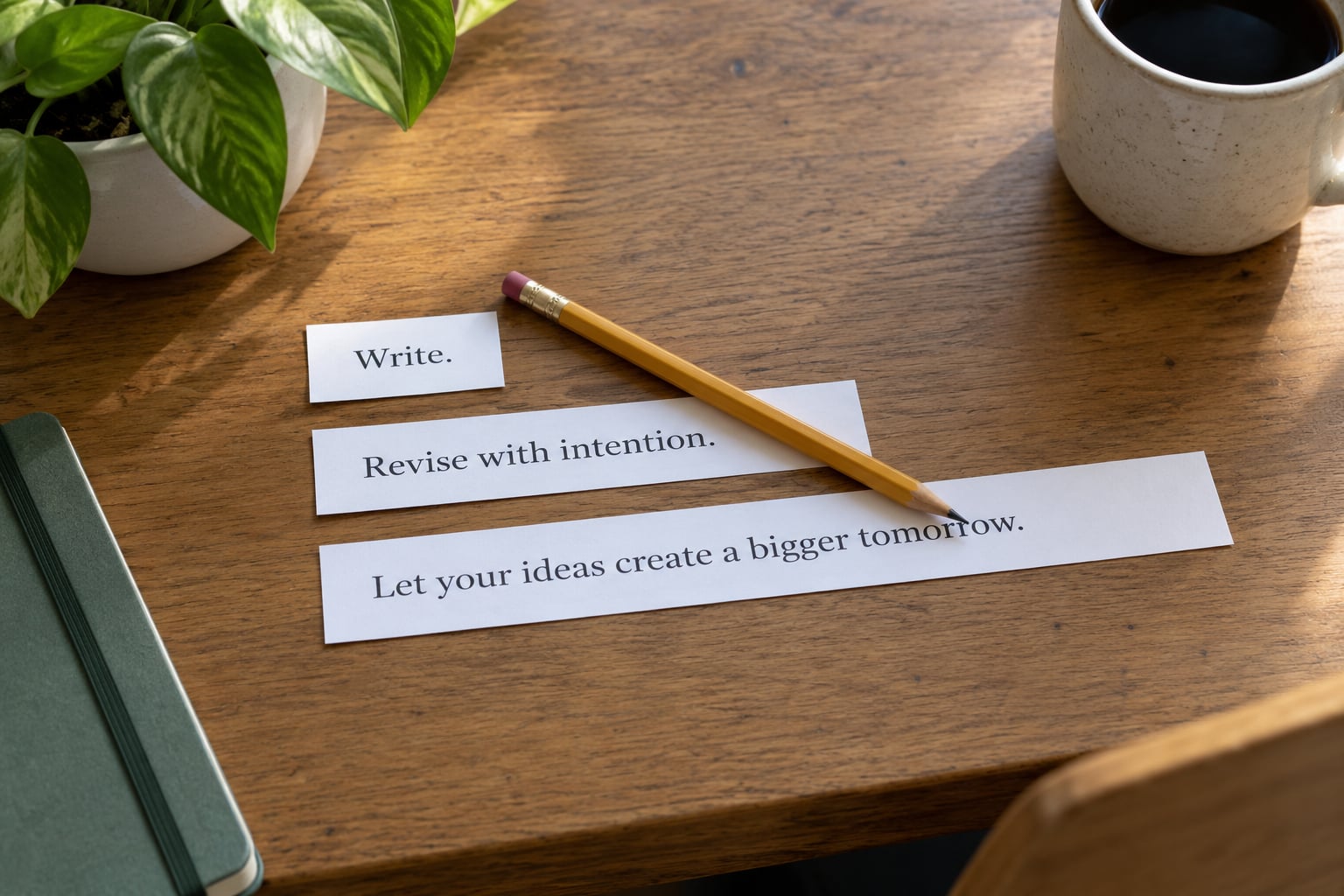
The rule of threes works alongside this. Three items, three beats, three clauses, escalating in length or weight, and the third lands hardest. Two items read as a pair and leave the reader waiting for a third, so if you have two, either find the third or make the pair’s incompleteness the point.
Use Sentence Openers Without Repetition
Fifth pass: read down the first three or four words of each sentence only. Most writers discover a stutter here rather than in the lengths. Character name plus verb, character name plus verb, character name plus verb, then pronoun plus verb, pronoun plus verb. The sentences may vary in length perfectly and still sound mechanical.
Openers can be moved around in a predictable order. Put the dependent clause first, as in After the vote failed, the committee resigned. Put the prepositional phrase first, as in On the third day the river dropped. Open with a participial phrase, as in Shuffling through the archives, she found the ledger. Lead with an adverb, as in Quietly, the machinery stopped. Start with a question. Start with a one-word sentence.
Each choice shifts emphasis, not just shape. The committee resigned after the vote failed stresses the committee; After the vote failed, the committee resigned stresses the vote. Vary the openings and you vary emphasis as a side effect, which is more valuable than variety for its own sake.
Resist changing every opener in a paragraph. Two adjacent sentences can legitimately share an opener when the second one deliberately echoes the first. Artificial variety is more noticeable than the repetition it fixes.
Read the Revision Aloud and Check the Flow
Sixth pass: read the whole thing out loud at your normal speaking pace. This is where problems that your eye skipped become audible, and it costs nothing but a room with no interruptions.
Listen for five things. A stumble means the sentence is longer than your breath. A flat run of equal rhythms means the lengths have not actually changed enough. A hard landing on a full stop means the short sentence is doing emphasis work, which is fine only if you meant it. A question about which sentence you just read means an antecedent or a modifier has drifted. And a moment where you would naturally speed up and could not means the pacing is fighting you.
Then run the checklist. Are there any three consecutive sentences in the same band? Did any paragraph end on its longest sentence? Do two adjacent sentences open the same way? Does every short sentence earn its shortness? Have you joined anything that only looks connected because you put it next to something?
Fix what shows up and stop. The goal is a reader who does not notice your rhythm, because nothing is dragging them out of it.
Common Mistakes
Most of the trouble people have with sentence length comes from over-applying one rule. Here are the five failures I see most often, and the direct fix for each.
Making every sentence short. Choppy prose is the most common result of general advice on this topic being read as a command to shorten everything. The fix: short sentences are for emphasis and pivots, so aim for one per paragraph rather than four, and let the sentences between them carry the weight. If you are writing fiction or narrative, put a long sentence back in roughly every third slot.
Adding artificial fragments. A four-word fragment after every full sentence reads like a poster. Fragments are strong when they are rare, so keep them for a moment of pressure, a piece of dialogue, or a line that should not be slowed down by a subject and verb.
Joining unrelated ideas. This is what happens when you apply the combining step to every pair of short sentences. The test is simple: if the joined sentence needs a transition word to make sense, the ideas were two things, and you should write a real transition or a paragraph break instead.
Changing every opener. Variety applied uniformly is its own kind of monotony, and it flattens emphasis because nothing is positioned where you meant it. Change openers where you hear a stutter, not everywhere.
Varying length without fixing transitions. You can produce a beautifully varied paragraph that still runs badly, because the joins are covered in also, furthermore, and in addition rather than logic. Length is the surface. Transitions are the plumbing, and a varied paragraph with bad plumbing still leaks.
Tips for Maintaining a Natural Rhythm
Fiction and academic writing want different mixes, and treating them the same is why general advice frustrates so many students. Action and dialogue want short sentences with long ones for setup, because the long sentence slows time down and the short one moves it. Description and setting want the opposite, with long cumulative sentences that stack detail and a short one to end the view. Academic and expository writing generally wants more medium sentences than fiction does, with a short one reserved for the claim that has to land, since a short sentence in a formal essay reads as emphasis the same way it does anywhere else.
On timing: fix this during revision, not during the first draft. Drafts need to be finished before you can see a pattern, and a writer who stops to balance sentence lengths at sentence one stops writing. Several people on writing forums say they now vary length on purpose while drafting, which works once you have done the edit a dozen times and the pattern is in your hand.
Three exercises with model answers, if you want practice. Exercise one: take a paragraph of all medium sentences and rewrite it so it ends on a sentence of five words or fewer. Model answer shape: setup, one medium sentence, one short sentence. Exercise two: take a 40-word sentence and split it three different ways, then decide which version puts the strongest fact last. Model answer: whichever split leaves the most consequential clause standing alone. Exercise three: write four sentences that all begin with a character’s name, then rewrite three of the four openers so only one stays. Model answer: keep the name on the sentence where the character is acting rather than being observed.
If you want the theory behind this in more depth, the standard advice from writing handbooks is worth reading in full. Purdue OWL’s variation strategies and Gary Provost’s widely circulated piece on the art of sentence length are both short, and both are old enough that you will notice how little has changed since.
Frequently Asked Questions
How short should a sentence be in academic writing?
Short is relative to the passage. A five or six word sentence is a genuine emphasis beat and should appear rarely, perhaps once per paragraph. In academic writing, the useful bands are six to fifteen words for short, sixteen to twenty-five for medium, and twenty-six or more for long. The test is not the count but whether the short sentence carries your claim. If it does, keep it. If it only makes the paragraph look choppy, merge it into the sentence before it.
Is it bad to use several short sentences in a row?
Three or more short sentences in a row create a choppy, staccato rhythm, and the effect compounds because each one keeps resetting the reader’s expectations. Two in a row is usually fine and often good, especially at the end of a paragraph. Three is defensible only when you want the reader to feel cornered, which is a deliberate effect, not a default one. Most drafts need a longer sentence between the shorts.
How do I vary sentence length without making my writing sound artificial?
Vary only the spots that flag a problem rather than rewriting every sentence. The safest method is to bracket your sentences, write the word count beside each one, and change the runs where three or more fall in the same band. Leave the rest alone. Variety that is applied evenly across a page draws attention to the editing, while variety applied to genuine patterns reads as rhythm.
What is a good sentence length for clear writing?
Most clear writing sits between 15 and 25 words per sentence on average, but the average matters far less than the spread. A passage where every sentence lands between 18 and 20 words is harder to read than one running from 6 to 30, because the reader has nothing to catch on to and no points to rest at. Check the range and the runs rather than the average.
Can sentence fragments be used effectively in essays?
Yes, used sparingly and with intent. A fragment works when the missing element is the thing you do not want to say, which is how dialogue, interior thought, and moments of pressure are often written. In a formal essay, keep them to a deliberate punch rather than a habit, and never use one where a reader needs grammatical clarity to follow your argument. If in doubt, complete the sentence.
How does sentence length affect paragraph flow?
Length sets pace and emphasis. Long sentences accumulate detail and slow the reader down, so they suit scene setting and complex reasoning. Short sentences stop the reader, so they suit verdicts, transitions, and the last line of a paragraph. Flow comes from arranging the two in contrast, and paragraphs often sag when a run of medium sentences gives the reader no change in pace to move with.
Conclusion
Start by doing nothing to the prose. Bracket every sentence in a page, write the word count beside each one, and find the runs where three or more land in the same band. That single pass takes about ten minutes and it will show you something your editing eye cannot, which is the shape your paragraphs currently have.
Only then combine, split, and rebalance, in that order, and read the result aloud before you call it finished. Most drafts need fewer changes than writers expect, because the problem is usually two or three paragraphs rather than the whole page.