Books about women inventors and scientists for kids fall into two families: true stories of women who made discoveries and built things, and fiction starring girls who love science. The right pick depends mostly on your child’s age and reading level, so the ten titles below come with an age band, a clear fiction-or-biography label, and one hands-on activity to try after reading. I update this list in 2026 whenever a new edition or a stronger option appears.
One more thing worth saying up front. Most lists you’ll find online give you Marie Curie and Ada Lovelace over and over, and leave out everyone else. That is a poor deal for a child, and a poor deal for a shelf. Representation only works if it’s repeated across a child’s whole life, so these picks lean on Katherine Johnson, Mae Jemison, Black women scientists, and women whose work is usually filed under history or mathematics rather than science.
Table of Contents
- Books About Women Inventors and Scientists for Kids at a Glance
- What to look for in books about women inventors and scientists for kids
- 1. Hidden Figures Young Readers’ Edition by Margot Lee Shetterly
- 2. She Persisted in Science by Chelsea Clinton
- 3. Women in STEM by Lisa Yee
- 4. Women in Science by Margaret S. McLure
- 5. Dreamers of the Day by Tyree Daye
- 6. Rosie Revere, Engineer by Andrea Beaty
- 7. Ada Twist, Scientist by Andrea Beaty
- 8. Marie Curie by Demi
- 9. Katherine Johnson by Leland P. De la Durantaye
- 10. Mae Jemison by Leland P. De la Durantaye
- Frequently Asked Questions
- What age group are books about women inventors and scientists for best suited to?
- Are books about women inventors and scientists for kids only biographies?
- How can I help my child learn about women scientists without making history feel overwhelming?
- What is a good first book for a child who likes engineering or space?
Books About Women Inventors and Scientists for Kids at a Glance
Start with this table if you want to choose in thirty seconds rather than read ten sections.
| Book | Author | Best age | Fiction or biography | One-line take |
|---|---|---|---|---|
| Hidden Figures Young Readers’ Edition | Margot Lee Shetterly | 9-14 | Nonfiction history | Katherine Johnson and the NASA mathematicians, told as a story |
| She Persisted in Science | Chelsea Clinton | 7-12 | Nonfiction profiles | Short, dense entries on dozens of women across many fields |
| Women in STEM | Lisa Yee | 8-12 | Nonfiction profiles | Centers Black, Indigenous, and Asian women scientists |
| Women in Science | Margaret S. McLure | 7-11 | Nonfiction survey | Illustrated tour of astronomy, medicine, physics, and biology |
| Dreamers of the Day | Tyree Daye | 6-10 | Nonfiction, lyrical | Black women whose work changed medicine and mathematics |
| Rosie Revere, Engineer | Andrea Beaty | 4-8 | Fiction picture book | The gentlest on-ramp into engineering for young children |
| Ada Twist, Scientist | Andrea Beaty | 5-8 | Fiction picture book | Imaginative story about testing, failing, and revising |
| Marie Curie | Demi | 7-11 | Illustrated biography | Detailed account of the radioactivity experiments and the barriers |
| Katherine Johnson | Leland P. De la Durantaye | 5-8 | Illustrated biography | Picture-book version of the orbital mathematics story |
| Mae Jemison | Leland P. De la Durantaye | 6-9 | Illustrated biography | Physician, astronaut, and advocate for kids in STEM |
What to look for in books about women inventors and scientists for kids
Age fit matters more than anything else. A child who can’t decode the words won’t meet the scientist at all, so an eight-year-old struggling with a chapter book will do better with an illustrated biography than with dense profile entries.
Next, check whether the book is honest about barriers. Race and gender discrimination shaped how these women worked, and a book that skips it teaches children that progress was simple. Look for one sentence about the obstacles, not a whole chapter.
Representation means breadth too. Check who is on the cover and inside, not just whether one woman is mentioned. A book with five scientists across four countries is worth more than five profiles of the same famous physicist.
Finally, look for a hook into activity. Books that end with something a child can hold, test, or build in the kitchen tend to be reread more, which is the point.
1. Hidden Figures Young Readers’ Edition by Margot Lee Shetterly
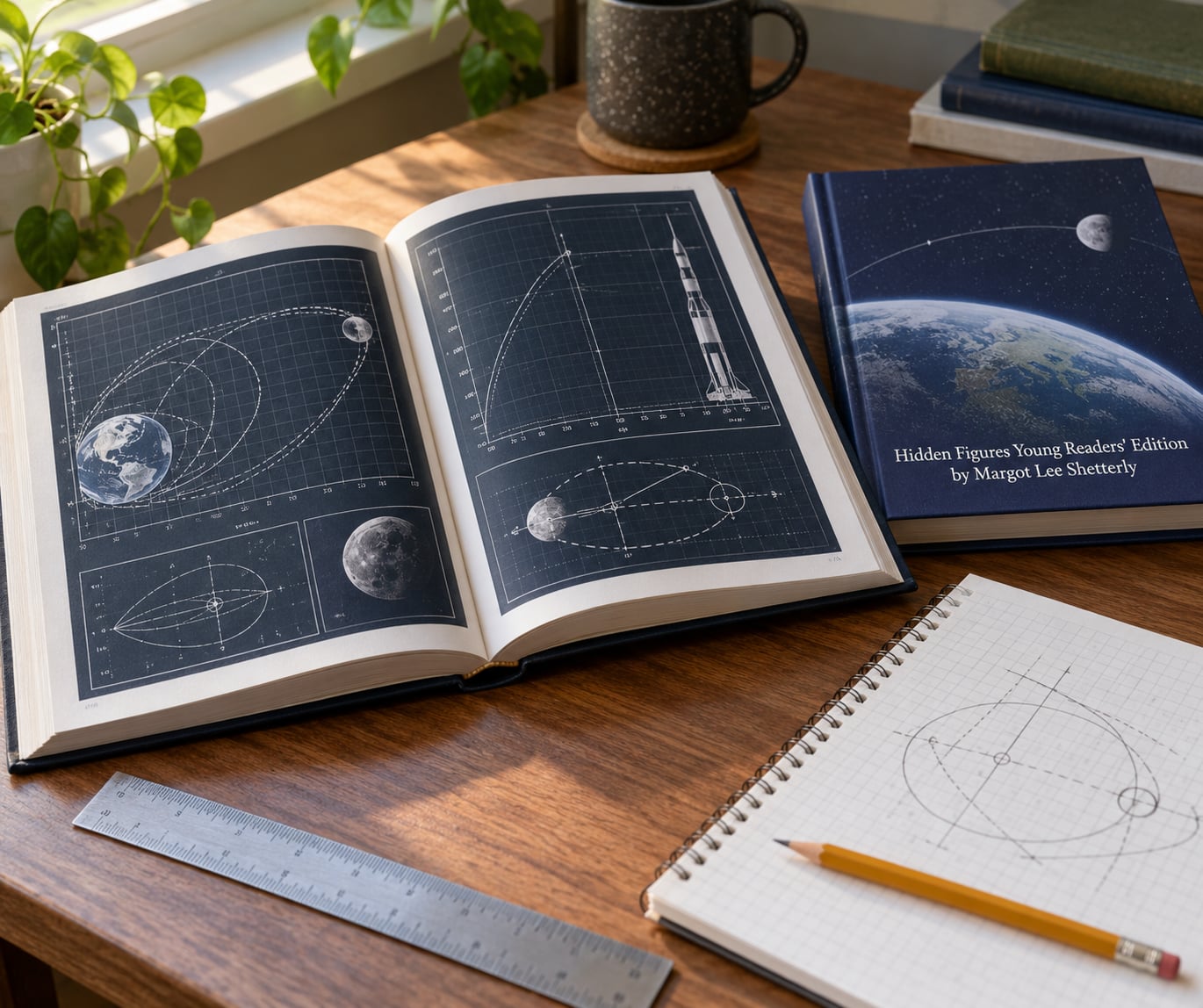
This is the strongest fit for ages nine and older on the whole list, and the adaptation is what makes it work: the original adult book was dense with orbital mechanics, and the young readers’ version keeps the story while trimming the physics.
Katherine Johnson appears here as one of a group of Black women mathematicians whose hand calculations supported early NASA missions, which matters more than the credit drama most people remember from the film. A child learns that competent women did this work and were not credited for it at the time.
Activity: before reading, have your child work out how long a family drive takes, including one planned stop. After reading, ask them what makes that calculation different from plotting a spacecraft path. They’ll struggle, and the struggling is the lesson.
2. She Persisted in Science by Chelsea Clinton
Short profiles, one page each, moving through history and across fields: physics, genetics, astronomy, medicine, and more. Because the entries are brief, a child can read five in one sitting and come back to one that sparks something.
The framing is persistence, which is useful for children because it converts abstract history into a behavior they can picture. The people and institutions that helped each scientist are also named, so the book isn’t a lonely-genius story.
Activity: read one profile aloud, then ask three questions. What problem was she trying to solve? What did she keep doing after it got hard? Who helped her? The third question is the one that surprises parents most.
3. Women in STEM by Lisa Yee
This collection does something rarer than most: it centers Black, Indigenous, and Asian women scientists as the main cast rather than as a token exception in a closing chapter.
It suits readers around ages eight to twelve, and it pairs well with a classroom unit because each profile gives you a natural starting point for a short research assignment.
Activity: pick one scientist and have your child build a one-page report three ways: as a written interview, as a labeled diagram of the work, or as a first-person narrative written from her point of view. Comparing the three formats is itself the lesson about how information gets shaped.
4. Women in Science by Margaret S. McLure
An illustrated survey rather than a series of portraits, which makes it the broadest entry here. Astronomy, medicine, physics, and biology all appear, so a child who thinks science means only lab coats gets a wider picture in about forty pages.
The format rewards going back to it. Unlike a linear biography, a survey can be opened at random, and children tend to do exactly that.
Activity: draw four columns on paper and label them astronomy, medicine, physics, and biology. As you read, jot each scientist into the right column, then choose one discovery and illustrate it. The sorting itself fixes the categories in memory.
5. Dreamers of the Day by Tyree Daye
This is the one to reach for when a child has stopped being interested in STEM and you want poetry instead of prose. The language is lyrical and the historical content is real: Black women whose work reshaped medicine, mathematics, and public life.
Because the writing is poetic rather than plain, pair it with something sturdier. Read one biography together, then check the facts against a timeline or a second source. That habit of verifying a beautiful claim is worth teaching early.
Activity: build a simple timeline on a strip of paper. Put the scientist’s birth year at one end, the discovery in the middle, and today at the other. Ask what your child would add to the timeline next.
6. Rosie Revere, Engineer by Andrea Beaty
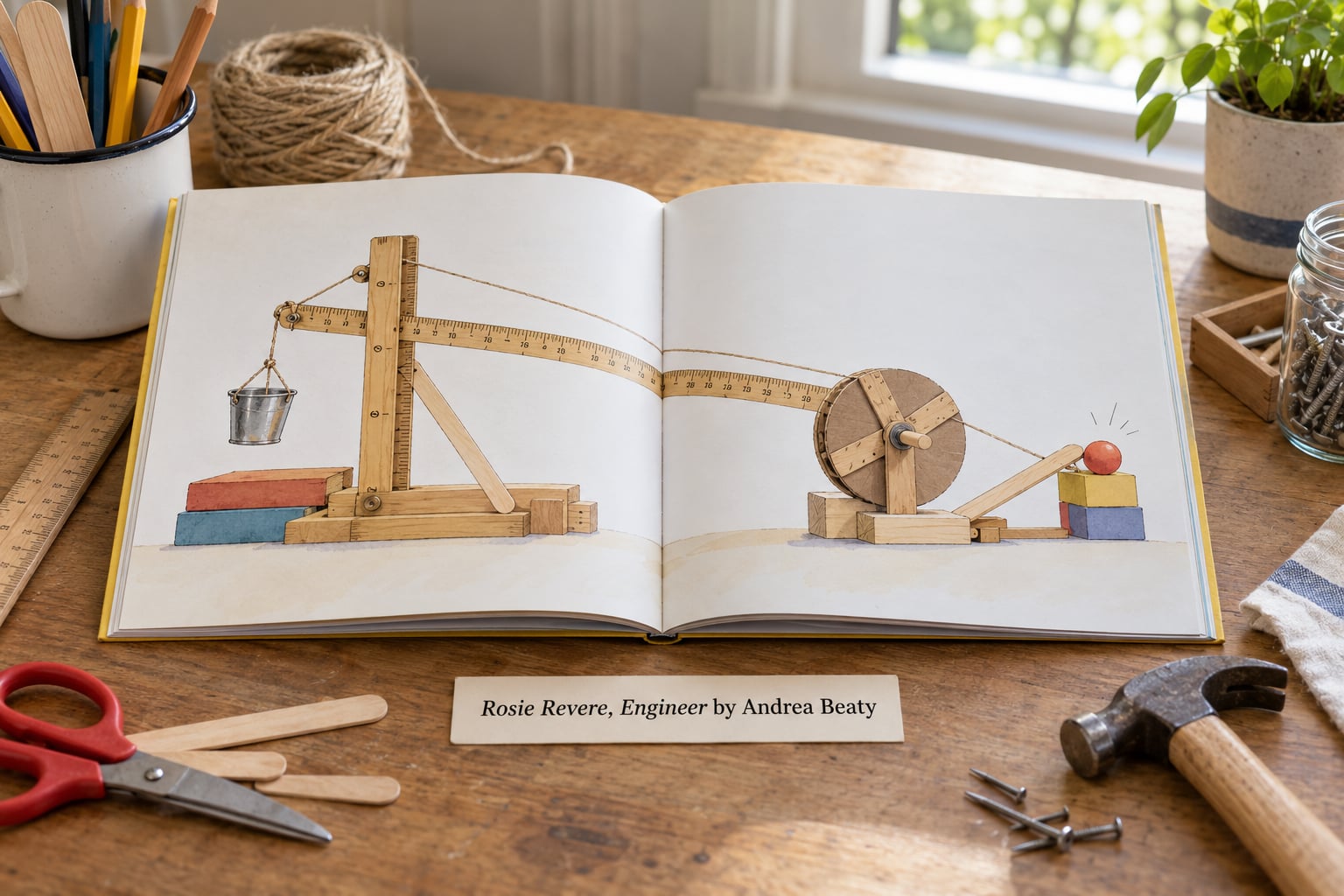
This is fiction, and it is the best entry point for a four- to eight-year-old who has no interest in biographies yet. Rosie falls asleep during a story about five women inventors, then falls out of bed trying to build the thing Aunt Deborah could not figure out.
It teaches that engineering is a process with retries, which is a more useful idea than the invention itself. Andrea Beaty writes the STEM-shaming characters with affection rather than mockery, so nobody in the book gets turned into a lesson.
Activity: the steam-table challenge is the whole book. Give your child a table, a glass, and a set of household objects, and ask for a design that moves something without spilling. Let the first attempt fail. That’s the point of the ending.
7. Ada Twist, Scientist by Andrea Beaty
Also fiction, and also worth being clear about that. Ada Twist is an imaginative character, not a biography, so it does not teach a specific scientist’s history. What it teaches is the shape of doing science.
Ada is curious about everything, which means the book can hold a child who likes physics and a child who just likes pulling things apart. The testing-and-revising thread is the strongest part.
Activity: make a paper structure. A bridge from two books and a sheet of paper works well. Predict what will hold first, then add weight a teaspoon at a time and write down where it fails. One revision, then stop, even if it still fails.
8. Marie Curie by Demi
Demi’s illustrated biography goes deep on the experiments with radioactivity and is unusually frank about the barriers Curie faced as a woman in science, including the difficulty of getting academic work recognized and the treatment she received afterward.
For children who have already met Curie in a listicle or a museum plaque, this fills in the parts that got skipped. Ages seven to eleven is the sweet spot.
Activity: make a two-column chart after reading. Left column: what Curie discovered. Right column: what other scientists worked out later. It’ll be a short right column, and that imbalance is a good conversation about how credit actually flows.
9. Katherine Johnson by Leland P. De la Durantaye
A picture-book biography that makes Johnson’s mathematical work and NASA career approachable for children around five to eight. Short sentences, plenty of illustration, and no equations.
The limitation is real. At this age the book gives you the shape of a career but not the reasoning, so read it alongside a fuller source such as the Hidden Figures edition above if your child is ready.
Activity: draw a four-box sequence with your child. Calculate. Check. Prepare the answer. Launch. Then ask which box they think was hardest, which usually gets an answer nobody expects.
10. Mae Jemison by Leland P. De la Durantaye
This biography covers three arcs: medical training, the work as an astronaut, and the later push to get more children, especially children of color, interested in STEM. It suits ages six to nine.
It is the title on this list that most directly answers the question children ask, which is whether you can be a scientist and something else at the same time. Jemison’s answer is yes, and she does it in the book.
Activity: make two columns of tools. Left: what a doctor uses to diagnose an illness. Right: what an astronaut uses to handle a medical problem in orbit. Talk through what overlaps and what the space version needs instead. It’s a great conversation for six to nine year olds.
Frequently Asked Questions
What age group are books about women inventors and scientists for best suited to?
Match the book to the reader, not the subject. Ages 3 to 5 do best with picture books and read-alouds like Rosie Revere, Engineer. Ages 6 to 8 handle illustrated biographies such as Katherine Johnson and Mae Jemison, usually with an adult nearby. Ages 9 and up can handle profile collections and narrative nonfiction such as Hidden Figures or She Persisted in Science. If a child stalls in the first chapter, drop an age band and try again.
Are books about women inventors and scientists for kids only biographies?
No, and the fiction titles matter. Rosie Revere, Engineer and Ada Twist, Scientist are invented stories about girls who build and test things, and they often reach children who find real history dry. A good shelf mixes both: fiction to make engineering and experimentation feel like something a kid does, and biography to put a real name and a real barrier on the page. Most parents read one of each per subject area.
How can I help my child learn about women scientists without making history feel overwhelming?
Read one book at a time and stop there. Resist the urge to finish a collection in a week, because the point is a returning reader, not a completed shelf. Pair each book with one concrete activity so the person becomes a problem the child solved rather than a name in a list. When a book mentions discrimination, ask one question about it and then return to the story. Small and repeated beats a long and heavy read.
What is a good first book for a child who likes engineering or space?
Start with Rosie Revere, Engineer by Andrea Beaty for anyone under eight. It is a read-aloud with a real build-it problem in it, so the child finishes with something made at the kitchen table. For a child six and older who loves space specifically, go to Mae Jemison by Leland P. De la Durantaye, which covers medicine and spaceflight together. Save Hidden Figures for readers who are comfortable with longer nonfiction.
If you only buy one, start with the age band from the table and pick the row your child sits closest to, not the row with the name you recognize. Then read it twice and do the activity. The second read is where the argument about it becomes yours rather than a fact they recited.