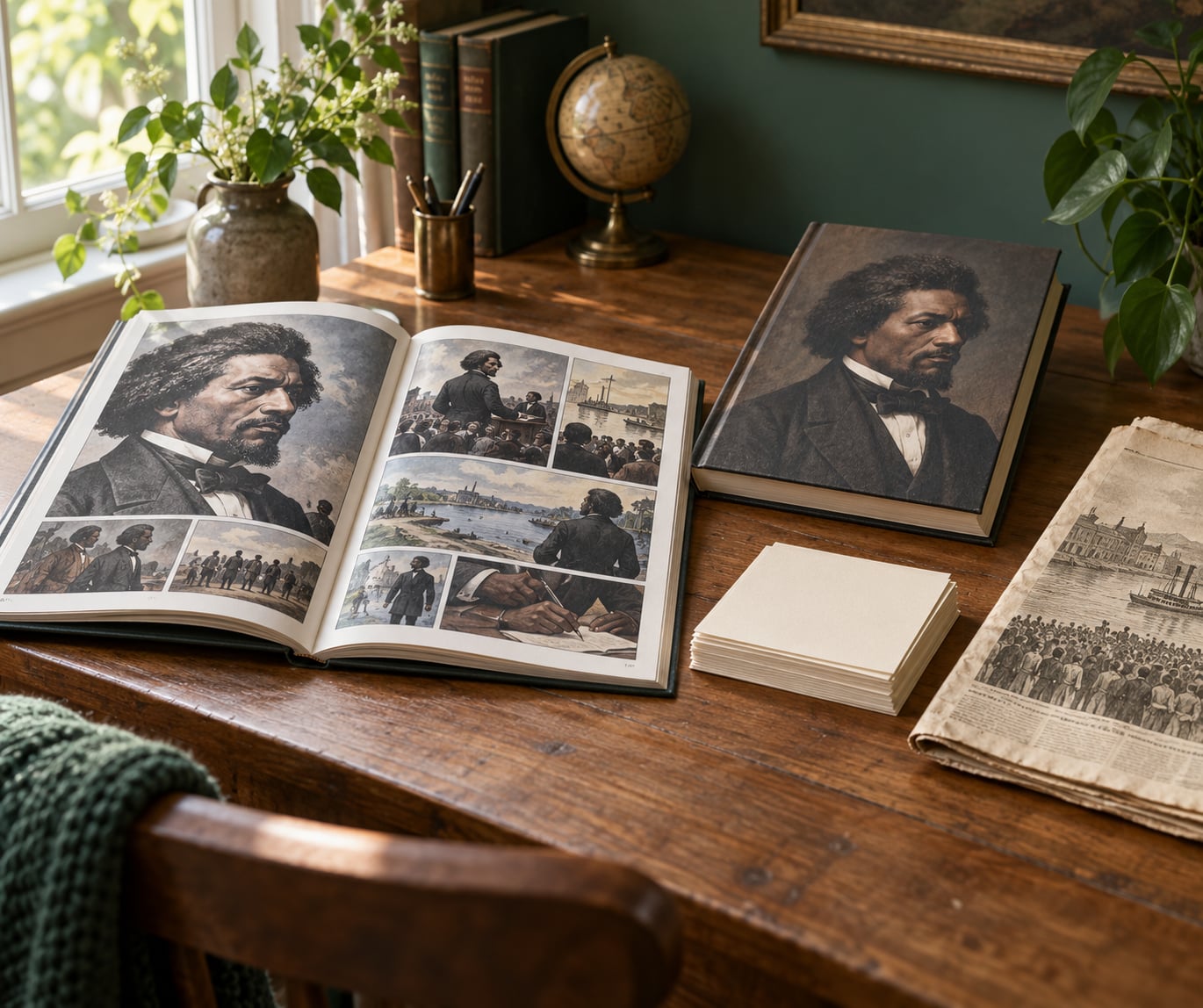
If you want one honest answer to the best book about the civil rights movement for teens, start with March: Book One by John Lewis and Andrew Aydin for a graphic introduction, Warriors Don’t Cry by Melba Pattillo Beals for a first-person memoir, and The Watsons Go to Birmingham by Christopher Paul Curtis for historical fiction. Each one puts a teenager at the center of events that textbooks reduce to dates.
That mix matters, because the books about the civil rights movement for teens that get assigned most often cover only one format. A teen who will not sit through a chapter of memoir will happily finish a graphic novel, and a strong reader who loves narrative will learn more from fiction than from an anthology of speeches. So the ten titles below are sorted by format and reading age, with the historical events each book covers and a note on heavier content, because that is what adults actually ask about.
Table of Contents
- Books About the Civil Rights Movement for Teens at a Glance
- 1. March: Book One by John Lewis and Andrew Aydin
- What adults should preview before assigning it
- 2. The Watsons Go to Birmingham by Christopher Paul Curtis
- 3. The Other Side of Truth by Kekla Magoon
- 4. Loretta Little Looks Back by Lily Christine Tang
- 5. March: Book Two by John Lewis and Andrew Aydin
- 6. March: Book Three by John Lewis and Andrew Aydin
- 7. Warriors Don’t Cry by Melba Pattillo Beals
- 8. I Am Rosa Parks by Carole Boston Weatherford
- 9. Root of Rage by K. Alexi
- 10. Warriors Don’t Cry: A Student and Teacher Guide to the Movement
- Frequently Asked Questions
- What is the best book about the civil rights movement for teens who are just beginning?
- Are books about the civil rights movement for teens mostly fiction or nonfiction?
- Which civil rights book is best for a high-school history project?
- How can parents introduce graphic novels about violence and racial injustice to teens?
- What is a good mixed reading list for studying the civil rights movement?
- Conclusion: Where to Begin
Books About the Civil Rights Movement for Teens at a Glance
Every title below is set in the 1950s and 1960s rather than in present-day America, which is the single most useful filter when you are building a reading list.
- March: Book One — graphic memoir, ages 11–14, set 1940s–1961, themes of childhood and choosing a cause, best for independent reading or a first unit.
- The Watsons Go to Birmingham — historical fiction, ages 11–14, set in 1963 Alabama and Michigan, themes of family and witnessed violence, best for book clubs and classrooms.
- The Other Side of Truth — historical fiction, ages 14–18, set in 1963 Birmingham, themes of divided perspective and activism, best for book clubs.
- Loretta Little Looks Back — short-chapter historical fiction, ages 11–14, set during the 1965 Selma campaign, themes of grief and courage, best for reluctant readers.
- March: Book Two — graphic memoir, ages 13–17, set 1961–1963, themes of national broadcasts and desegregation, best as a sequel or paired read.
- March: Book Three — graphic memoir, ages 15–18, set 1965–2000s, themes of loss and legacy, best as a capstone for older teens.
- Warriors Don’t Cry — memoir, ages 14–18, set 1957 Little Rock and later, themes of school integration, best for research projects.
- I Am Rosa Parks — picture-book biography in verse, ages 8–13, set 1930s–1955 Alabama, themes of daily segregation, best for read-aloud.
- Root of Rage — graphic novel, ages 15–18, set 1965 Los Angeles, themes of hunger and policing, best for older teen discussion.
- Warriors Don’t Cry: A Student and Teacher Guide — classroom resource, ages 14–18, themes of terminology and source work, best for teachers and study groups.
Readers who want the same titles sorted by reading difficulty rather than format can start with March: Book One and I Am Rosa Parks, then move up as the reader is ready.
One note on sourcing. Every title here is set between the 1930s and the late 1960s, and none of them is a modern-day story about racism. Titles like Stamped!, Dear Martin, and The Hate U Give belong on a different shelf, one covering what the movement changed and what it left behind.
Where the format matters most is length. Graphic novels run short and move fast, novels run long, and memoirs sit somewhere between. Check the page count before assigning to a reluctant reader.
1. March: Book One by John Lewis and Andrew Aydin
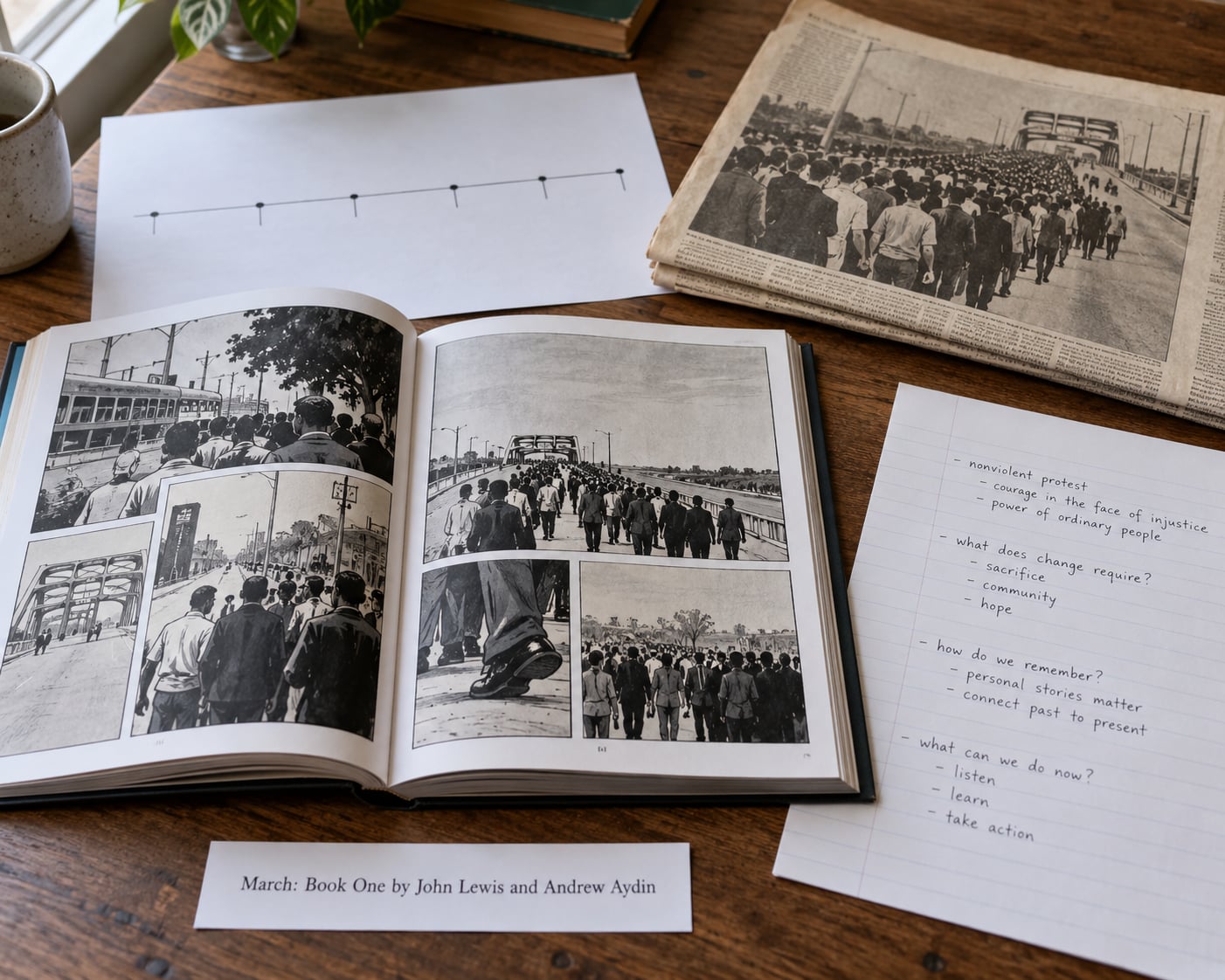
March: Book One is the gentlest door into the subject for middle-grade readers, and it is the one I hand to a teen who says history is boring. The art by Kwame Alexander carries most of the narration, so the reading load is light even when the events are not.
The book follows Lewis from his childhood in Troy, Alabama, through the segregated world of the 1940s and 1950s into his decision to leave Troy State College for American University in Washington, D.C., and then into the sit-ins and the Freedom Rides. Nothing is softened into a heroic montage. Lewis was frightened, he was told to leave, and he describes the calculation each time.
What adults should preview before assigning it
Expect racial slurs in the speech of white characters, police intimidation, threats against the Lewis family, and physical danger during the rides. For most middle-grade classrooms that is workable at ages 11 and up. For younger readers or readers who have not yet met the topic, a parent read-through first helps a lot.
Two discussion prompts work well. Ask students to find the page where Lewis first describes being afraid, then the page where he acts anyway, and talk about what changed in between. A second pairing activity works nicely: lay out a five-event timeline of the 1950s and early 1960s, put a printed copy of the book beside it, and have students match each panel to the event on the timeline.
Readers who finish this volume usually want the next two, which is worth knowing before you assign it.
One thing worth saying out loud to students: Lewis was not a finished hero at the start. He describes hiding books he was afraid to be seen reading, hesitating about whether his family would survive what he was about to do, and being advised to leave Alabama entirely. That hesitation is what makes the book useful for teenagers, who often assume conviction arrives fully formed.
None of the three volumes is short, so pacing matters when you assign them. One volume per marking period gives readers room to sit with the events, and rushing all three in a single unit leaves students with names they cannot place.
2. The Watsons Go to Birmingham by Christopher Paul Curtis
This novel follows the Watson family as they drive from Flint, Michigan, to Birmingham, Alabama, in 1963, where they are staying with relatives while the family deals with grief and the city’s violent response to the civil rights campaign. Because the family are visitors rather than organizers, the reader sees the campaign from the outside, at street level.
Readability is the reason this book gets taught so widely. Curtis keeps sentences plain and short, and he moves the story with chapter endings that pull the reader forward. Younger teens who stall on long books usually finish this one.
The hard material is real. There is bombing of a family home, a hate crime, threats, and the execution scene at the Birmingham jail that parents often forget to expect. Language is accessible, but the subject is not gentle. Preview the last third of the book before assigning it to a sixth-grade class.
One classroom activity works better than a general discussion: after finishing, students compare the Watsons’ trip with photographs of Birmingham in 1963 and with recorded oral histories from the era, then write a paragraph on what a visiting family could see that a photograph does not show.
A second use worth considering is pairing. Curtis’s novel sits naturally next to March: Book One, since one arrives at the same Birmingham summer from inside the movement and the other watches from a car window. Readers compare the two versions and see that a single city in a single year contains far more than one story.
3. The Other Side of Truth by Kekla Magoon
The Other Side of Truth alternates between two girls in Birmingham in 1963. One is there, organizing and living inside the campaign. The other is in the North, writing letters for a civil rights organization and trying to understand a movement she is helping from a distance.
The structure is the point. Readers watch the same events described by someone standing in them and someone reading about them, and the book quietly argues that participation from outside is still participation. That makes it excellent for book clubs studying activism, family, and divided points of view.
Magoon did extensive research before writing, and she includes a note about her sources, which makes the book a good model for teaching research habits. Content includes the 1963 church bombing, the deaths of Black children in the Birmingham campaign, and sustained harassment of the northern narrator. I would place it at ages 14 and up rather than middle grade.
The alternating structure makes it a natural book-club pick because the discussion can split by chapter. One group reads the chapters set in the North and the other reads the chapters set in Birmingham, then they compare what each narrator was able to know at the time.
4. Loretta Little Looks Back by Lily Christine Tang
Loretta Little Looks Back follows a nine-year-old girl in Lush Alabama during the 1965 Selma campaign. Her father has been killed, her family is grieving, and she is caught between adults working to register voters while the town pushes back.
The chapters are very short, often only a page or two, and the viewpoint stays firmly with a child. That combination is the whole appeal. A teen who found The Watsons emotionally heavy will often get through this one because the tension arrives in bursts instead of a long build.
The emotional intensity is the trade-off. Grief is constant, and the book does not soften how frightened Loretta is. It suits younger teens and strong readers, and it works as an entry into the Selma material before a student meets March: Book Three. A short extension activity: have readers list three words Loretta uses about fairness, then compare them with the language adults use in the same chapter.
Tang wrote the book after working with young readers, and she keeps the narration in the present tense throughout. That choice puts the reader inside a single day rather than watching a decade pass, which is why the book can be short and still feel crowded.
It is also the rare middle-grade title that takes voting rights as its subject rather than a walk to the middle of the street. Students often assume the movement was about buses and lunch counters; this book corrects that in about two hundred pages.
5. March: Book Two by John Lewis and Andrew Aydin
The second volume picks up around 1961 and runs through the Freedom Rides, the March on Washington, and the 1963 bombing of the 16th Street Baptist Church in Birmingham, which killed four girls. Lewis is now a national figure with a national audience, and the book shows the cost of that visibility on him and on the people around him.
It works as a continuation because the art style and structure stay identical, so a reader who finished Book One can start without re-reading. I have also seen it used cold, with Book Three afterward, for older teens who found the childhood framing slow.
Sensitive material here includes Klan intimidation, prison, the death of Medgar Evers, and the bombing. Build a timeline activity around this one with two columns: events students can verify from outside sources on the left, Lewis’s own recollection and interpretation on the right. The gaps between the columns are where the real thinking happens.
Book Two is also where the trilogy’s scope widens noticeably. A teenager following a single act against a local system in Book One meets, in this volume, the machinery that turns local acts into national news: press conferences, television coverage, and a White House that has to answer for what it can now see.
6. March: Book Three by John Lewis and Andrew Aydin
The final volume covers the Selma campaign, the 1965 Voting Rights Act, the assassinations of Malcolm X, Martin Luther King Jr., and Robert Kennedy, and Lewis’s later decades of activism and public life. It ends with him looking back on what he would tell a child standing at the beginning of the book.
This is the heaviest volume. It contains assassination and funeral scenes, prison violence, and sustained grief that does not resolve. I would not hand it to a reader with no prior exposure to the subject.
Used well, it is a capstone. Students read Book One as a young person entering the movement, Book Three as the cost of staying in it, and write a short response on whether the movement was worth what it asked of its participants. Older teens and high-school classes get more out of it than middle schoolers do.
It also finishes the arc the trilogy opens, since the last volume returns to Lewis speaking directly to young readers. Teachers who finish a unit with it often find the discussion goes further than the middle volume manages.
7. Warriors Don’t Cry by Melba Pattillo Beals
Melba Pattillo Beals was nine years old and among the Little Rock Nine when they integrated Central High School in Little Rock in 1957. Her memoir covers her childhood in an all-Black school, the integration attempt, the harassment and threats she and her family endured, and her later work as a lawyer suing the school district to dismantle what remained of segregation.
It is the first-person account of the Little Rock Nine most often handed to young readers, and it does not soften anything. The writing is direct and the reading level is accessible, but the bullying, the anonymous threats, and the constant fear are the point of the book, not decoration.
For educators, a few terms come up that are worth previewing with students rather than defining in front of them: segregation, desegregation, unconstitutional, mob, and the legal phrase separate but equal. Pair the memoir with a reliable historical source so students can check the timeline against a second account. Beals herself writes in the afterword about why the fight did not end at Central High, which makes the book easy to link to her later legal work.
Some older printings of the memoir carry study material attached to the text, which is a separate matter from the discussion resource described in entry 10 below. If you are cataloguing or assigning from a specific printing, preview the copy in hand.
8. I Am Rosa Parks by Carole Boston Weatherford
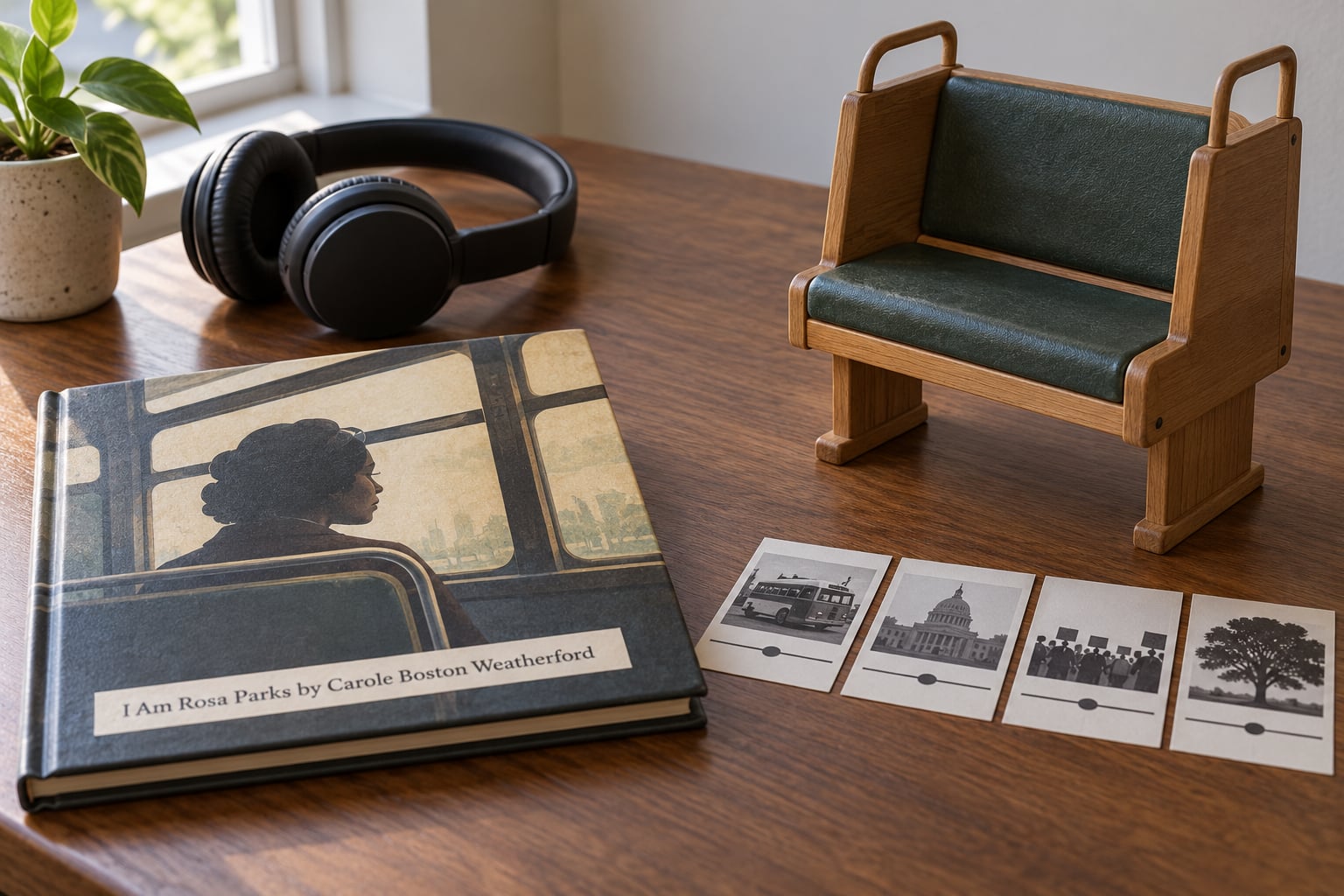
This picture-book biography is written as a first-person poem. It traces Rosa Parks from childhood in Tuskegee through daily segregation in Montgomery, to the 1955 bus refusal and the activism that followed. Because the line length matches a child’s speaking voice, it reads aloud beautifully and holds the attention of listeners far past the usual picture-book age.
The framing is authoritative: Weatherford’s text is balanced by Bryan Collier’s paintings, and the book keeps to documented history rather than dramatizing invented childhood scenes. For younger teens and older elementary readers, it is the shortest honest way into the Montgomery bus boycott.
One prompt keeps it from being a passive read-aloud. After reading, have students underline three lines they think a reader could not have understood before knowing the historical context, then place those lines on a shared timeline card. Ask where the timeline gives them an explanation the poem deliberately leaves out.
The book also handles a common misconception head-on. Parks is often remembered as one person on one bus, and the poem spends most of its pages on the years of routine segregation that made that moment ordinary. That framing is worth naming out loud in a discussion.
9. Root of Rage by K. Alexi
Root of Rage is a graphic novel about Ashli, a biracial teenager in Los Angeles whose family is dealing with food insecurity while police pressure tightens on their neighborhood before and after the 1965 Watts rebellion. The story is fictionalized, but it draws directly on testimony from people who lived the unrest.
What it does well is immediacy. A reader who finds a 1965 policy debate abstract can feel what a patrol car at the end of the block feels like to a teenager who is also hungry. For older teens who ask why the movement did not seem to change their grandparents’ daily lives, that is the question this book answers.
Flag the mature themes before assigning: police violence, a death by shooting shown on the page, food insecurity, and adult anger. Also be clear with students that this is a fictionalized story built on real testimony, not a comprehensive history of the movement. The Watts rebellion, the Black Panther Party, and Freedom Summer each deserve a nonfiction source alongside it.
The strongest classroom pairing puts a historical nonfiction chapter beside the graphic one, so students see the difference between an event as it happened and the same event as it was lived by one family. That comparison is where the teaching value sits.
Alexi sets the story in Watts rather than on the national stage, which is deliberate. It asks a question the big-picture histories tend to skip: what happened to ordinary families in the neighborhoods the speeches were not about?
10. Warriors Don’t Cry: A Student and Teacher Guide to the Movement
This entry is a classroom and discussion resource built around Beals’s memoir rather than a separate narrative. Think of it as the companion piece for anyone teaching or studying Warriors Don’t Cry, and return to entry 7 above for the age guidance on the memoir itself.
A workable sequence runs in four steps. Start with terminology: students build a glossary from segregation and desegregation to separate but equal and NAACP, using a dictionary rather than the class period. Next, primary source work: students read the 1954 Brown v. Board of Education summary alongside the Little Rock chapter and mark where the law promised one thing and the experience delivered another.
Then source comparison. Have students check the memoir against a second historical account and list three places where Beals adds detail no official document contains. Finish with reflection: a written response on the difference between choosing to act and choosing not to act, which is the central question in Beals’s account.
Because the guidance is organized by task rather than by chapter, it also works for independent study groups meeting without a teacher in the room.
Because it is a resource rather than a story, it should never be counted as a title a student reads for pleasure. Treat it as the scaffolding and put a narrative book underneath it.
Frequently Asked Questions
What is the best book about the civil rights movement for teens who are just beginning?
March: Book One by John Lewis and Andrew Aydin is the safest first choice. The graphic format lowers the reading load, the story follows a teenager, and the history is introduced through panels instead of speeches. Pair it with a simple printed timeline so readers can place events. For a reader who prefers prose, The Watsons Go to Birmingham works as a first pick instead.
Are books about the civil rights movement for teens mostly fiction or nonfiction?
Both, and the mix matters. Nonfiction titles here include March: Books One through Three, Warriors Don’t Cry, and I Am Rosa Parks. Fiction includes The Watsons Go to Birmingham, The Other Side of Truth, Loretta Little Looks Back, and Root of Rage. Readers remember the movement far better when they get at least one of each, and assignment work goes deeper when both are on the list.
Which civil rights book is best for a high-school history project?
Warriors Don’t Cry by Melba Pattillo Beals works best for research-driven work. It is a first-person memoir with an afterword, so students can quote directly and still verify the timeline against a second source. March: Book Three is a close second when the project focuses on the 1965 Voting Rights Act or on what activism cost organizers. Avoid a title chosen only for its length.
How can parents introduce graphic novels about violence and racial injustice to teens?
Preview the book yourself first, then talk about the purpose before the reading starts. Say plainly that the story includes racial slurs, threats, and violence, and ask whether your teen wants to read it alone, read it with you, or talk afterward. Graphic novels concentrate hard material into a small number of pages, so a two-page preview tells you more than a description does.
What is a good mixed reading list for studying the civil rights movement?
Build it in three tiers. Start with I Am Rosa Parks for the personal scale and March: Book One for the visual one. Follow with The Watsons Go to Birmingham for a full family narrative. Finish with Warriors Don’t Cry for the memoir account and a nonfiction source for the legal timeline. That sequence moves from accessible to demanding while keeping the same historical ground.
Conclusion: Where to Begin
Start with March: Book One if you want a broad introduction that works across reading levels, since it also doubles as the on-ramp to the other two volumes. Choose The Watsons Go to Birmingham for a younger teen who reads fiction well and wants a complete story with a family at its center. Choose Warriors Don’t Cry for an older teen ready to study a first-person memoir and check it against sources.
Whatever you pick, pair it with a timeline and a second account of the same events. A single book gives one person’s version of a decade, and these ten titles are far more useful to a teen who can compare them.