
Yes, you can write an essay when you haven’t read the book, but only as an honest essay: build the plot spine from a reliable summary, get the critical conversation from published guides and commentary, quote the text directly where you can reach it, and cite the study guides as the secondary sources they are. What does not work is inventing quotations, inventing page numbers, or describing a scene you never saw. Those are easy to catch and they follow you around.
Most students asking this question are not being lazy. The deadline is shorter than the book, the title may never have appeared on their reading list, or they may simply not have started. Some of those are recoverable situations with a real method behind them. This guide is that method, in order, with the honest parts left in.
One rule up front, because it is the whole difference between a legitimate approach and a disaster: you are allowed to be informed by a study guide. You are not allowed to pass a study guide’s sentences off as your own reading of the novel. Those are different activities with different citation requirements, and the difference is entirely in how you attribute your sources.
Table of Contents
- What You Need
- Step-by-Step
- Start by Understanding the Assignment
- Gather the Information You Can Trust
- Find a Narrow, Supportable Argument
- Build an Evidence Plan
- Write an Honest First Draft
- Ask for Help Before Submission
- Revise for Accuracy, Coherence, and Voice
- Common Mistakes
- Frequently Asked Questions
- Can I use a SparkNotes summary to write an essay?
- How much of a book do I need to read to write an essay?
- Is it cheating to write an essay about a book I haven’t read?
- How do I start a book analysis essay?
- What are the five components of literary analysis?
- Is the thesis statement the first sentence in an essay?
- Conclusion: Start with What You Can Verify
What You Need
Gather these five things before you type a word. Without them, an unread-book essay collapses into plot retelling, which is the one thing markers recognise instantly.
- The assignment prompt itself. Not a paraphrase your friend gave you. The actual sheet, with the verb, the word limit, the required elements and the marking criteria.
- Whatever reading you do have. Assigned excerpts, the chapters you did get through, lecture notes, seminar questions, anything your teacher handed out that was supposed to be the reading.
- Two reliable summaries. Two, not one. If two reputable sources agree on the sequence of events, you can reasonably rely on it. Where they disagree, you simply do not claim it.
- The required citation style. MLA or APA or Chicago, whatever the department uses. You need to know this before your first parenthetical reference, not the night you are formatting.
- A route to a person. Your instructor’s email, a tutor, a librarian. This is not a fallback, it is a required tool, and the earlier you use it the better.
Be clear about what these materials can and cannot do. A summary gives you the spine of the plot. Study guides give you the questions teachers ask and the critical vocabulary. Context sources give you publication history, genre conventions and authorial context. None of them give you a close reading of a specific passage, and an essay that pretends otherwise is the version that gets flagged.
There is also a legitimate case for not reading the whole book at all. If you have a diagnosed reading disability or ADHD, brute-force reading may not be a realistic route no matter how much time you have. Talk to your instructor or your disability service about an audio version, an extended deadline, a shorter extract assignment or an alternative assessment. That is a conversation you are entitled to have, and it is a far better position than quietly faking it.
Step-by-Step
Start by Understanding the Assignment
Underline the verb in the prompt, because it decides everything else. Analyse, argue, compare, evaluate and summarise produce completely different essays, and most unread-book disasters are really prompt-reading disasters.
Then list every element the assignment names explicitly: a thesis, three pieces of textual evidence, a counterargument, a works cited page, a particular citation style. Tick them off as you build. Then mark which elements your teacher did not ask for, so you do not pad an essay with a plot summary because you are nervous.
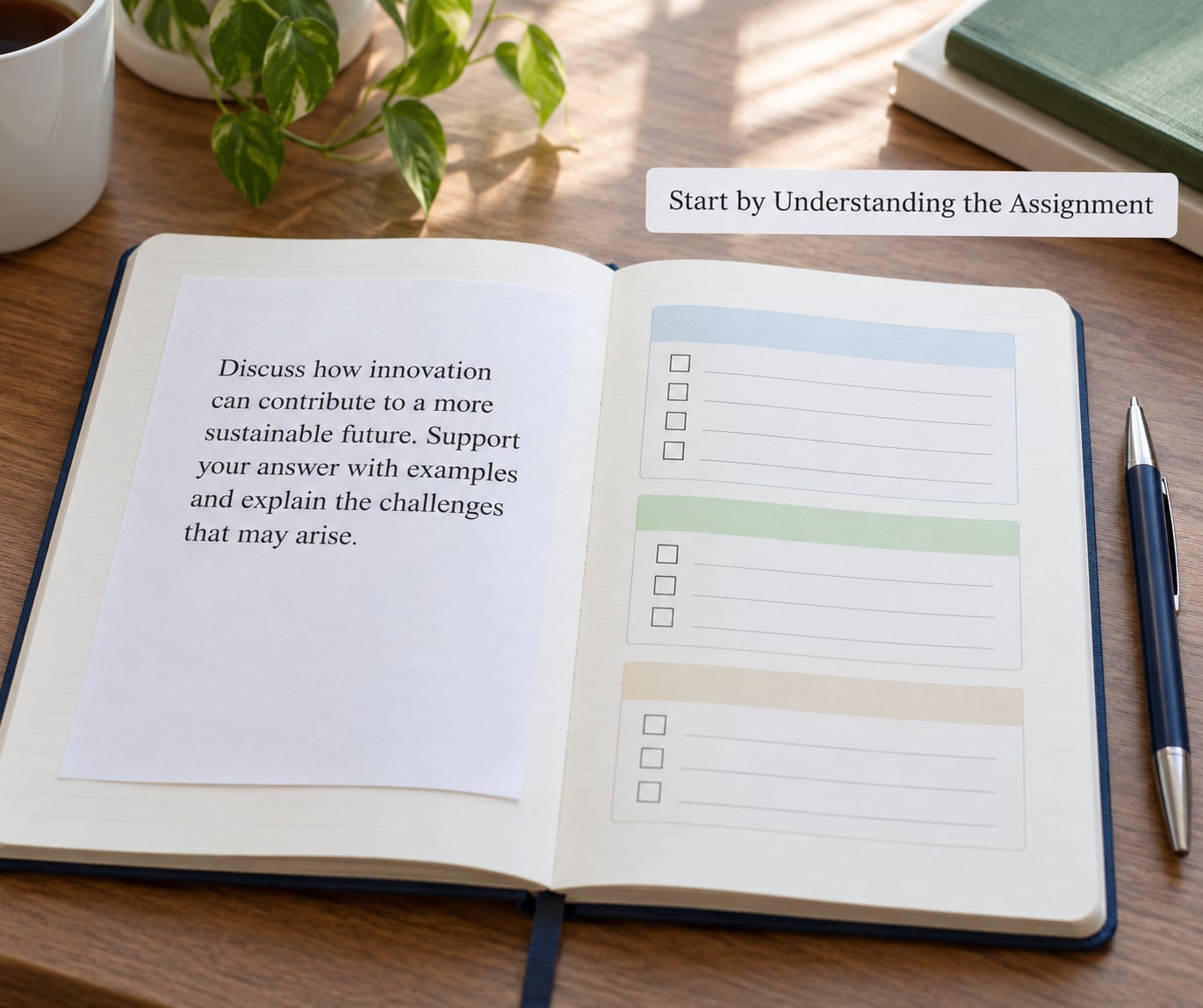
Write the prompt as a manageable question before you write anything else. “Discuss Great Gatsby” becomes “How does Fitzgerald use the green light to argue against the American Dream?” The second version tells you which chapters to read and which quotations to look for. The first version tells you nothing.
You will know this step worked when you can say, in one sentence, what kind of essay this is and what it has to contain.
Gather the Information You Can Trust
Not all sources are equal, and the difference matters when your marker asks. Set up a source list as you go, with three columns: the claim, the source, and where you found it. That last column is the one students skip and the one that saves them when a citation needs checking.
On trust, roughly: reputable encyclopaedic and scholarly reference works are safe for context. Publisher study guides are safe for critical framing and study questions. Commercial study guide services are useful for structure and symbolism, but they are not evidence and you never cite them as though you read the novel. Review aggregators and reader forums are opinions from named individuals, which is useful if you present them as opinions. Video summaries and AI-generated overviews are the weakest tier, and nothing you take from them should carry a claim you cannot confirm somewhere else.
Film and television adaptations sit in an awkward middle. They show you staging, performance and visual symbolism that a novel does not have, and they cut material. A detail that exists only in the adaptation is not a detail you can use in a literary analysis essay.
The test for this step: pick any three facts from your notes and trace each one back to a source you could name. If you cannot, delete it or flag it as unverified.
Find a Narrow, Supportable Argument
Here is the actual blocker for most people in your position, and it is rarely access to the book. It is that nobody has shown you how to turn a topic into a claim. That is the commonest failure mode, and it has almost nothing to do with how much you read.
Keep the claim narrower than you think you need. This is the single most useful adjustment when writing a literary analysis without reading the book, because a narrow claim is one you can actually support with the evidence you managed to gather.
Before: “The characters in this novel are complex and develop throughout the story.”
After: “Nora’s decision to leave her family at the end of the play shows Ibsen treating marriage as a financial arrangement rather than a romantic one.”
The second version names a character, a moment, an author and an interpretive claim. Everything you found in the summary, the guide and the context sources can be tested against it.
If you genuinely have thin evidence, there is a second move, and it is more honest than bluffing: write the thesis about the limits of what is knowable. A carefully argued piece on why a particular reading of a novel has been disputed for decades, supported by the criticism you can actually access, is a real essay. It is also considerably better than confident invention.
Build an Evidence Plan
Stop treating summary, quotation, paraphrase and criticism as interchangeable. They carry different weight and they have different rules, and mixing them up is the fastest way to write something that reads as unoriginal.
A short quote is the strongest evidence and the hardest to get without the text. A paraphrase lets you use the idea while putting it in your own words, but it still needs a citation. A summary is orientation, not evidence; you never cite a summary to prove a claim about the book. Secondary criticism is evidence about other readers, and it is the one category you can build a full essay from when the primary text is out of reach.
Now write the outline, which at this stage is three or four lines long:
- Claim, in one sentence, with the author and title named.
- Point one, with the specific evidence attached to it and the source recorded.
- Point two, same format.
- Point three, or a counterargument if your prompt wants one.
Attach the source to each piece of evidence at the outline stage, not the writing stage. If you find yourself writing a quotation you cannot locate, that is the moment to go looking for it or cut the sentence.
Write an Honest First Draft
Write from what you verified, and nothing else. Where your evidence is strong, say so. Where it is thin, use the hedging that belongs in academic writing anyway: “the critical reception has tended to read,” “the closing chapters suggest,” “one contested interpretation holds.” Tentative language is not weakness in a literary analysis essay; it is what accurate academic hedging looks like.
Keep your uncertainty in your notes rather than in the essay itself. An essay that says “I did not read this book but” is doing something different from an essay that argues well, and the first one usually reads as an excuse. The second reads as scholarship. Do not confuse honesty about your sources with confessing the assignment situation in the body.
Label quotations as you go, with author, page and the source you actually took them from. Write “Nora, act three” rather than the number you half remember. If a quotation came from a study guide quoting the novel, that is a real quotation of the novel, but you need to find it in the text itself before you attribute a page number to it.
Do not write past the point where you are guessing. The moment you start constructing a sentence because the paragraph needs one, you are fabricating, and that is the single thing this whole method is designed to avoid.
Ask for Help Before Submission
Ask early, in writing, and be specific about what you are asking for. Vague messages get vague answers. A short, plain message is enough:
Dear Ms Adeyemi, I need to flag that I have not completed the reading for Thursday’s essay on Beloved. Rather than submit something I cannot support, I would like to ask whether I can have an extension until Monday so I can read Part Two properly, or whether I could instead submit an annotated bibliography of the sections I have read. Please let me know what is realistic.
The rule most writing tutors give is blunt enough: reference what you have read, and do not reference what you have not. That is also why you should ask rather than improvise. An extension costs a teacher very little. A fabricated quotation costs you far more.
If you genuinely cannot reach the primary source, there is a defensible citation form: cite it as it comes through the critic. “Darwin (1859, cited in Webb 2012)” tells your reader exactly what happened. That form is honest, it is standard practice in the social sciences, and it will not read as a cheat to anyone who knows the difference between reading and researching.
Two other routes worth naming, because students rarely think to offer them. You can ask to change the book, since a literary study of a work you have actually read is worth more than a poor one you have skimmed. Or you can propose an annotated bibliography as the deliverable, which lets you show real engagement with a text you have only partly worked through.
Revise for Accuracy, Coherence, and Voice
Revision on an essay like this has three separate jobs, and mixing them is how students miss problems.
Accuracy first. Go through every factual claim and check it against your source list. Remove any detail you cannot trace. Check that every quotation exists, that the attribution is right, and that page numbers came from a copy of the book rather than from memory. This is the pass that protects you, so give it real time.
Then check citations against the required style, and check that you are not leaning on a single study guide for every idea. A summary of the argument should not occupy more than a sentence or two before analysis begins; if it does, you are writing a book report and calling it an essay.
Coherence comes next: does each paragraph make one point, does that point connect to the thesis, and does the order of points make sense to a reader who has not read the book? Transitions and signposting matter more than usual here, because your reader needs a path through material they have not seen.
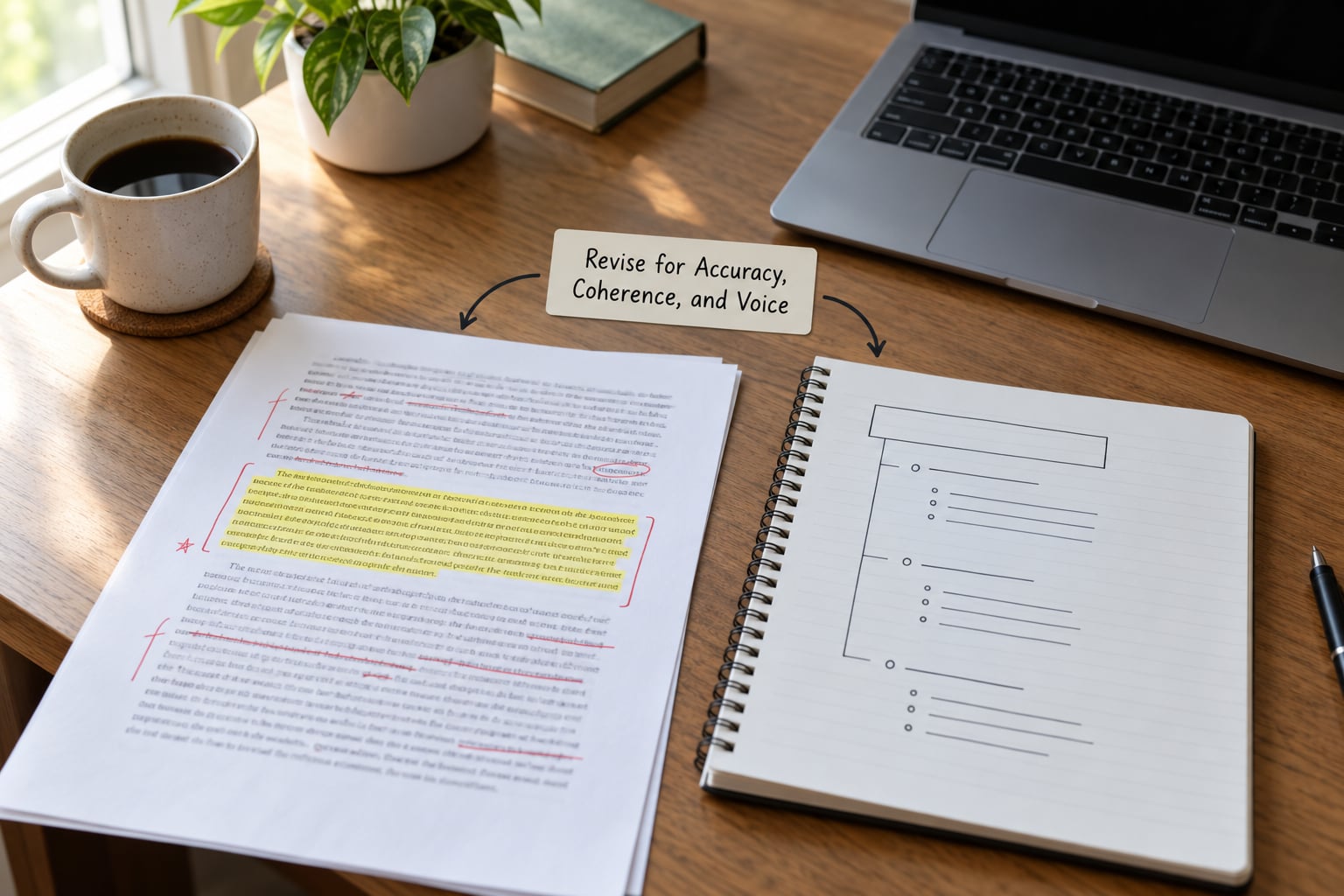
Voice last. Read the essay aloud and listen for sentences that sound like a textbook. That is usually where language got copied and pasted from a guide at midnight. Rewrite those in your own words and, if you still cannot, treat it as a citation problem rather than a style problem.
Before submitting, delete your source list file and read the essay as if you were the marker. Everything you can no longer verify, cut.
Common Mistakes
These are the errors that turn a difficult situation into a real problem, with the fix for each.
Inventing quotations or page numbers. This is the one that ends badly, because a fabricated quotation is easy to check and impossible to explain. Fix: every quote gets traced to a copy of the text, and any page number you cannot confirm gets removed.
Copying a study guide’s sentences. Plagiarism checkers flag matching phrasing even when the idea came from an authorized source, and a marker reading closely will recognise a well-known study guide’s summary anywhere. Fix: understand the point, close the tab, then write it in your own words and cite the guide as a secondary source.
Treating a plot summary as the essay. Retelling what happened earns almost nothing in a literary analysis assignment. Purdue OWL’s guidance on literary analysis is still the standard reference here: a brief summary for orientation, then analysis. Fix: cap the summary at roughly a quarter of the piece and spend the rest on argument.
Writing to the prompt you assumed rather than the prompt you were given. Students routinely produce a competent review when the assignment asked for an argument, or an argument when it asked for a close reading of one passage. Fix: reread the prompt before you outline, not after.
Inventing a personal response. A first-person reaction to a book you did not read is the hardest habit to break and the easiest to spot. Fix: cut the reaction, keep the analysis, and let your position live in the argument rather than in a claimed emotional experience.
Hiding that you did not read it when asked. If an instructor or tutor asks directly, the answer costs you far less than a discovery later. Fix: tell the truth in the conversation, and ask what they would like you to do instead.
One final check before you hand it in. Can you defend every quotation? Can you name the source behind every paraphrase? Is the summary under a quarter of the essay? Is there a real counterargument? Does it answer the actual prompt? Would you be comfortable if your marker asked which pages you had read?
Frequently Asked Questions
Can I use a SparkNotes summary to write an essay?
You can use a summary as orientation and as a source you cite, but you cannot present its language as your own reading. The safe pattern is to read a reputable summary for the plot spine, then support every claim in your argument with either a quotation from the text or a citation to published commentary. If your only source is a summary site, your essay is a report on that site rather than an analysis of the book.
How much of a book do I need to read to write an essay?
For a literary analysis, you need the passages you write about, the chapters framing them, and the ending. The first and last chapters of a novel carry most of its structural argument, and so does the section containing any scene you plan to discuss. Reading those gives you more usable material than skimming straight through. For a poem or short story collection, read it all; the unit of analysis is small and specific.
Is it cheating to write an essay about a book I haven’t read?
It depends on your institution’s rules and on what you claim. Researching a work you cannot access is legitimate, provided you cite only what you actually read and never fabricate. Writing as though you read it, inventing quotations or presenting a summary’s sentences as your own is not research, and institutions treat it as academic misconduct. Where access is genuinely blocked, most departments have an alternative worth asking about.
How do I start a book analysis essay?
Start from a specific moment rather than from the plot. Find one scene, one repeated image or one line of dialogue that carries the theme, and let that point drive your paragraph. Open the introduction with the observation, then name the book and author, then state your thesis as a claim about that moment rather than about the whole novel. Analysis of one concrete thing beats summary of everything.
What are the five components of literary analysis?
The five components usually taught are plot, character, setting, point of view, and theme, with symbolism, conflict and style folded into them. Each answers a different question: what happens, who changes, where it happens, who is telling it, and what it means. Strong essays combine at least two in a single paragraph rather than covering each one separately, which is also what stops the piece turning into a retelling.
Is the thesis statement the first sentence in an essay?
No. The thesis usually comes at the end of the introduction, after framing, context and a definition or two have done their work. Putting it in the first sentence leaves the reader with nothing to wait for, and for a literary analysis it can flatten a complicated argument into an announcement. A good test: your opening sentence should draw the reader in, and your thesis should tell them precisely what you will prove.
Conclusion: Start with What You Can Verify
Unpack the prompt and find the verb. Gather the summaries, guides and context you can actually name. Build one narrow claim and attach real sources to every piece of evidence behind it. Then send the message to your instructor, because an extension or an alternative deliverable is a better outcome than any paragraph you invent.
That is the whole method for how to write an essay when you haven’t read the book: work from what you can verify, attribute everything, and say plainly what you still owe the reading. A well-supported draft built from named sources beats a confident imitation of a reading that never happened, every time. And once the deadline has passed, the honest move is to go and read the book.