To write a short story you need one idea, one character who wants something badly, and one obstacle in the way. Draft the whole thing without stopping to edit, then revise it in separate passes. A first story usually runs 1,000 to 7,000 words and takes a beginner anywhere from two weeks to two months of short sessions.
I have watched beginners stall for months on a first story, almost always for the same reason: they treat the first draft as the final draft. Finish something small, finish it badly, and the second story gets twice as fast. That is the whole trick.
Table of Contents
- What You Need
- Step-by-Step: How to Write a Short Story for Beginners
- Choose a Focused Story Idea
- Create a Believable Main Character
- Build a Conflict and a Clear Story Question
- Use Setting to Shape the Story
- Outline the Beginning, Middle, and End
- Draft a Complete Short Story
- Revise for Stronger Scenes and Clearer Meaning
- Polish and Share Your Story
- Common Mistakes and How to Fix Them
- Frequently Asked Questions
- How long should a short story be for a beginner?
- Should I outline a short story before writing it?
- What should I do when I get stuck writing a story?
- How do I write dialogue that sounds natural?
- Do short stories need structure?
- Can I use ChatGPT or other AI tools to write a short story?
- Conclusion
What You Need
Six things, and none of them are expensive. You need a story idea, a main character, a central conflict, a setting, somewhere to write, and a block of time you are not going to interrupt.
The idea can be two lines long. “A locksmith is called to open a door nobody has the key to” is enough to start. The setting can be your own street. The conflict can be as small as a conversation you wish you had handled differently.
A notebook is the traditional tool and it is genuinely useful, mostly because you can capture overheard fragments of dialogue without breaking your train of thought. A laptop or phone works just as well if that is where you already write. No special software, no course, and no talent required.
What you do need is a realistic expectation of time. A 2,000-word story is roughly an hour and a half of actual typing once you stop stopping to fix sentences, spread across a fortnight of daily half-hours. Beginners who plan for one long weekend usually abandon the story; beginners who plan for twenty short sittings usually finish one.
Step-by-Step: How to Write a Short Story for Beginners
Seven steps take you from a blank page to a revised draft. Each one has a job, and each one leaves you with something you can check.
Choose a Focused Story Idea
Narrow a broad idea down until it fits inside one sitting. A broad idea is “a story about grief.” A story-sized idea names a character, a specific problem, and a change that might happen: a woman who has sorted her late father’s belongings by accident finds a letter she was never meant to read.
Three prompts work well for beginners. Have a character make an unexpected decision. Have a character keep a secret that is about to surface. Have a character face a deadline they did not set for themselves. Each one puts pressure on the story immediately, and pressure is what short fiction runs on.
You will know the idea is focused when you can finish this sentence: “Because of ___, this character must ___, before ___.” If the blanks need more than a few words each, keep narrowing.
Create a Believable Main Character
Give your protagonist four things: what they want, how they behave, the flaw that trips them up, and what it costs them if they fail. Want and flaw are the important pair. A character who wants to reconnect with her brother and who cannot sit still through a conversation already has tension built in.
Short stories do better with one central character than with a large cast. Every extra character costs you page space you will want for the scenes that matter, and most beginners lose momentum when they start introducing names.
To check the work, look for three moments where this person could only be this person. If the protagonist could be swapped for anyone without changing a line, you have written a role, not a character.
Build a Conflict and a Clear Story Question
Turn the character’s goal into a question the reader wants answered. That question is the engine of the story. “Can she repair things with her brother before she moves away on Friday” pulls a reader through 2,000 words; “what will happen to the family” pulls nobody anywhere.
Conflict can come from four places. Another character can oppose the protagonist. Society or an institution can block them. The environment can block them, a storm, a locked road, a power cut. Or the obstacle can sit inside them, in which case the story can happen in one room and still work.
Write your story question on paper before you draft. If you cannot phrase it in a single sentence, the conflict is still foggy, and foggy conflicts produce stalled middles.
Use Setting to Shape the Story
Setting is not scenery. It should shape what the character wants, what gets in the way, and which choices feel possible at all. A story set in a crowded train station generates interruptions, missed connections, and strangers who watch you cry, whether you planned them or not. The same reunion set in a quiet rural road forces the two characters to keep talking, which is a completely different pressure.
Pick one location and stay inside it as much as you can. Beginners get restless and add a second location, a flashback, and a change of season in the same 1,500 words, and the story loses its grip.
A useful test: write three sentences about your setting using only physical detail, no emotion words. “The announcement board flickered over the word delayed.” “A porter swept the same patch of floor.” “Rain came through the roof by the bins.” Now attach the protagonist to that detail and see what the detail does to them.
Outline the Beginning, Middle, and End
An outline is a tool, not a contract. One page is plenty. Note what changes, not every sentence you plan to write.
| Beat | What it does | Share of a 2,000-word story |
|---|---|---|
| Exposition | Establishes the normal life, or the imbalance in it. Start late, on the verge of change, rather than explaining the whole history. | About 10 percent |
| Rising action | Complications stack. Each one narrows the character’s options. | About 50 percent |
| Climax | The pressure peaks and the character makes the decision that defines them. | About 10 percent |
| Falling action | The consequences of that decision land. | About 20 percent |
| Resolution | The new normal. Show it, do not explain it. | About 10 percent |
Notice how much of the story sits in rising action. Beginners routinely spend a third of their words on the setup and ten words on the ending. If your outline shows more exposition than climax, redistribute.
Draft a Complete Short Story
Write to the end without looking back. Do not reread the previous chapter, do not fix a sentence you dislike, and do not delete a scene because you have not solved it yet. Writers on Reddit who describe finishing twenty-seven short stories say the same thing: nothing in the first draft is sacred, and the draft’s job is to exist.
Give each scene one job. Enter it late, let the character want something, let them make a choice that changes the situation, and leave when the situation has changed. If nothing in a scene changed anything, it is a candidate for the bin.
Start where something is already happening. Beginning in medias res, in the middle of the action, is the fastest way to lose a beginner’s fear of the blank page. You can always add the earlier context later, if the story turns out to need any.
The most common way a draft stalls is a middle where the character wants nothing new. When that happens, either raise the cost of failing or hand the character a deadline. Forgetting what comes next is usually a structural problem rather than an imagination problem.
Revise for Stronger Scenes and Clearer Meaning
Revise in passes, one job at a time, with a gap of at least a day between them. Trying to fix structure and punctuation in the same sitting is how beginners end up with a clean, well-spelled, shapeless story.
Pass one, structure. Mark each scene with one word: what changed. Any scene whose word is “nothing” gets cut or merged. Then check that the climax is the highest-pressure moment in the story, not just the loudest one.
Pass two, character and motivation. For every paragraph that contains an action, check that the reader can see why the character did it. If you needed the word “because” to justify a line, plant the reason earlier instead.
Pass three, show don’t tell. Find the emotion words and cut them where a behaviour would carry it better. “She was nervous” becomes “She checked the time twice and put her phone back in her pocket.” “He was an angry man” does not survive the rewrite at all.
Pass four, pacing and language. Vary sentence length, trim the adverbs, and cut every paragraph that exists only to explain the one before it. Trust the reader to infer the ending rather than spelling it out.
Pass five, point of view and tense. Read straight through and mark every tense shift and every head hopping into another character’s thoughts. Choose past or present and hold it, and stay outside your protagonist’s head unless you deliberately go closer.
Polish and Share Your Story
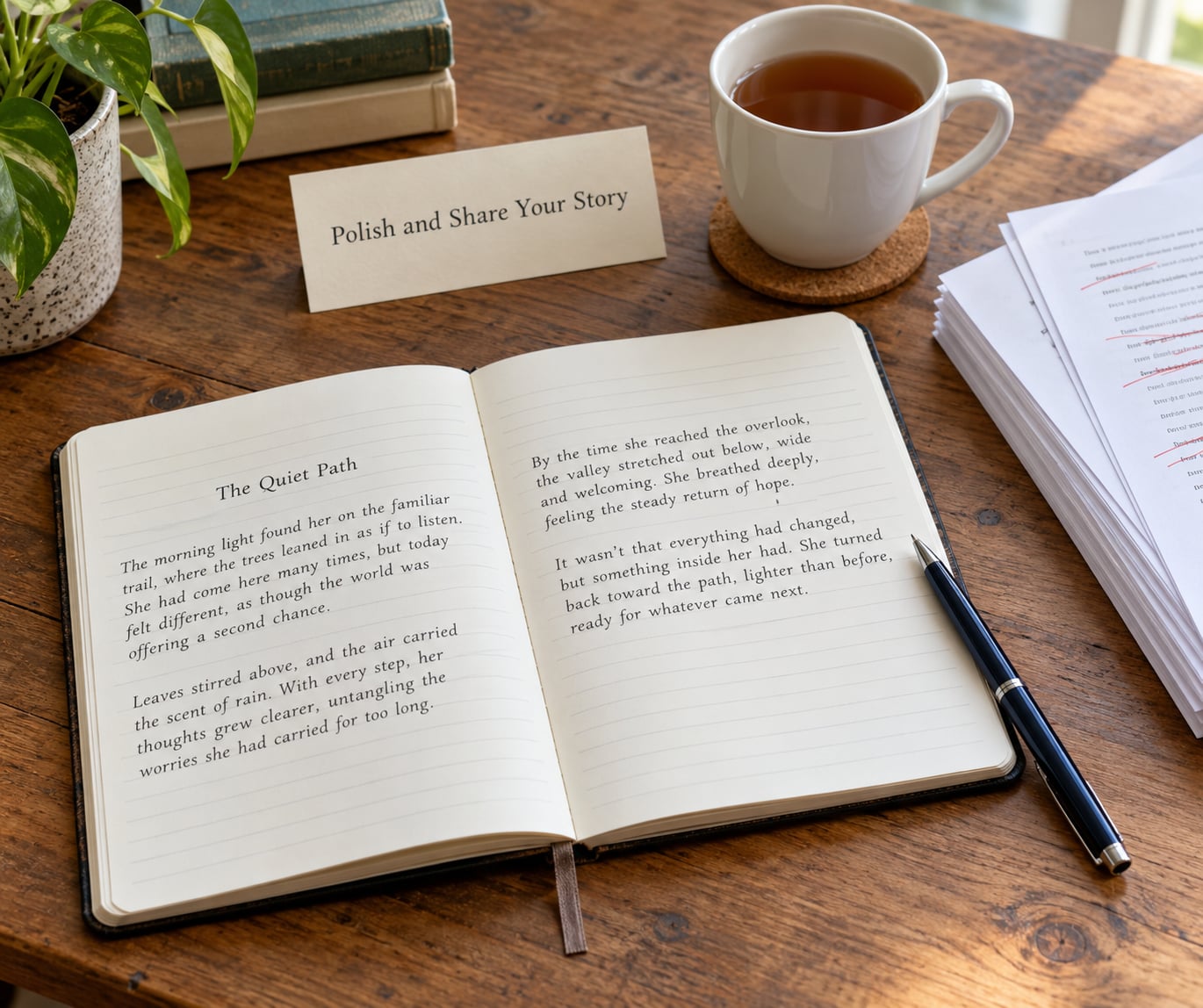
Polish is a separate job from revising, and it is mostly mechanical. Fix spelling and grammar. Check the title actually fits what you wrote, not the idea you started from. Remove double spaces, stray capitals after full stops, and any paragraph break that happens in the wrong place.
Then read the whole story aloud. Your ear finds run-on sentences and missing commas faster than your eye does, and it will also tell you whether the ending feels earned. If you stumble on a line, that line probably needs cutting.
Send it to one trusted reader rather than five. Ask two questions: where did you get bored, and where did you stop believing the character? Those answers are worth more than a full-page critique, and they are far easier to act on when you are new to finishing things.
Feedback is not an instruction to change everything. When someone suggests a different ending, ask yourself whether the problem is that the ending is wrong or that they were not given enough to reach it. Frequently it is the second one, and the fix is two sentences, not a rewrite.
Common Mistakes and How to Fix Them
Most beginner problems repeat across hundreds of first drafts, and they are all fixable with a specific move.
Starting with worldbuilding. Three pages of invented history before anyone speaks is preparation disguised as progress. Fix: begin at the moment the imbalance appears, and let the history arrive in the specific things characters say and do.
Too many characters. Five named people in 1,500 words means nobody gets a scene. Fix: keep one protagonist and one opposing force, cut the rest, and see whether the story improves immediately.
Every scene carrying equal weight. When nothing matters more than anything else, the reader feels nothing. Fix: mark each scene as essential or cuttable. You should end up with two or three essential scenes.
Dialogue that sounds like a script. If characters say full sentences to each other with no interruptions, no deflection, and no subtext, the scene stalls. Fix: have characters talk about something adjacent to what they mean, and let them answer questions with questions.
Ending with an explanation. Summarising what the character has learned tells the reader they were not paying attention. Fix: end on a choice or an image. The last line should show what is now true, not explain what it meant.
Narration instead of dramatisation. This is the most common complaint from beginners in writing forums, and it is the one with the clearest fix: take every sentence that reports an emotion or a decision and rewrite it as behaviour, speech, or physical detail.
Missing a story question. If you cannot say what the reader is waiting to find out, the middle will bloat. Fix: write the question at the top of the draft and check that every scene either advances or answers it.
Frequently Asked Questions
How long should a short story be for a beginner?
Aim for 1,000 to 2,000 words on your first attempt. That is long enough to hold a character, a conflict and an ending, and short enough to finish in a couple of weeks of short sessions. Flash fiction at 300 to 1,000 words is even better for building the habit of completing things. Longer stories are fine, but beginners usually stall because they are trying to hold too much in their heads at once.
Should I outline a short story before writing it?
Outline loosely, not tightly. One page naming the major beats, roughly a tenth for the setup, half for rising action and a tenth each for climax, falling action and resolution, is plenty. An outline stops the draft from wandering, but writing to a rigid plan turns the first draft into a transcription job. Keep the plan, and change it whenever the story tells you something better.
What should I do when I get stuck writing a story?
Stuck almost always means structural, not a shortage of imagination. Ask what the character wants in this scene. If the answer is nothing, raise the cost of failure or give them a deadline. Then change the mode: work on something unrelated for a day, or talk the scene out loud to a friend. Coming back fresh is the technique experienced writers use most often, and it works better than staring at the page.
How do I write dialogue that sounds natural?
Write for the ear. Read every line aloud as a person speaking, not as a written sentence, and cut anything that sounds like an announcement. Characters rarely answer what they were asked, so let them deflect, interrupt, and answer with a question. Put more weight in subtext, meaning what they say rather than what they mean, and use gesture or silence between the lines to signal the real subject.
Do short stories need structure?
Yes, even though most short stories hide their skeleton. Structure is what stops a short story drifting: an opening imbalance, complications that narrow the protagonist’s options, a climax where they make a defining choice, consequences, then a new normal. You can follow the five beats loosely, and readers will never notice the shape directly, but they will absolutely notice its absence.
Can I use ChatGPT or other AI tools to write a short story?
Rules vary and they change, so check the specific terms before you rely on it. Many contests and publishers require disclosure of AI assistance, and some accept only spelling or grammar help rather than generated text. If you use a tool for brainstorming or feedback, keep the drafting and the voice yours. Publishing guidelines differ by platform and by country, so read them rather than assuming.
Conclusion
The process is short enough to memorise. Find one focused idea, build a character who wants something specific, turn that want into a question the reader wants answered, choose a setting that adds pressure, outline five beats on a single page, draft to the end without editing, then revise in five separate passes.
Start where you are. Pick the idea you have been circling, write one page of beats today, and give yourself two weeks to finish a rough draft nobody has read. When you revise it, fix one scene properly rather than trying to perfect the whole story at once. The third story is where the craft starts to feel obvious.