Free verse vs blank verse is a difference of rhythm, not rhyme. Free verse has no fixed meter and no rhyme scheme; blank verse is unrhymed but keeps a regular meter, almost always iambic pentameter. Both forms can sit side by side in the same anthology and look identical on the page until you read one aloud.
That is why the label gets argued about. Students analyse a poem, call it free verse because it does not rhyme, and then a marker points at the ten evenly beat syllables in every line. The poem was blank verse the whole time.
Both forms are legitimate. Blank verse runs from Marlowe and Shakespeare to Milton and Frost. Free verse runs from Whitman’s long catalogues to Carol Ann Duffy’s short Lyric poems. Neither is the “proper” version of the other, and neither is easier by default.
This guide covers what each form actually is, how to tell them apart in under a minute, and what each one asks of you as a writer or reader. Updated for 2026.
Table of Contents
- Free Verse vs Blank Verse at a Glance
- What Is Free Verse?
- What Is Blank Verse?
- How Free Verse and Blank Verse Differ
- Why free verse vs blank verse get mixed up
- Line length and rhythm
- Syntax and punctuation
- Three misconceptions worth dropping
- Free Verse Examples
- Example one: line break doing the work
- Example two: rhyme without a scheme
- A famous example to know
- Blank Verse Examples
- Published examples to recognise
- How to Choose Between Free Verse and Blank Verse
- Choose free verse when the subject is emotional or contemporary
- Choose blank verse when the language needs to stand up in public
- Choose based on the constraint you enjoy
- Check what the assignment actually says
- Which Should You Choose?
- Frequently Asked Questions
- Is all unrhymed poetry free verse?
- Does blank verse have to sound like Shakespeare?
- Can free verse use rhyme or repetition?
- Is free verse easier to write than blank verse?
- What are the three R’s of poetry?
- What is the most famous free verse poem?
- Conclusion
Free Verse vs Blank Verse at a Glance
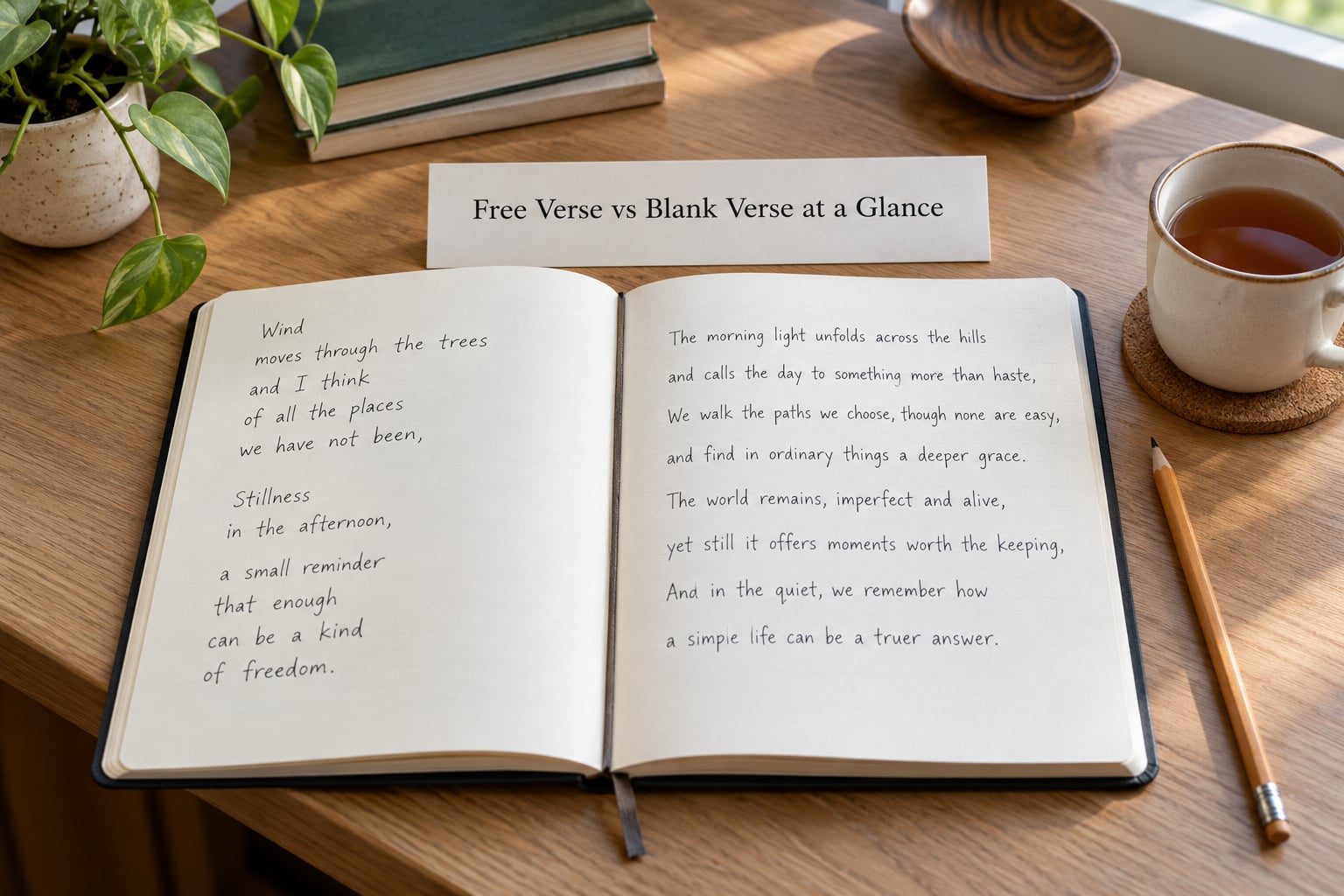
| Feature | Free verse | Blank verse |
|---|---|---|
| Rhyme scheme | None, though internal rhyme or occasional end rhyme is allowed | None. The absence of rhyme is part of the definition |
| Meter | No regular meter; lines follow the cadence of speech | Regular meter, almost always iambic pentameter |
| Syllables per line | Any number, from two words to a full sentence | Ten syllables per line, five stressed beats |
| Line length | Irregular, often breaking where the meaning turns | Fixed by the meter, usually similar length line to line |
| Punctuation | Full stops, commas and no punctuation at all | Standard punctuation, often sparse, as in Shakespeare |
| Resembles | Speech or a paragraph broken into lines | Elevated or dramatic speech with a beat underneath |
| Main control | Line breaks, repetition, image, sound | Meter, word choice, tonal restraint |
| Typical uses | Lyric, elegy, modernist and contemporary poetry | Drama, epic, narrative poetry, dramatic monologue |
| Common names | Whitman, William Carlos Williams, T. E. Hulme, Rimbaud | Shakespeare, Marlowe, Milton, Robert Frost |
The single row to read twice is the meter one. Everything else can flex. If a poem has ten syllables per line and a consistent unstressed-then-stressed pulse, it is blank verse, whatever it does with punctuation.
What Is Free Verse?
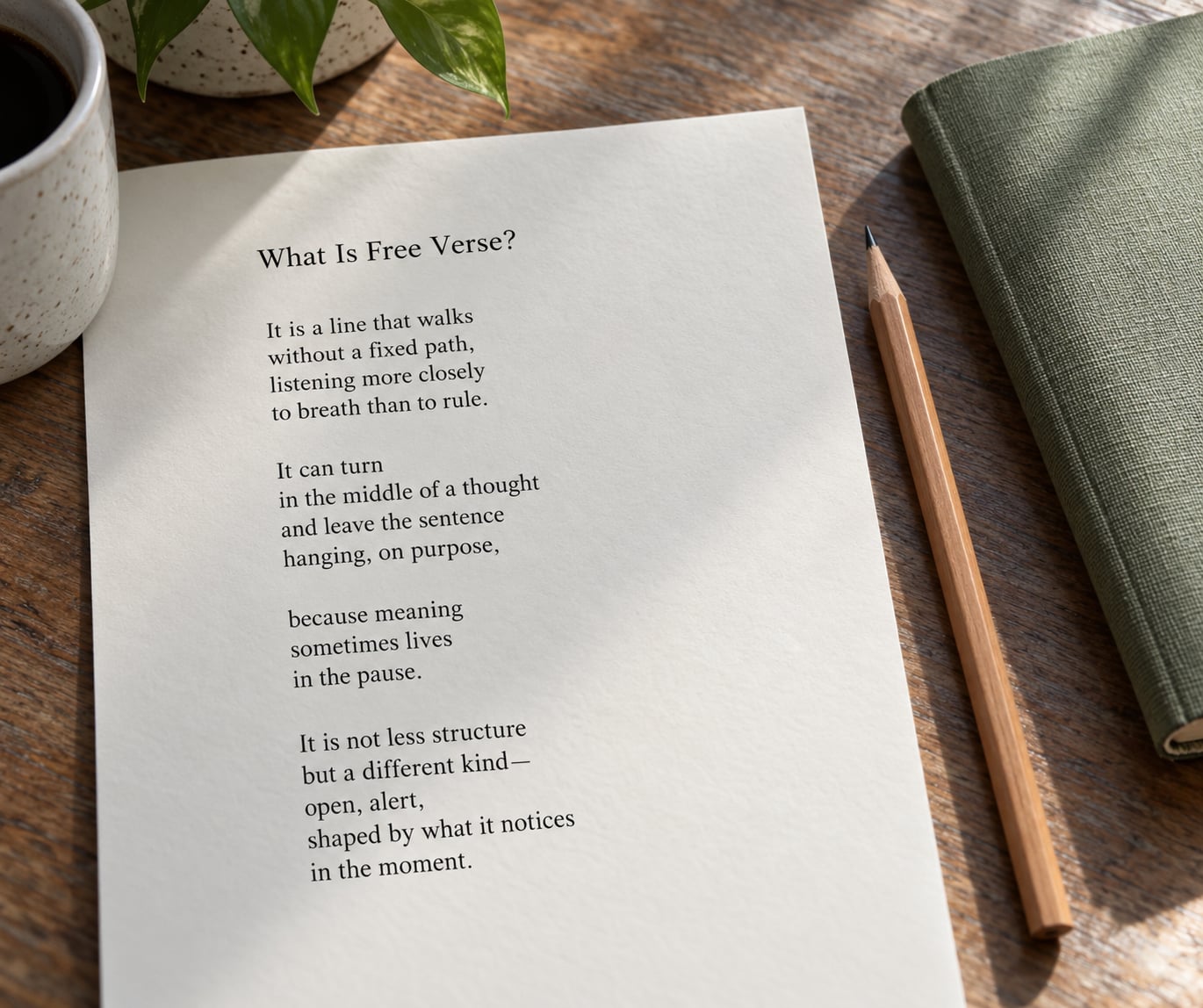
Free verse is poetry with no fixed rhyme scheme and no regular meter. Line length, line breaks and sound follow the natural rhythm of speech or the pressure of the image instead of a pattern imposed from outside.
It grew out of the French vers libre, promoted by Kahn and Laforgue and pushed hard by Rimbaud. In English, Walt Whitman had already been writing it decades earlier in Leaves of Grass, where lines run long, repeat themselves and build by accumulation rather than by meter.
T. E. Hulme’s “Autumn,” usually taught as the first English free verse poem, compresses that into three lines. William Carlos Williams took it further into short, plain, domestic images. Today most new poems published in magazines are free verse of some kind.
The common complaint, repeated constantly on writing forums, is that free verse is “just prose with the line breaks in.” It is a fair worry to check, and the answer is that line breaks in free verse do real work. A break can hold two words apart so they land harder, stop a sentence mid-thought, or let one image arrive after another instead of being joined by a conjunction.
What Is Blank Verse?
Blank verse is unrhymed poetry written in a regular meter, and the meter is almost always iambic pentameter. The name means the lines are blank because no rhymes fill them in; the rhythm is not blank at all.
An iamb is a foot of two syllables: one unstressed, then one stressed. The everyday shorthand is da-DUM, as in the word “a-LONG” or “for-GET”. Pentameter means five of those feet per line, so a line runs ten syllables with five of them landing hard.
The pattern, written out: da-DUM da-DUM da-DUM da-DUM da-DUM. Count it in Shakespeare and the count holds. A line can lose a syllable or add one in performance, but the underlying pulse stays recognisable, which is the whole point of the form.
The lineage runs through Italian versi sciolti, unrhymed but measured lines, and reaches English through Henry Howard, Earl of Surrey, whose Aeneid translation used the form in the sixteenth century. Marlowe and Shakespeare turned it into the default speech of English drama. Milton stretched it across ten thousand lines of Paradise Lost, and Frost used it in the twentieth century for plain-sounding American speech in “The Mending Wall.”
So does blank verse have to sound like Shakespeare? No. It is defined by meter, not by subject or accent. Frost sounds like a New Hampshire farmer and it is still blank verse.
How Free Verse and Blank Verse Differ
Why free verse vs blank verse get mixed up
Because rhyme is the clue everyone checks first, and both forms withhold it. Once rhyme is gone, the only reliable signals left are line length and rhythm, and those are much harder to see.
The same question turns up on r/Poetry, r/writing and r/grammar forums again and again: is this unrhymed poem free verse or blank verse? One widely shared forum answer gets it backwards, claiming blank verse has no regular rhythm. That is the single most common error in this topic, and it is worth correcting plainly. Blank verse is the most rule-bound of the unrhymed forms, not the least.
Another error creeps in from the other side: reading ten-syllable lines as free verse simply because they are not rhymed couplets. If the beats fall in the same place on line after line, the poem has meter, whatever the line endings do.
Line length and rhythm
Free verse lines are decided by sense. A line might be four words and the next forty. Blank verse lines are decided by the foot, which means most lines land within a syllable or two of each other no matter what is happening in the sentence.
That produces a felt difference before you can name it. Blank verse has a floor under it, a tread that keeps returning. Free verse has no floor; the momentum comes from syntax, sound and the reader’s expectation.
Syntax and punctuation
Free verse can run a single sentence across forty lines, or use no punctuation at all and let the line break carry the grammar. Blank verse usually keeps ordinary punctuation and often ends a thought at the end of a line, because the meter makes the line ending a natural resting place.
Three misconceptions worth dropping
Free verse is not rule-free. Line breaks, image, sound and revision are the craft, and poets have argued about them for a century. T. S. Eliot complained in 1917 that vers libre had loosened the line without giving back the discipline of metre, and Frost’s image of writing free verse as tennis with the net down is still the sharpest version of the argument. William Carlos Williams’s reply was that the foot should be variable but still present.
Free verse is not prose. Prose is measured by information; a poem is measured by attention. If removing the line breaks would leave something complete and unchanged, the breaks were decorative.
Blank verse is not structureless. It trades one kind of constraint for a stricter one. The metre never lets you waffle, and finding ten syllables that also say what you mean is harder than it looks.
Free Verse Examples
Here are two short original examples with the mechanics named, followed by a published one worth knowing.
Example one: line break doing the work
He kept the receipt in his coat pocket
long after the shop had folded,
a small square of proof
that the world once had let him buy something.
Line lengths run nine words, six, four, nine. No line has the same number of syllables as its neighbour and none of them carries a beat pattern, so this is free verse rather than blank verse. The break before “a small square of proof” isolates the noun phrase and delays the reader one line before learning what the receipt proves. The repetition of “square” against “buy something” at the end gives the closing image a flat, deflating tone without a single rhyme.
Example two: rhyme without a scheme
I want the sound of a word with no ending.
The rain keeps dropping proof on the roof,
and nothing I have written yet has the nerve to stop.
Dropping and stop form an internal rhyme that no rhyme scheme required. That is allowed in free verse. What still defines the form is the absence of a recurring metrical pulse: try to force a da-DUM pattern onto the third line and it breaks apart.
A famous example to know
Walt Whitman’s “A Noiseless Patient Spider” (1888) is the free verse example most students meet. The two alternating stanzas, one repeating “you” without rhyme and one spinning out longer descriptive lines, show free verse using repetition and line length as its structure rather than meter.
Blank Verse Examples
Here is an original stanza in blank verse, with the stress pattern marked above the syllables.
she COUNT | ed the | HOURS till | the TRAIN | came IN
and the | LET ters | lay O | pen ON | the STAIR
the KET | tle went | COLD while | she SAID | his NAME
out SIDE | the NIGHT | held ITS | BREATH un | BLINK ing
Every line has five iambs, ten syllables, no rhyme. Line two is the awkward one: “pen ON the STAIR” is a substitution of a trochee in the third foot, the kind of licence Shakespeare allows constantly to keep the sentence natural. Read it aloud and tap your foot on the five stressed beats. If your foot lands on the same syllable five times, you are hearing the meter whether or not you could name it.
Published examples to recognise
The balcony speech in Romeo and Juliet opens “But soft, what light through yonder window breaks”, ten syllables in five iambs with no end rhyme anywhere in the speech. Milton’s Paradise Lost uses the same form for epic narration, and Frost’s “The Mending Wall” uses it for a conversation about stone and spring, which shows how ordinary blank verse can sound.
If an assignment asks for “a Shakespearean verse extract”, blank verse is what they mean. If it says “modern, experimental or free verse”, the metered option will not fit.
How to Choose Between Free Verse and Blank Verse
Choose free verse when the subject is emotional or contemporary
Free verse suits confession, grief, memory, argument and anything where the feeling is the point. Modern references, fragmentary thoughts and inner monologue are hard to force into ten syllable lines, and the form forgives long lines and awkward syntax.
Choose blank verse when the language needs to stand up in public
Blank verse suits dialogue, narration and elevated subjects, which is why Shakespeare used it for stage fights and Milton for the Fall. The fixed pulse gives a speaker authority and weight, and the absence of rhyme keeps long speeches from sounding singsong.
Choose based on the constraint you enjoy
Free verse asks for control over where lines stop. Blank verse asks for control over how the line sounds. If you like hunting syllables and shaping a sentence around them, take blank verse. If you would rather chase an image and let the breaks fall where they fall, take free verse.
Check what the assignment actually says
Read the brief for words like metre, iambic, pentameter, unrhymed or Shakespearean, which point to blank verse, and for free, experimental, contemporary or modernist, which point to free verse. If it says nothing, both are defensible, and you can say in two sentences which form you chose and why.
Which Should You Choose?
If you are writing a poem from scratch and have no other instruction, I would pick based on the voice in your head. A voice that is already beating, counting, arguing in balanced clauses wants blank verse. A voice that is fragmentary, image-led or rushing wants free verse.
If you are classifying a poem that already exists, use three quick checks.
- Rhyme check. Find the end words. Regular rhymes such as ABAB or AABB point to neither form, but no end rhymes at all means you are looking at free verse or blank verse.
- Count the syllables. Count three lines. Near ten syllables every time suggests blank verse. Wildly different counts suggest free verse.
- Tap the beats. Read aloud and tap on the loud syllables. Five even taps per line is pentameter. No consistent tap is free verse.
That test takes under a minute and settles almost every argument I have seen about these two forms, including the ones I have lost myself.
Frequently Asked Questions
Is all unrhymed poetry free verse?
No. Unrhymed poetry is a broad category. Free verse generally has no regular meter, while blank verse is unrhymed but follows a regular meter, usually iambic pentameter with five iambic feet per line. Many other unrhymed forms exist too, including sprung verse and accentual verse, where the beat is regular but the syllable count is not fixed.
Does blank verse have to sound like Shakespeare?
Not necessarily. Blank verse is defined by unrhymed iambic pentameter, not by a subject, accent or performance style. Robert Frost wrote it in conversational American English and Milton used it for epic narration. A poem in blank verse can sound reflective, formal, conversational or dramatic; the meter is the fixed element.
Can free verse use rhyme or repetition?
Yes. Free verse does not require the absence of all sound patterns. A poet may use internal rhyme, occasional end rhyme, alliteration, assonance and repetition while keeping the lines metrically free. What defines free verse is the lack of a regular metrical pulse, not a ban on any particular sound device.
Is free verse easier to write than blank verse?
It depends on the writer. Free verse is faster to begin because no fixed meter constrains the first line, but it demands deliberate choices about line breaks, image and sound. Blank verse is harder technically, since every line must fit ten syllables and five beats. Many writers find blank verse easier once the meter becomes automatic.
What are the three R’s of poetry?
Rhyme, rhythm and repetition. Rhyme is matching end or internal sounds, rhythm is the pattern of stressed and unstressed syllables, and repetition is the deliberate return of words or structures. Free verse has no rhyme but uses rhythm and repetition freely. Blank verse keeps rhythm in a fixed meter and has no rhyme.
What is the most famous free verse poem?
For a single poem, most people answer Walt Whitman’s u0022O Captain! My Captain!u0022 (1865). For a body of work, Whitman’s Leaves of Grass (1855) is the usual choice, since it defined American free verse at scale. T. E. Hulme’s u0022Autumnu0022 (1909) is the standard early English example used in classrooms.
Conclusion
Rhyme tells you almost nothing here, because both forms leave it out. Find the rhythm first: count syllables, tap the stressed beats, and check whether they keep time. Regular five-beat lines mean blank verse; no consistent pulse means free verse.
Then pick the form that fits the voice. Free verse for expression and experiment, blank verse for control, dialogue and weight. Neither is the safer choice for 2026, and both are done well by serious poets.