The shortest useful answer is this: study for AP English Literature by reading closely with a pencil in hand, writing one timed free-response essay per sitting, and scoring every essay yourself against the College Board rubric. The exam is 55 multiple-choice questions in 60 minutes (45% of your score) and three free-response essays in 120 minutes (55%), so roughly 60% of your study hours should go to writing.
Most of the movement between a 3 and a 5 comes from commentary depth rather than reading volume. Four focused hours a week for a month is enough for most students; less if your class already runs timed practice.
Below is how to study for the AP Literature exam in practice: what the exam asks, what you gather, a repeatable weekly cycle, and the mistakes that quietly cost points.
Table of Contents
- How to Study for the AP Literature Exam: Know What You Are Being Tested On
- What AP Lit Actually Grades: The Big Six
- What You Need
- Step-by-Step
- How to Study for the AP Literature Exam Day by Day
- Build a Literature Review System
- Practice Close Reading and Poetry Analysis
- Time Multiple-Choice Reading Practice
- Write and Revise Timed Essays
- Use Practice Tests to Find Weak Spots
- Finish with a Full Exam Rehearsal
- Common Mistakes
- Frequently Asked Questions
- How long should I study for the AP Literature exam each week?
- What should I study first if I have only two weeks?
- Is memorizing the endings and plots of assigned books useful?
- How should I practice analyzing poetry for the AP exam?
- How many timed essays should I write before the exam?
- Can studying alone be enough for AP Literature preparation?
- Start With One Practice Set Today
How to Study for the AP Literature Exam: Know What You Are Being Tested On
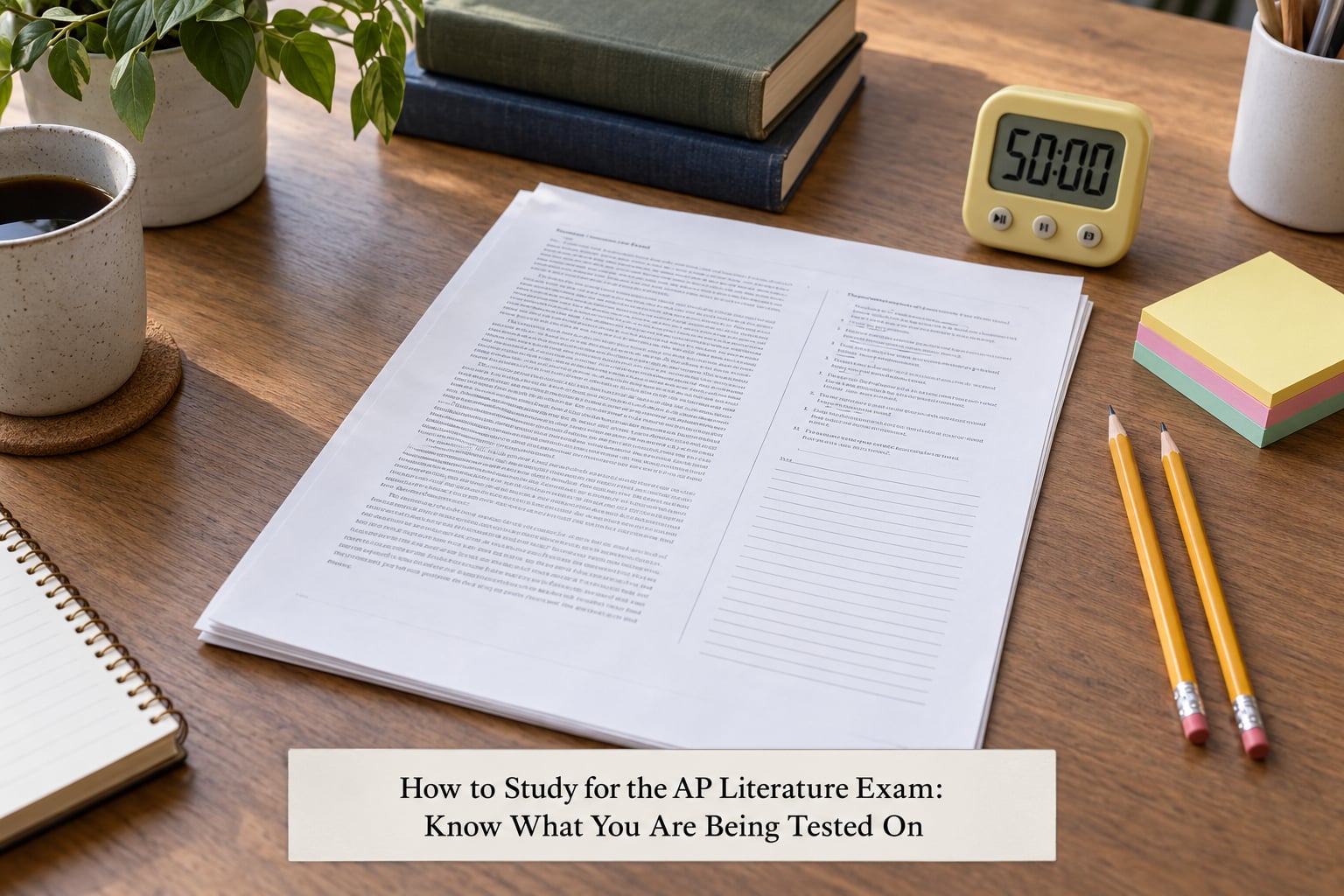
Open the current College Board course framework before you open any study guide. Everything else you do should trace back to a task the exam actually performs, and almost every wasted study hour comes from reviewing material that never shows up on the page.
The exam has two sections, and they are not weighted the same way:
| Section | Questions | Time | Weight | What is on it |
|---|---|---|---|---|
| Section I, Part A | 55 multiple-choice questions in five sets | 60 minutes | 45% | Short fiction, poetry, longer fiction or drama |
| Section II | 3 free-response essays | 120 minutes | 55% | Q1 poetry analysis, Q2 prose fiction analysis, Q3 literary argument on a work of your choice |
Those weights set your study split. A student who spends every practice hour on passage sets is leaving more than half the score on the table.
What AP Lit Actually Grades: The Big Six
Students usually call this list the Big Six, and treating it as a checklist is more useful than memorizing definitions. It is not a list of literary terms; it is a list of things readers do.
- Reading closely for what the passage is doing, not only what it says.
- Explaining how meaning is built through structure, form, perspective, word choice, and pattern.
- Justifying with specific textual evidence quoted accurately and framed so the reader knows why it matters.
- Building a literary argument around an original claim a reasonable person could disagree with.
- Organizing and developing so each paragraph moves the argument instead of restating it.
- Reasoning and clarity — the sophistication point, which rewards controlled, purposeful writing.
If you can run a practice essay through those six lines and find where it fails, you have a study plan. That is faster than rereading a chapter and hoping something sticks.
What You Need
You need fewer tools than most students buy, and all of them are free or already in your classroom.
- The current course framework from College Board, which lists the course content and skills the exam assumes.
- Your assigned texts in any form, physical or digital. For Q3 you need one work you can quote without looking.
- Released free-response questions with scoring guidelines and sample responses from AP Central. This is the single most valuable free resource that exists for this exam.
- AP Classroom if your teacher has unlocked the question bank; it includes progress checks and a practice exam.
- A notebook kept for writing only. Rough drafts belong here, not in the margins of a book you may want back.
- A timer and a way to block distractions. Phones in another room, not face down on the desk.
- A self-scoring sheet: the question-specific rubric columns for claim, evidence, commentary, organization, and sophistication, with one box per row.
Two things you do not need: a stack of commercial prep books, and someone who grades for you. The released scoring guidelines do the grading job if you use them honestly.
Step-by-Step
The cycle below repeats: orient, drill, write, review, rehearse. Start at the top, take it as far as you have time for, and never skip the review step, because reviewing errors is where the score actually moves.
How to Study for the AP Literature Exam Day by Day
If you are asking how to study for the AP Literature exam in a normal school week, split your hours deliberately rather than reading by whatever mood you are in on a given night. A workable week looks like this.
- Two sessions of 60 minutes: one close-reading passage set, scored and reviewed. One timed essay, written in one sitting.
- Two sessions of 30 minutes: one poetry drill, one Q3 work review where you quote from memory and check the text.
- One 20-minute review session: log every error from the week in one place, with a category attached.
That is about four hours. When you have far less — some weeks you have ninety minutes total — do the timed essay first, then the review. A single finished essay with an honest self-score teaches more than three hours of multiple-choice drills.
| Time remaining | Focus | Weekly minutes | What done looks like |
|---|---|---|---|
| 4 weeks | Build the habit and find weak genres | 240 to 300 | Two timed essays, three scored passage sets, Q3 work chosen |
| 2 weeks | Weight the genres and the rubric | 300 to 360 | Two timed essays per week plus one full Section II block |
| 1 week | Rehearse under real conditions | 240 | One full practice exam, fully reviewed the same day |
| Last 48 hours | Taper | 60 total | Review your own annotations and Q3 quotes, no new passages |
The taper row matters more than students expect. Reading new dense passages in the last two days feels productive and leaves you slow on test day.
Build a Literature Review System
Organize by argument, not by plot. For each work you keep a single page with: the period and context, two or three themes with a claim attached to each, notes on narrative structure and style, the narrator’s perspective and how it limits what the reader knows, and five quotations you could defend out loud.
Students routinely try to memorize whole books in the final weeks. It does not work, and it burns hours. What earns points is a claim you can support with two or three precise quotations that you can recall on demand.
Do the same for the short fiction and poetry you will meet on the exam. Build a running list of patterns rather than a catalog of every work: unreliable narrators, objects that shift meaning, weather as emotional barometer, verse forms and where the line break fights the syntax.
Practice Close Reading and Poetry Analysis
Annotation is the skill that carries both sections, so make it a fixed routine rather than something you do when you feel like it. Mark verbs before adjectives, underline the sentence carrying the main movement, and bracket any repeated image or word.
Then write one sentence that says what the passage is doing. Not what it is about — what it is doing. “This story is about guilt” is a topic; “the third-person narrator withholds the victim’s name until the final paragraph, which makes the closing confession land as an admission rather than a revelation” is a claim.
For poetry, read through punctuation rather than stopping at every line break. When a line ends without punctuation and the sentence runs on, the line break is doing work, and when a line ends hard with a full stop, the poet wanted you to stop there. Students on r/APLit and r/APStudents repeat this tactic more than any other, and it is the single biggest poetry improvement available to you.
One short poem a day with a minute of decoding it is a realistic habit. It is also the habit most students drop first and miss most later.
Time Multiple-Choice Reading Practice
Section I gives you about 65 seconds per question. Sit down with a timer for a full set, do not pause, and never leave a question blank, because there is no penalty for guessing.
Read the question before the passage so you know what you are hunting for, and read each answer choice as a claim about the passage rather than as a summary of it. Eliminate choices that are literally true but irrelevant, that misread the narrator’s perspective, or that name a device without explaining its effect.
When a question asks for an inference, the right answer is usually the one the passage supports without restating a line. When it asks about structure, ignore the plot.
Then review every miss, including the ones you got right by luck. Write down the reason you missed it in three words. That log is the single most useful study document you will build this year, because the same four or five error types keep repeating.
Write and Revise Timed Essays
Time one complete essay per sitting, not outlines. Drafting under time pressure teaches you how much explanation you can actually afford, and that is information no study guide can give you.
A workable Section II pacing system: read all three prompts and choose first (5 minutes), then roughly 40 minutes per essay, leaving 5 to 10 minutes at the end for a full read-through. On Q3 especially, students who wander into the book before deciding what they want to argue run out of time with an unfocused essay.
Compare a first draft to a revised version of the same essay. Most students notice the same three gaps: the thesis states a topic instead of making a claim, evidence is quoted in a sentence that never explains why the quotation matters, and the last paragraph repeats the introduction in different words. Those three fixes account for a startling amount of lost points.
Contextualization is the fourth. One or two sentences placing the work in its period and justifying the connection is enough. A paragraph of background is not.
Use Practice Tests to Find Weak Spots
Take section-specific practice before you are ready to take a whole exam. Sit down with one passage set, or one Section II block, and treat it as the real thing. Full practice exams are for the last two weeks, not the first month.
Score the multiple-choice by raw count and the essays against the question-specific rubric. Then classify every error into one of five categories: content you do not know, reading you misread, timing, interpretation, or writing.
Those five categories point at five different fixes. Content errors mean reread. Reading errors mean slower annotation practice. Timing errors mean a pacing system. Interpretation errors mean more close reading on passages outside your comfort zone. Writing errors mean revision, not new reading.
Finish with a Full Exam Rehearsal
One full-length practice exam, taken at the same time of day as the real thing, with no notes and no phone, tells you more than a month of study notes. Do it in one sitting with the real breaks.
Plan your energy in advance. Section I is a sprint and Section II is a marathon, and the mistake students make is burning everything in the first hour. Eat something real beforehand, bring water, and go in having decided what your first essay will be.
Then review the exam the same day, while you still remember what you wrote and why. Score it honestly, write down the three things that cost you the most, and do not chase the number. One practice score is noise; the gap between your sections and your rubric commentary is signal.
Common Mistakes
Most of these are invisible to students because they feel like studying. Each one has a specific correction.
- Rereading notes instead of practicing. Notes are recognition; the exam is production. Fix: convert every review session into one finished answer you will be scored on.
- Memorizing complete works too late. Plot recall is not what Q3 tests. Fix: five defensible quotations per work, each attached to a claim, learned early.
- Writing essays untimed. You will outrun the clock on test day. Fix: hard stop, pen down, phone gone.
- Listing literary devices without explaining them. Naming a symbol earns the evidence point; explaining what it does in the argument is what earns sophistication. Fix: after every device, write one clause beginning “which means.”
- Ignoring poetry devices and verse form. Enjambment, meter, rhyme scheme, and shifts in tone are examinable, not decorative. Fix: one poem a day, decoded aloud once.
- Reviewing answers without explaining errors. Knowing you missed something teaches nothing. Fix: a one-line cause per error, logged and re-read weekly.
- Choosing a Q3 work that is familiar but thin. A short book you know deeply beats a famous one you skimmed. Fix: pick the work where you can already recall three long quotations.
- Saving Q3 for last. Students who decide on exam morning choose something they have not opened in months. Fix: choose it four weeks out and defend it in writing.
One more worth naming, because it is common in students who also take AP Language: studying AP Lit with AP Lang methods. Argument-based rhetorical analysis, claims about the author, and persuasion do not transfer here. This exam asks what a text does and how it constructs meaning, not what it is trying to convince you of.
Frequently Asked Questions
How long should I study for the AP Literature exam each week?
About four focused hours a week for the final month is a realistic target: two 60-minute sessions and two 30-minute sessions. One session should be a timed essay and the other a scored passage set. If you can only study twice a week, write the essays. The free-response section carries 55% of the score, so an hour of timed writing with an honest self-score is worth more than two hours of multiple-choice drilling.
What should I study first if I have only two weeks?
Take one timed passage set and one timed essay to find your weak genre, then spend the next three days drilling only that genre. After that, run one full Section II block to test pacing. Do not spend the first week rereading assigned books. With two weeks, the highest-value work is timed writing with rubric self-scoring, because that is where 55% of the score lives and where students get the least feedback.
Is memorizing the endings and plots of assigned books useful?
Only weakly. Question 3 asks for a literary argument about a work, and graders reward a defensible claim supported by accurately recalled quotations. Knowing the ending does not help much; knowing which scene shows the narrator losing control, and being able to quote it without looking, helps a great deal. Memorize five or six strong passages per work early, with the claim each one supports attached.
How should I practice analyzing poetry for the AP exam?
Read through punctuation rather than stopping at every line break. A line that ends mid-sentence is doing deliberate work, and a line that ends with a full stop wants you to stop there. Then underline verbs, bracket repeated words, and write one sentence naming the shift in meaning. One short poem a day, decoded in a minute or two, is the habit most students abandon and most need.
How many timed essays should I write before the exam?
Six to eight finished timed essays is enough to see your patterns, and more than eight rarely helps if you are not scoring them. Each one needs a same-day self-score against the question-specific rubric and a written cause for every point you failed to earn. Unscored practice essays mostly teach you to write quickly, which is the easy half of the problem.
Can studying alone be enough for AP Literature preparation?
Yes, with discipline. The released free-response questions on AP Central come with scoring guidelines and sample responses, and those guidelines are the grading standard, so you can score your own work line by line. The missing piece is a second reader, and you can replace it by scoring your essay, then rereading a College Board sample response for the same question and comparing commentary depth.
Start With One Practice Set Today
Do one thing before you close this page. Download a released AP Literature free-response question set from AP Central, set a timer for sixty minutes, and answer every question without notes. Score it honestly when you are done.
Then look at where you lost points. If the multiple-choice hurt, your next week belongs to close reading. If the writing hurt, your next week belongs to one timed essay every sitting with a rubric self-score the same night.
That is how to study for the AP Literature exam in practice: not by reading everything twice, but by writing real answers, marking them honestly, and fixing the same three problems until the score moves. Start tonight, and the exam stops being a surprise.