Updated for 2026. Written for students, teachers, and anyone who has read the same information twice and enjoyed it once.
Poetry and prose differ mainly in how language is arranged. Prose builds sentences into paragraphs to explain, narrate or argue. Poetry builds lines, using metre, rhyme, line breaks, compression and imagery so the sound of the language carries part of the meaning.
If you have ever had to label a text for a class, a submission or a shelf, that two-sentence answer is enough to get started. It is not enough to classify blank verse, free verse, or a prose poem, which is exactly where most definitions online fall apart.
The version below adds a comparison table you can scan, a three-step test you can apply to any text in front of you, and original examples annotated line by line. I have kept the tone neutral on purpose: prose is not the dull twin of poetry, and poetry is not automatically the better form. Each does a different job.
Table of Contents
- Poetry vs Prose What’s the Difference at a Glance
- How Poetry and Prose Differ in Form and Structure
- What Is Prose?
- What Is Poetry?
- Verse Is a Form, Poetry Is an Effect
- Poetry vs Prose: Language, Rhythm, and Sound
- How poetry vs prose handles sound and compression
- How to Tell Whether a Passage Is Poetry or Prose
- Poetry and Prose Compared Through Examples
- Five examples of prose
- Five examples of poetry
- Famous prose poems
- Can Something Be Both Poetry and Prose?
- Which Should You Choose?
- Frequently Asked Questions
- Is all poetry verse?
- What is the main difference between poetry and prose?
- Does prose poetry count as poetry?
- What is the difference between verse and free verse?
- Why do poems use short lines?
- Conclusion: Choose the Form That Fits Your Purpose
Poetry vs Prose What’s the Difference at a Glance
This table is the whole distinction compressed into rows. Read it once and the rest of the guide will look obvious.
| Criterion | Poetry | Prose |
|---|---|---|
| Basic unit | The line, grouped into stanzas | The sentence, grouped into paragraphs |
| Line breaks | Structural, and often meaning-bearing | Only between paragraphs, never inside one |
| Rhyme | Often patterned in a rhyme scheme; not required | Absent, except in verse quotation |
| Metre and rhythm | Regular pulse such as iambic pentameter, or free cadence | Rhythm comes from sentence length and syntax |
| Tone and register | Compressed, figurative, plain-spoken or elevated by choice | Conversational to formal, sustained over a whole piece |
| Figurative language | Dense and frequent: metaphor, simile, image | Used sparingly, for emphasis or tone |
| Typical length | A few lines to a few hundred | A scene, a chapter, a whole book |
| Common genres | Sonnets, odes, haiku, elegies, free verse, song lyrics | Novels, essays, journalism, speeches, biography, reports |
| How it is read | Out loud, for sound and pacing as much as sense | Silently, for sequence, argument and detail |
Two myths sit underneath most of the confusion, and both are worth dropping before going further.
- Myth: prose is dull and ordinary, poetry is elevated. The highest-ranked definition page on this topic has carried that framing since 2010, and readers have complained about it ever since. The best prose is as expressive as the best poetry; it just spends its expressiveness differently.
- Myth: anything printed in short lines is poetry. A chat transcript, a recipe card and a badly wrapped paragraph are all lineated. Line breaks are a strong clue, not a verdict.
How Poetry and Prose Differ in Form and Structure
Structure is where the difference becomes concrete. One form is built out of sentences that run to their natural end; the other is built out of lines that can stop wherever the writer wants.
What Is Prose?
Prose is language organised into complete grammatical sentences and paragraphs. The word comes from the Latin prosa oratio, meaning straightforward or plain speech, and it entered English in the fourteenth century. Plain speech, not plain thinking: the sentence structure is ordinary while the content can be as exacting as you like.
Prose carries almost everything long-form we read. Novels, essays, news reports, biographies, speeches, academic arguments and most of this article are prose.
What Is Poetry?
Poetry is language shaped by deliberate arrangement, usually through line breaks, and often through metre, rhyme, sound patterning or heavy compression. Verse is the technical word for writing set in lines; poetry is the word for writing whose sound and arrangement are doing real work.
Inside verse you will meet named forms: a sonnet runs to fourteen lines, usually in iambic pentameter with a rhyme scheme such as ABBA ABBA CDE CDE; a haiku runs to seventeen syllables in a 5-7-5 shape. Walt Whitman’s long catalogue lines in Leaves of Grass are verse too, even though they read almost like paragraphs. Line length is a choice, not a genre.
Verse Is a Form, Poetry Is an Effect
Most exam confusion comes from treating these as synonyms. They are not, and separating them makes every hybrid case easier to place.
| Term | What it means | Example |
|---|---|---|
| Verse | Written in lines; a matter of layout and structure | Blank verse: unrhymed iambic pentameter |
| Poetry | Language compressed and arranged so sound and form carry meaning | A sonnet that turns on one word in the ninth line |
| Prose | Written in sentences and paragraphs, the ordinary default | A short story or an essay |
| Prose poem | Poetic compression and imagery delivered as continuous prose | Baudelaire’s Paris Spleen |
A poem can be unmetrical, unrhymed and hard to classify. A page of verse can be flat writing that happens to be narrow. Form and effect are separate judgments, and the difference between poetry and prose is really a difference about the second one.
Poetry vs Prose: Language, Rhythm, and Sound
Once form is settled, language follows. Poets tend to remove connecting tissue and load what remains; prose writers build the connective tissue and let the load sit evenly across a page.
How poetry vs prose handles sound and compression
Compression. A poem says less, and every remaining word carries weight. A line like the house colder than the promise holds a comparison, an atmosphere and a small hint of disappointment in five words. Prose would unpack that into a sentence or two, which is not better, just slower.
Imagery. Poetry leans on concrete image: a kettle, a door, ink drying. Prose builds scenes too, but it usually keeps explaining what they mean. The novelist who refuses to explain gets closer to verse the harder they work at it.
Repetition and sound patterning. Alliteration, assonance, consonance, anaphora and refrains are cheap to add and expensive to write well. Half past six, the side door again repeats the hour and the gesture, and the line stops where the breath stops.
Metre and rhyme. A regular metre gives a poem a pulse a reader can feel without noticing. Rhyme does the same job at line endings, and it also closes a stanza, which is why so many sonnets rhyme by the octave and sestet. Neither is compulsory: much modern verse keeps the line break and drops the pattern.
Prose rhythm. Writing that sounds like speech has a rhythm too, and it comes from sentence length. Truman Capote, interviewed about In Cold Blood, treated rhythm as the engine of prose style: short sentence, long sentence, short again. Read a chapter of any well-made novel aloud and you will hear it.
That is the honest correction to the poetry-supremacist version of this topic. Prose can be lyrical, compressed and image-driven. A reader who dismissed Gibran or Neruda as plain reporting was not reading closely.
How to Tell Whether a Passage Is Poetry or Prose
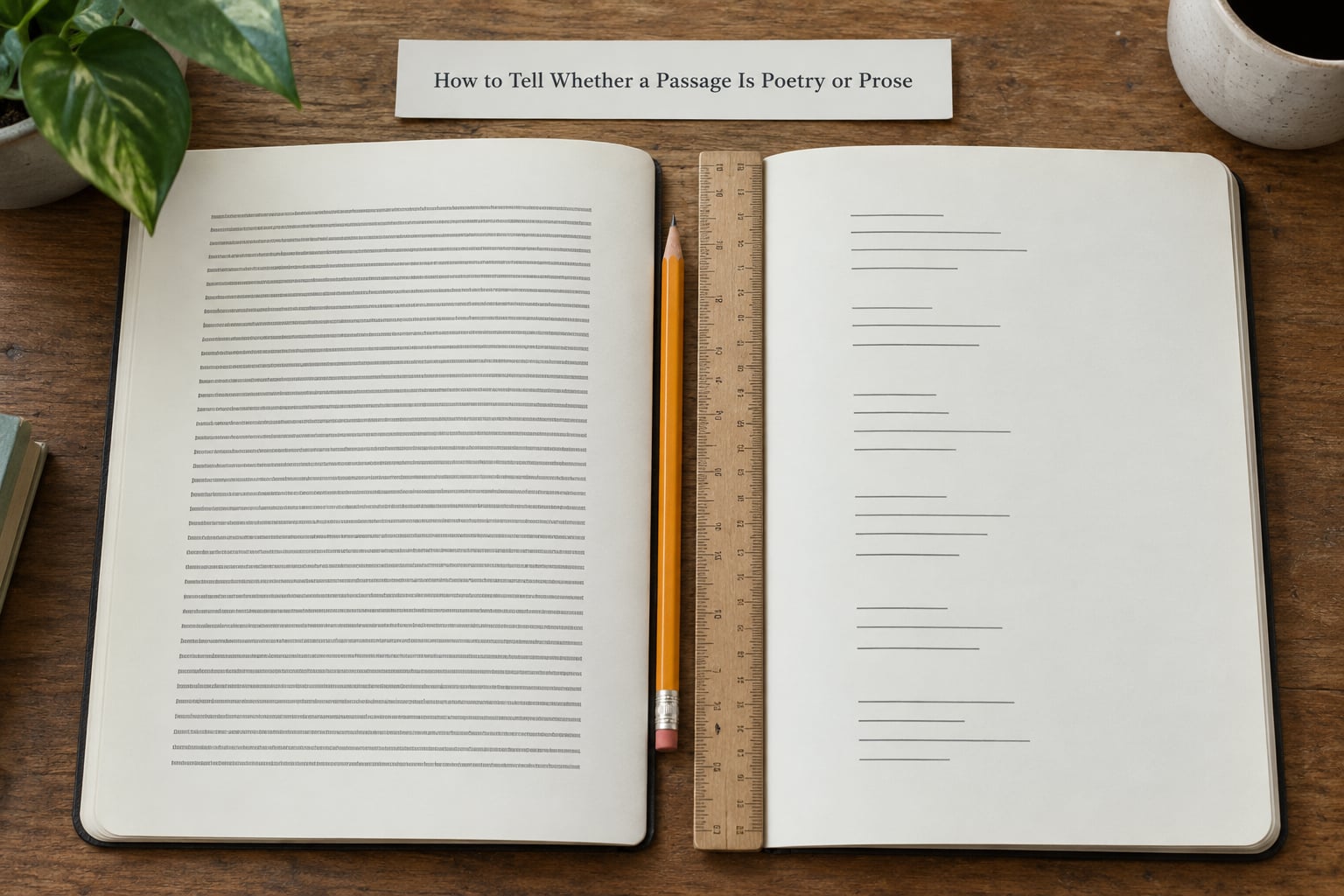
Most students are handed a four-bullet answer and told it is final. It fails on the first modern poem they meet. This three-step test holds up better.
- Look at the shape on the page. Lineated, set in stanzas, or flowing unbroken? Shape alone is a clue, not proof, because formatting choices get made for layout reasons as often as poetic ones.
- Listen for patterning. Read three lines aloud. Is there a pulse, a rhyme, a repeated sound, or deliberate end-stopping? Prose sentences have cadence too, but they run to the full stop their grammar demands.
- Test for compression. Is figurative language carrying the argument, or is it decorating it? If you can strip the images out and the paragraph still carries its information cleanly, you are looking at prose.
Three real cases that defeat the simple rules. Blank verse is unrhymed iambic pentameter, so it has a strong metre but no rhyme and often a plot: verse by the metre test, prose by the plot test. Song lyrics are printed as lines but behave as prose narrative with musical support. Scripture and legal texts are traditionally lineated for memory, not effect, which is a reminder that layout is sometimes inherited rather than chosen.
There is an accessibility angle here that classroom definitions leave out. Readers with dyslexia often report that verse is harder to track because the eye loses its place at every line break, while prose scans straight down a page in predictable blocks. That is not an argument against poetry. It is an argument for knowing your reader before you choose a form, and for teaching students that a poem read aloud usually solves the tracking problem.
Poetry and Prose Compared Through Examples
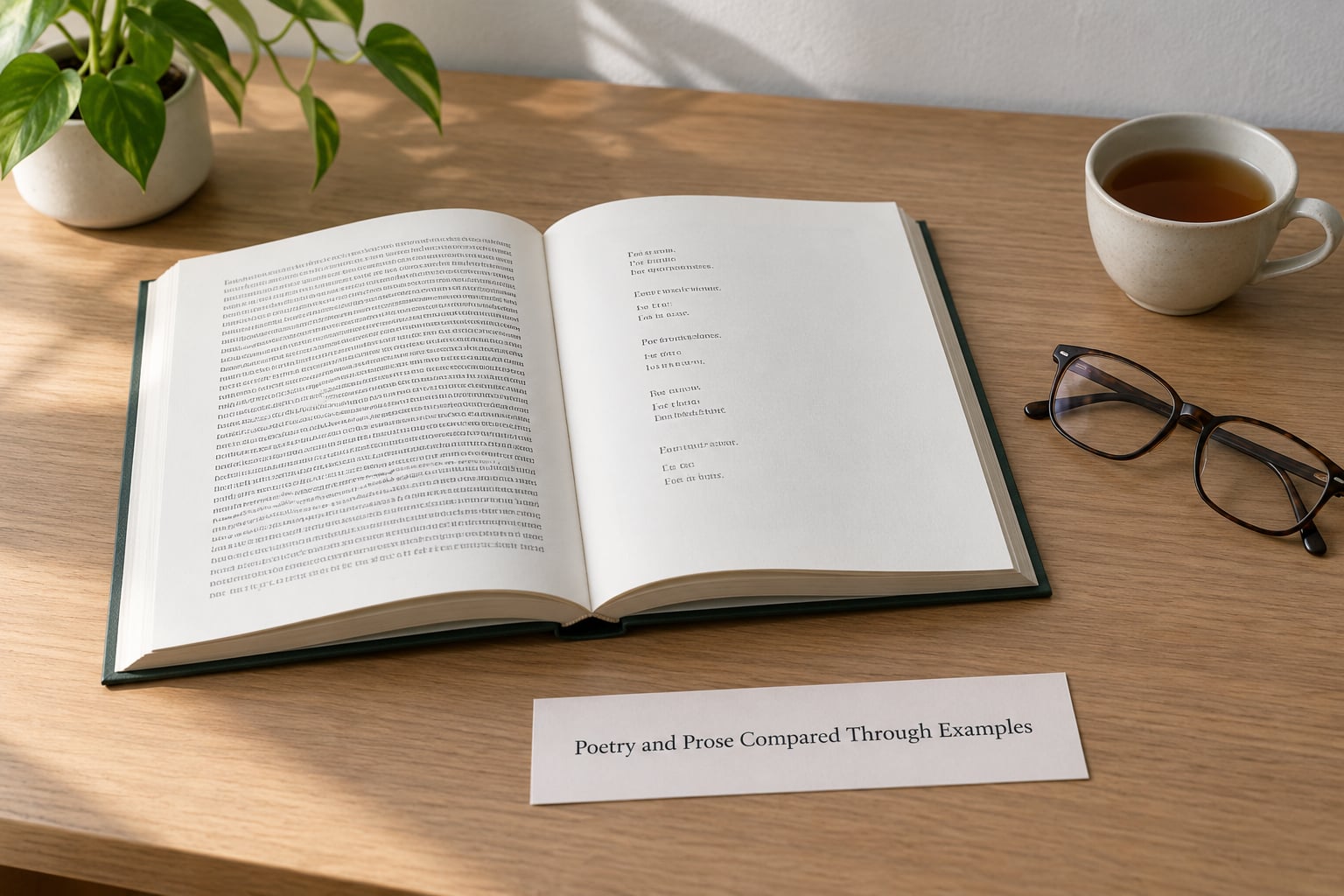
Both passages below are mine, written for this guide, and they carry the same information: a woman arriving home at half past six on a cold morning.
Prose version. She unlocked the side door at half past six, the way she had done every morning since the move, and set the kettle on the low ring. The house was colder than the forecast had promised. She wrote the date on the back of her hand instead of finding a calendar.
What makes it prose: three complete sentences with ordinary syntax, past tense carrying sequence, one metaphor, and information handed over without resistance. The reader gets a time, a habit, a temperature, a task and a small frustration. Nothing is hidden, because nothing needs to be.
Poetry version.
half past six, the side door again —
the kettle on its low ring,
the house colder than the promise.
She wrote the date on her own hand:
no calendar, no month, no year,
just the day, gone when the ink dried.
What makes it verse: the line break after again creates a pause where the prose version had none, and the second half expands what the prose version compressed into a single clause. The triple no slows the line down and makes absence felt. Just the day, gone when the ink dried turns a small practical act into something that will not last. Same facts, different effect.
Notice what did not happen. Nothing was added to the story. The change is entirely in arrangement, which is the difference between poetry and prose in one observation.
Five examples of prose
- A novel – Dickens, Great Expectations: narration built from sentences and chapters.
- An essay – an argument that develops over paragraphs, such as this one.
- A news article – inverted triangle structure, plain diction, full sentences.
- A speech – Lincoln’s Gettysburg Address, written to be heard but laid out as prose.
- A biography or report – sustained factual narration across thousands of words.
Five examples of poetry
- A sonnet – Shakespeare or Hopkins: fourteen lines, fixed metre, a rhyme scheme.
- A haiku – three lines of 5, 7 and 5 syllables.
- An epic – Homer’s Iliad in dactylic hexameter, a long narrative in verse.
- A lyric – Whitman’s Song of Myself, long lines with a repeated refrain.
- Free verse – no metre, no rhyme scheme, line breaks doing all the structural work.
Famous prose poems
Three to start with. Baudelaire’s Paris Spleen, published in 1855, is the collection that established the genre: short pieces of poetic writing set as continuous paragraphs. Rimbaud’s Illuminations, written in the 1870s, pushes the form towards disorientation and speed. Gertrude Stein’s Tender Buttons, from 1914, strips sentences down to repeated phrases so that sound and association carry the piece.
Can Something Be Both Poetry and Prose?
Yes, and the overlap is bigger than most textbooks admit. T. S. Eliot put it well: the distinction between verse and prose is clear, the distinction between poetry and prose is obscure. The line breaks are a fact you can see. The poetic effect is a judgment you have to make.
- Prose poem – poetic language set as paragraphs, with no line breaks and normal punctuation. It is poetry in prose form, not prose with prettier word choices.
- Free verse – verse without metre or rhyme scheme. The line break remains the structural signal, which is why it is still verse.
- Blank verse – unrhymed iambic pentameter. Verse with a fixed metre and no rhyme, and one of the most useful tests for students.
- Prosimetrum – the technical term for a work that mixes prose and verse, such as Coleridge’s The Rime of the Ancient Mariner, or any novel written in alternating chapters and poems.
- Verse paragraph – a single long line, common in Whitman, functioning as a paragraph of verse.
- Purple prose – prose overloaded with adjectives and rhythm until the clarity drops. It is a warning label, not a genre.
Not everyone accepts the distinction at all. In a widely shared thread on r/literature, novelist Tao Lin argued that asking for the difference between prose and poetry is like asking for the difference between two groups of people, because it invents a division that is really a convention. The top reply conceded the point about the labels while noting that academies, libraries and speech-and-debate competitions still need working categories.
Both halves of that argument are correct. The categories are constructed, and you still have to use them. What helps is knowing that the labels are tools rather than natural facts.
Which Should You Choose?
Choose by purpose and audience, not by which form feels more literary. Here is the mapping I give students.
| If your purpose is… | Use | Why |
|---|---|---|
| Explain, argue, report, instruct | Prose | Readers can follow a developed line of reasoning |
| Tell a story with characters and plot | Prose | Narrative needs room to develop |
| Hold one feeling, image or idea in focus | Poetry | Compression keeps attention on a single thing |
| Make the sound of the language part of the meaning | Poetry | Metre, rhyme and repetition do work words cannot |
| Sound out a poem to a class | Verse | Line breaks mark the pauses you want them to hear |
| Be read quietly by someone who finds verse hard to track | Prose | Continuous paragraphs reduce visual fragmentation |
For a beginner writer, start with the form that fixes fewer variables. Prose has one real problem, and writers on r/writing name it constantly: length. A short poem might be fourteen lines, while a comparable piece of prose runs to several thousand words. Poems are good practice for compression because you cannot hide. Prose is good practice for development because you have to finish the argument.
Whichever you pick, write one deliberately in the other form. A paragraph rewritten as a poem, or a poem expanded into a paragraph, teaches the difference faster than any definition.
Frequently Asked Questions
Is all poetry verse?
No. Verse is a form: language set in lines. Poetry is an effect: language arranged so that sound, compression and imagery carry part of the meaning. Plenty of verse is flat and unadorned, and plenty of poetry arrives as continuous prose with no line breaks at all, which is what a prose poem is. Verse is a reliable structural clue and an unreliable definition.
What is the main difference between poetry and prose?
Structure. Prose is organised into sentences and paragraphs and is built to be understood in sequence. Poetry is organised into lines and is built to be heard and understood at once, using metre, rhyme, line breaks and compressed figurative language. That is a tendency rather than a law, since prose can be lyrical and poetry can be flat.
Does prose poetry count as poetry?
In most catalogues and anthologies, yes. A prose poem is a short piece of poetic writing set as continuous paragraphs, using imagery, compression and repetition instead of line breaks and rhyme. Baudelaire’s Paris Spleen and Rimbaud’s Illuminations are the standard examples. What it is not is ordinary prose with fancier word choices, which is the distinction the term exists to protect.
What is the difference between verse and free verse?
Verse is the broader category: any writing set in deliberate lines. Free verse is a particular kind of verse that uses no regular metre and no rhyme scheme, letting the line breaks alone carry the structure. Rhymed or metered verse gives the reader a pattern to feel; free verse gives the reader only the pause where the writer placed it.
Why do poems use short lines?
Three reasons. A short line is easier to hold in memory and to read aloud with control. It creates a pause at the break, which lets the writer control pace and emphasis directly. And it concentrates the unit of thought, so each line tends to complete one small movement of the argument. Whitman’s long lines show that none of this is compulsory.
Conclusion: Choose the Form That Fits Your Purpose
Decide what you want the reader to do first. Understand something, follow a story, or feel something once and hold it. Then pick the form whose structure supports that aim, and check your own work against the three-step test before you hand it in.
If you want a practical way to see the difference working, read a short lyric next to a page of short story and notice how much longer the short story takes to say less. That gap is the whole subject of this guide in a single comparison.